Teaching Evolution and Moral Panic (SS#5)

In today’s episode of Science Sunday, I will be discussing a rather dated article from Sociological Viewpoints, Fall 2005, titled “The Quasi-Theory of Godlessness in America: Implications of Opposition to Evolution for Sociological Theory.” As a general rule for SS I shy away from articles over three years old, but I’m making an exception for the purpose of discussion.

In this article researchers ask the basic question, what is the source of opposition to teaching children evolution in schools? Their basic hypothesis is those who oppose evolution equate it with the threat of social deviance. They reveal a “quasi-theory” of godlessness in America that encourages people to act immorally. In their words, opponents of evolution conclude:

[T]he teaching of evolution encourages the spread of godless atheism whose consequences include all manner of immorality.

As a very important point of order, the researchers also remind us the weight of this kind of research:

No subfield of investigation is more closely identified with the discipline of sociology than that of deviance, and perhaps no school of sociological thought has produced a more interesting or controversial account of deviance than symbolic interactionism (Hewitt 2000).

What is this school of thought? It’s probably the most popular school of thought in the non-physical sciences, which spreads to all fields of social sciences: Social constructivism. If you’re not familiar with it, visit the Wiki page on the topic. Social constructivism theory states — in its simplest terms — that important, deeply held social ideas become social facts through a process of reinforcement. For example — and to use a contemporary phenomenon — LGBT rights were nonexistent and relatively unimportant five decades ago, but through social interaction and the spread of ideas about what rights mean, LGBT rights took on a meme-like quality until they became just as deeply ingrained in American youth society as Civil Rights became ingrained in the previous generation’s society.

This theory of social constructivism is, as the authors conclude, responsible for the social facts about what deviance means. Deviance, they argue, is the product of a “concerted social activity called moral enterprise.” The authors put it this way:

People learn to interpret actions performed by others (and themselves) as either good or bad by witnessing the way others respond to that action.

The researchers then take this theory of deviance through social construction and apply it to the “public opposition to the teaching of evolution in the public schools.” This is a stark contrast to the previously held positions of scientists, who viewed the opposition to evolution as simply “a case of public misunderstanding of science.” In other words, the researchers’ theory suggests the public may or may not understand the science behind evolution, but that is irrelevant to their beliefs about deviance. They oppose evolution simply because of the moral implications associated with it:

From a sociological point of view … we want to argue that the biology textbook controversies of the twentieth century are better understood as a case of fundamentalist Christian groups engaging in moral crusades to halt the advance of what they define to be deviant ideas.

BOOM. They conclude in a way that I think sums up their ideas succinctly. I’ll paraphrase.

Opponents of evolution have constructed a quasi-theory of godlessness in America as a product of deviance. One source of godless deviance in America is the teaching of evolution. And to finish the opponents’ horrible bastardization of a syllogism, opponents to evolution believe the teaching of evolution will result in the moral decay, which would have a severe impact on our security.

We might take some valuable insight from these findings, especially within the pro-science, secular community. If we conclude that opposition to the teaching of evolution is a response to the perception of the threat of deviance, then we might also conclude that simply teaching opponents what the scientific literature says about evolution is futile. Thankfully, social constructivism goes both ways. Anything that can be constructed can be deconstructed by constructing new social norms. The American civil religious opposition to the teaching of evolution can be countered by a gradual shift by young people towards secular sources of morality and ethics. As our society grows more secular and “godless” without becoming more violent or willing to express other immoral acts, opponents to evolution will lose the backbone of their argument.

I’ll finish with the obvious. The opponents’ arguments are strange and not based in reality in any discernible way. Never once has someone said, “I’m the product of billions of years of gradual change; therefore, I’m free to murder, rape, and pillage.” No. Laws, too, are socially constructed because we all agree not murdering, not raping, and not pillaging are important social norms.
Posted in Science Sundays | Tagged , , , , , , | Leave a comment

Taking on the Burden of Proof

I’m going to make this very short.

Today I had a conversation with a non-religious man who believed in some vague, nondescript god. At some point in the conversation, the issue of the burden of proof came up. I accepted the burden of proof. Here’s how the conversation went.

Me: “Your position is a god exists. My position is I don’t believe you. Can you demonstrate the validity of your position? Because I can certainly demonstrate the validity of mine.”

Man: …

The benefit of atheists taking on the burden of proof in this manner is it forces the believer to accept the real definition of atheism. The worst that can happen after that is cognitive dissonance makes a fool of the other person.

Posted in Atheism | Tagged , , , | 6 Comments

The Islamic State through Three Waltzian Lenses: An Analysis in IR Theory

In 1959 heavy-hitting, contemporary political scientist Kenneth Waltz published Man, the State, and War, a required reading for both undergraduate and graduate students in international politics. It’s often the fist book students of politics read because it gives them an accurate overview of the different levels of analysis, called “images,” we use when explaining major global and interstate events. In his book, an adaptation of his doctoral thesis, Waltz identifies three schools of thought in the study of international relations (from here on out, referred to as “IR theory”).

This rather long post examines the Islamic State (IS) situation in the Middle East, Northern Africa, and, some fear, its spread to Europe, using Waltzian IR theory to best explain the situation and make predictions. Please note this is merely a blog post. Therefore, this is not to be taken as gospel, but simply to begin a dialog. Still, this would be a very fun and interesting research topic, and some day one of you might write your own dissertation about the Islamic State using this kind of analysis (if so, feel free to mention me in the acknowledgements section).

The three images

First Image: Human Nature

This level of analysis looks at individuals in international politics. Proponents of this level might make the assertion — when discussing war — that conflict is deeply imbedded in human nature. That is, we are a violent species. Some might not wish to generalize all humans and would therefore assert that some humans are violent by nature. They might cite examples of Hitler and Napoleon, while contrasting them with Icelandic or Danish state leaders (who generally don’t fight wars).

Takeaway: Individuals matter in IR theory.

Second Image: State Behavior

This is a state level of analysis. That is, it disregards individual people but still focuses on individual states. This level analyzes to what extent states are self-regarding. Some might assert that war is caused by states’ needs to expand, grow economically, or prevent external conflict spillover or mitigate internal conflict.

Takeaway: Individuals are less important in IR theory. States behave according to their own needs.

Third Image: The Anarchical System

This is Waltz’s major contribution to IR theory, which he would develop by 1978 as his own theory called neorealism. This level of analysis asserts that war is systemic because states exist in a world without a global authority to reward good states and punish bad states. There is no sovereign global government to oversee international relations. In other words, if state A wrongs state B, who is state B going to call to arrest state A? The answer is ultimately no one. They have to handle the situation themselves, and that leaves them with limited options; one of those options being war. You might argue they could go the the UN or ask allies to help them force state A to make up for its wrongdoing, but the UN could refuse to hear the case, and allies could decline to get involved. We call this a self-help system. In a self-help world, states’ issues at the highest tier of importance offer the easiest and most likely path to war.

Takeaway: State behavior is systemic.

The Islamic State through three lenses

First Lens: Human Nature

We might say the Islamic State’s aggressive behavior towards non-Sunni Muslims and governments is a natural product of human nature. This level of analysis leaves room for (in my opinion) bad ideas about how to handle IS. Some proponents of the first image might argue that, while some humans are inherently evil, they have the potential to become good. This means that IS members can be socialized and educated enough to mitigate their own violent tendencies. Proponents might argue that in a perfect world, we can potentially live peacefully with the group.

I’m not saying they can’t be socialized and educated enough to mitigate their own violence; rather, I feel the methods we would use to get to that point are based on long-term commitments of appeasement and coexistence with people willing to murder innocent civilians and sell their organs on the black market. I’m not sure the families of future victims will appreciate a strategy in terms of years.

My problem, however, is that this level of analysis is the only level of analysis that even leaves room for non-state actors. IS is not an actual state. It is a non-state actor acting across international lines. For the sake of my argument, however, let’s pretend IS is a sovereign state, which allows us to examine it from the…

Second Lens: State Behavior

If, for the sake of argument, we assume IS is a sovereign state, then we can examine it based on its needs. Well, what are they?  IS needs territory, resources, and a people to govern. At this level, analysis and predictions begin to look moderately better. For example, proponents of the second level might propose that international law, social norms, and institutional liberal economies might mitigate IS violence. IS, as a sovereign state, can enjoy friendships with neighbors, trade in goods and wares, and identity as a contributing member of the international community. Furthermore, if it needs territory, resources, and a population, then it can achieve all of these things by playing nice (and not attacking innocent neighbors or murdering its own people).

While there is a bright side to this approach, the State Behavior level does not necessitate that states will play nice. Indeed, if a state needs resources badly enough, it might take them by force. And as far as I can tell, IS is not the kind of state that would play nice.

Bad behavior on IS’s part might be a compelling reason to go to war with it, which brings us to the…

Third Lens: The Anarchical System

Still assuming that IS enjoys state sovereignty (for the sake of argument), through this lens we can easily explain IS’s behavior. In this self-help world, IS has no one to go to to express its grievances with other states (or people). Therefore, it can only count on itself. And while neighbors enjoy the excess of military resources (especially Naval forces and Air forces) [note: this is bringing me closer to neorealism than Waltz planned in 1959] IS has no choice but to balance against its neighbors in order to protect itself. IS will seek to balance the distribution of power and share of resources. One way to do that is by force.

Thankfully IS is not a state. We can stop assuming it is. That part of the argument is complete. And because IS is not a state, IS is completely irrelevant in international politics! We have no expectation that IS will grow sufficiently enough that it poses a threat to the survival of neighboring states. While IS might be knocking at Turkey’s door, they would be rather irrational and stupid to attempt to overthrow the Turkish government and assume authority over Turkish lands. Indeed, IS is so insignificant that — even if it could collapse the Turkish state — it would be spread so thinly across the Levant and into Europe that it would collapse under its own weight (or at least, that’s my hypothesis).

In other words, if we view IS through this lens then IS becomes merely an incredibly annoying group of thugs and criminals who are completely incapable of changing the world in any meaningful way. Indeed, people who adopt the anarchic view of IR theory would say (as horrible as this sounds) 9/11 was irrelevant in regards to the state of the international system. To use a milder example, they would say the collapse of the Soviet Union was equally as inconsequential. We have no reason to expect a group of terrorists can have more impact than the end of the Cold War.

So which lens is correct?

I would say that’s up for you to decide. In my view, however, the evidence tends to suggest that an evolutionary theory based on an anarchical global reality is probably the correct one. I also think it gives us the best possible prediction: IS is irrelevant and will continue to expand its irrelevance. This is not to say it doesn’t matter that they’re killing innocent people; that’s a very relevant situation. But bad ideas are bad ideas. But a worse idea is when IS tries to play state in an anarchical world filled with heavily-armed states willing to fight back.

Posted in Political Science | Tagged , , , , , | Leave a comment

ISIS Shows Christians What True Persecution Is

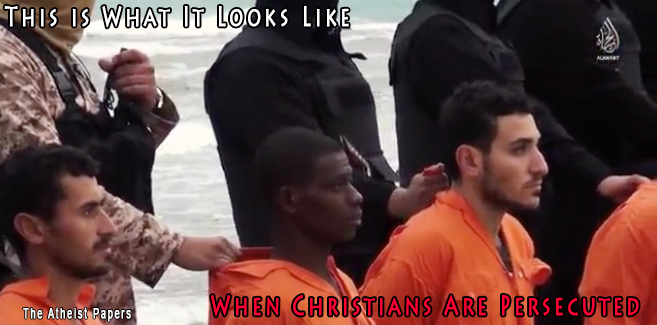
ISIS is great at making terrible and extremely graphic and overproduced propaganda films. In the latest piece to cross my desk, an ISIS branch in Libya parades 21 Egyptian Coptic Christian men onto a beach in Northern Libya. The orange jumpsuit-clad Christians are lined up, each with their executioner behind them, while a presumably American member of the terror group explicitly calls this act an attack against Christians in an ongoing war between the Christian West and the Muslim World. This video (extremely graphic!! Do not watch unless you welcome nightmares!!) underscores a reality that many Christians have been claiming for the last decade plus; Christian persecution is a real thing!!!

ISIS and Christian Persecution

The problem is this isn’t exactly what American Christians had in mind when they go on Fox News and claim they’re being persecuted. Let’s discuss and keep score.

On the one hand we have American Christians being forced to live side-by-side with married gay and lesbian couples. On the other hand we have Egyptian Christians headless and rotting on a Libyan beach. One of these two groups of Christians suffered more than the other. One of these groups was specifically persecuted for being Christian, while the other merely has to live while people do things they don’t like.

On the one hand we have American Christians losing their jobs or businesses for refusing to serve gay and lesbian people. On the other hand we have Egyptian Christians losing their heads for refusing to accept Muhammad as the prophet. One of these two groups’ families suffered more. One watched their parents struggle to find a new job. The other struggled to comprehend the immensity of a parent’s, sibling’s, child’s or other loved one’s death.

On the one hand we have the perceived but nonexistent atheist-led annual War on Christmas, where Christians have to live with seeing beer can Festivus poles next to Baby Gee. On the other hand we have the ongoing Islamic-led “War against the Cross” in the Muslim World, where Christians are being slaughtered day and night. One of these groups of Christians suffers actual casualties of war, while the other has to look at non-Christmasy stuff on Christmas.

On the one hand we have skeptics and atheists asking American Christians to demonstrably support their religious claims with evidence. On the other hand we have a terror organization demonstrating their willingness to murder Christians for not believing Islamic claims. One of these two groups has a real enemy. The other has a partner in discussion.

Finally, on the one hand we have secular laws in the US preventing American Christians from monopolizing social standards of decency. On the other hand we have Sharia law in the proposed Islamic State that will literally monopolize social standards of decency and will make it legal to murder Christians for not following the tenets of Islam. One of these two systems of law undermines peace, freedom, and equality at every turn. The other system of law promotes peace, freedom, and equality, even if it annoys some Christians who want more authority.

Dear American Christians

Shut the fuck up about your persecution complex. Until the US starts rounding you up, marching you out on the shores of the Atlantic and starts chopping your heads off, you have nothing to complain about. I hope this latest example of actual Christian persecution is sufficient enough to make you realize that you’re not being persecuted in the slightest.

This also serves as a stark reminder that the Clash of Civilizations is not just a witty catchphrase made up by a dead political scientist; it was his prediction formulated after years of research into the post Cold War era. And if the Clash is upon us, just remember, ISIS started the war, not you. If you’re going to complain about persecution, make sure it’s actual persecution. Just off the top of my head I can think of at least one very real example.

Posted in Atheism | Tagged , , , , , , , , | 5 Comments

Trusting Atheists: Remember Kids, the Police Exist (SS#4)

There’s a general consensus that atheists are to be distrusted. Without belief of an all powerful being who ultimately serves as a judge, jury, and executioner for all of our earthly transgressions, who’s to say atheists aren’t breaking any and every legal and moral law? Indeed, a lot of research has gone on to discover the extent to which atheists are distrusted, and the findings tend to suggest there is no limit. Non-believers are simply incapable of earning trust. But that’s not necessarily true.

In this episode of Science Sunday I examine a study published in Psychological Science [23(5) 483–491, 2012] titled “Reminders of Secular Authority Reduce Believers’ Distrust of Atheists.”

The researchers conducted a series of experiments on groups of non-atheist undergraduate students who watched videos that primed them for responses (Experiment 1, Police Effectiveness). For example, in one video for the secular authority test, a police chief discussed his department’s effectiveness at preventing crime. The control group either watched a video of a tourist discussing his first impressions of a city or were not primed at all. The researchers then had the subjects complete a task that revealed their distrust of atheists or prejudices generally. It should be noted here the researches tell us “In a subsequent funnel-debriefing interview, no participants indicated suspicion regarding the connection between the two tasks,” meaning it’s unlikely the participants biased the results.

Experiment 2 (Distrust of Atheists Versus Disgust Toward Gays) was rather similar, but instead of watching a priming video, participants were asked to make sentences out of jumbles of words, which may or may not have contained secular authority words, such as “jury” or “court” etc.

Experiment 3 (Distrust of Atheists and Gays Among American Adults) was very similar to Experiment 1 and 2, but participants came from a wider population to include non-atheist, American adults, which greatly increased the role Christianity plays in the results.

The results

I’ll let the researchers sum it up. In the first paragraph of their overall discussion, they say it very well:

Our three experiments demonstrated that subtle reminders of effective secular authority—secular institutions that help secure cooperation among individuals—reduce religious believers’ distrust of atheists. In addition, we tested and found no support for three theoretically plausible alternative explanations for these findings.

The results are quite long and very detailed. I won’t bore you with them, but they all point to the same conclusion. As secular authority increases, distrust of atheists decreases.

Discussion

I find it rather amusing that some religious people need to be reminded that police exist when talking about to what extent they can trust atheists. To me it seems that if a police officer, public prosecutor, judge, and a jailer can do all the things god promises to do, there is absolutely zero reason to suspect atheists are more likely to behave criminally or immorally. The police exist for a reason — not just to keep atheists well behaved — but to enforce the laws on the populations generally. But still, if the police department’s presence helps religious people overcome their stereotypes of and prejudices towards non-religious people, then I can’t complain too much.

Secular authorities exist and are more than willing to publicly mete out justice. I can’t say the same about any god.

Posted in Science Sundays | Tagged , , , , , | 2 Comments

When I win, Everyone Wins: Burning Flags Does Not a Failure Make

A few months back my criticism of the Islamic State reached a point many felt had obviously crossed a line. In response to a movement my friends began in Beirut, Lebanon, I made two videos (Part 1 and Part 2) where I burned the ISIS flag. My videos and the videos my friends made were quickly picked up by major media outlets, where I was quoted in the New York Post:

“I call on everyone to show their contempt for ISIS,” self-avowed atheist Rayan Zehn of Norfolk, Virginia, said in his own video, in which he burned a printout of the flag. “Go ahead,” he added. “Burn the f–k out of a symbol of both ISIS and Islam.”

(Censorship of the word “fuck” theirs, not mine).

At the end of the first video I also added, “Fuck Islam.” Surprisingly, I only faced a major backlash for this statement in the comments section on the Youtube video. The real backlash occurred simply because I burned the ISIS flag. I can say anything I want about Islam, and I’ll only be yelled at and maybe receive a death threat or two. But if I dare to burn the ISIS flag, which contains the most sacred saying in Islam — the Shahada — then I’ve stepped way over the line and even Western Muslims begin a campaign to censure me.

I’ve kept this under wraps because I didn’t want to say anything that might undermine my efforts to protect free speech at my university. But the dust settled long ago, and I’ve come out not only as the victor but also with newly recognized respect from the university itself, which recognizes the intrinsic value of free speech.

The problems began when a Muslim student and personal friend of mine (perhaps paradoxically, we’re still friends; friendship has nothing to do with personal opinions, as long as we respect each other as people) saw the videos and confronted me. He brought a local Imam to meet with me and urge me to remove the videos. I told them I was expressing an idea and that they could both freely and legally express an opposing idea that condemns my idea.

So they did… well, kind of.

A group of Muslims at the university attempted to bring me up on disciplinary charges for 1) violating their freedom of religion and 2) fostering a hostile environment for Muslim students. Of course, this is not what I had in mind when I told them to publicly criticize me. And I was quickly surprised to see a small group of non-Muslim students taking their sides (these are students who changed their minds after the Charlie Hebdo attacks). This is what happens when you have an organization made up of students who still believe they can make a positive impact on this world and that respecting people’s religious ideas is necessary.

Thankfully, the university practically completely ignored these students. I faced no charges. I faced no disciplinary hearings. No one even came to me and asked me to tone my actions down. The university’s position was clear; the freedom to criticize ideas — even deeply held religious ideas — was a necessary component in a properly functioning higher universal education. To censure or punish me simply because someone doesn’t like something I said or did is to undermine the university experience. But still, I feared the situation might make it more difficult to further my career.

A month prior to making the videos, I applied for acceptance into a very difficult modeling and simulation program funded by the US military and NATO in the most advanced political science M&S research center in the world, which happened to be built on my university’s campus. Certainly the videos and the publicity around them, particularly amongst our own students, would be a difficult hurdle to overcome when choosing who to accept into this program.

I had my heart set on it. I’ve been active in qualitative research analysis for years, and I was excited that a program would open up locally that would allow me to expand my analysis skill set into cutting edge M&S and quantitative research. I spent many nights wondering if I’d made a huge mistake by posting those videos.

In the end, however, the public backlash against my videos was completely irrelevant. Not only did the school refuse to even shake their finger at me for burning the Shahada, they still felt that my works were compelling enough to grant me entrance into the metaphorical (and perhaps literal) future of political science.

Now granted, if I worked for a private firm, my free speech would be less important. I don’t necessarily think all my readers should feel they can say whatever they want and get away with it. Free speech is only protected by the state. Your job is free to fire you if you say something that brings discredit upon the company’s image. But still, this experience can be chalked up as a victory for free speech and a loss for those who attempt to dismantle it.

Posted in Uncategorized | 1 Comment

Why Objective Morality Can Be Bad

Previously I’ve tackled the objective morality question, arguing, in part, that we can all agree that certain acts are immoral. These include things like murder, rape, and torture. If we all agree these things are wrong, then we have a moral foundation that is objectively true. But commonly I see the challenge arise from people who ground their morals in religious texts: “How do you know murder is immoral?” True, not all of us share the same black and white, here-it-is rulebook, and we acknowledge the difficulties in constructing objective morality in the social context. But we all — no matter where we live — do share similar black and white, here-it-is rulebooks that are as objective as we’re going to get. And I’m here to argue why that can be a bad thing.

I’m talking about penal code. Let’s take perjury for example. I’ll use California to illustrate this point. California’s criminal code for perjury is certainly black and white.

It’s a rather long code, most of it dealing with the prosecution for perjury. The meat of the law is in the beginning. In California perjury is when a person, “willfully and contrary to the oath, states as true any material matter which he or she knows to be false.” That’s it. That’s perjury. We’re talking about lying. The code then expands on the definition, equating educated guesses by lay people as perjury as well:

An unqualified statement of that which one does not know to be true is equivalent to a statement of that which one knows to be false.

In other words, in California we can be convicted of perjury if we make a false statement under oath even if we just believe it to be true. For example, pretend you are subpoenaed to testify in a child custody case about domestic abuse, and you testify that the husband regularly beat his ex-wife, but you’ve never seen the abuse; you’ve just taken the wife’s word for it. We later discover no abuse occurred. Without adding the caveat “she told me he beat her,” you’ve just committed perjury. And guess what! In California perjury is punishable by two to four years in prison.

The thing is that, despite this black and white law, no judge will convict you of perjury because doing so violates the spirit of the law (the subjective reasoning for establishing the law). Furthermore, doing so could cause eyewitnesses to be reluctant to come forward, but that’s beside the point.

Here we have an objective moral law about lying that equates guessing with maliciously making a false statement. But because we understand there is a difference between the two, the law is trumped by common sense. We acknowledge the objective nature of this law is wrong. Let’s look at another black and white law in Virginia.

There’s a Virginia code that makes wearing masks in public a felony. The code carves out some exceptions, but absent from this list is “during cold weather.” This means when a motorcyclist wears a face mask to protect him- or herself from sub-zero temperatures at 60 miles per hour, he or she has just committed a felony. There have been several attempts to change this statute; however, they have all failed. The language has not been amended.

When a police officer in Virginia stops a motorcyclist for wearing a mask in public, he or she often politely informs the cyclist that wearing a mask in public is a felony without making an arrest. This, despite the fact that police are compelled to make an arrest if they see someone commit a felony. In other words, the police are technically breaking the law by not arresting the motorcyclist. But the police understand that the language of the law is too strict, and it makes criminals out of thousands of innocent bikers.

Here we have two black and white laws with an objective reference point: state penal code. If I try to argue it’s immoral to wear a mask while riding a motorcycle because a book says so, then I’ve suddenly made life much more difficult for a lot of people, including police officers, who feel there’s nothing wrong with wearing a mask to protect your face from cold weather. If I say it’s immoral to guess under oath because a book says so, then I’m arguing that practically everyone who’s ever taken the stand during a court hearing needs to be imprisoned. Even judges disagree with this law.

If we base our morals on black and white texts, then we leave no room for the fluid movement of social behavior. In this case objective morality is an immoral constraint.

Finally, for anyone asking where we get our morals from if not from a god, I’ll draw your attention to one of thousands of academic journal articles that tackles this question. At this point we’re fairly certain we understand how morality came about.

Posted in Atheism | Tagged , , , , | Leave a comment

“Divine Wind”: New research supports 13th century “Kamikaze” typhoon legends

In this episode of Science Sunday, I’m leaving behind religious discussions and opening up Geology, January 2015; v. 43; no. 1; p. 91–94 to a rather interesting article titled, “Depositional evidence for the Kamikaze typhoons and links to changes in typhoon climatology.” I’ll begin with a little background.

In the 13th century Kublai Khan twice tried to invade and ultimately conquer the Japanese islands. Both campaigns were failures. Legend has it Khan was defeated both times — not by the Japanese army, which was vastly outnumbered and ill-equipped to protect themselves — but by massive typhoons that utterly destroyed Khan’s fleets, which, without evidence, is extremely unlikely because typhoons are extraordinarily rare in that region. Legend also has it the Japanese called these super storms “kamikaze,” or divine wind, suggesting, perhaps, that the Japanese thought there was a supernatural explanation for the storms, and that they believed a divine being was protecting them from Khan’s fleets. There is no question of whether or not Khan was defeated; remains of his fleets have been discovered in recent centuries. The question is whether or not typhoons were to blame for his defeat, or to what extent they were to blame. Now four researchers from the University of Massachusetts and Worcester State University suggest there might be some merit to the “kamikaze” legend.

These researchers were investigating extreme coastal flooding event deposits in the coastal lakes where Khan’s fleet was destroyed. In their analysis of these deposits, the sediments suggest typhoon activity in that region was “greater during the time of the invasions.” Moreover, a deeper analysis suggested “that it is highly probable that two intense overwash events occurred in the region during the late 13th century,” meaning during the time of Khan’s invasions, two major climate events took place. The authors are very honest about their limitations and do not claim to know this for a fact, but they have confidence in their results.

Despite these very interesting results, the authors brush it off in the discussion chapter, focusing instead on how this evidence actually supports a different established climatological theory. Suggesting a subsequent (and necessary if their results are correct) decrease in typhoon activity, they close with:

The decrease in typhoon frequency at Lake Daija and Kamiko-shiki at 1600 CE also occurs during a transition to more documented typhoon strikes in the Guangdong Providence of southern China (Fig. 4C; Liu et al., 2001); this is consistent with a southern shift in preferred typhoon tracks away from Japan and toward southern China following a transition toward more La Niña–like conditions, with fewer El Niño occurrences. It is all but certain that a majority of the rise in typhoon counts in the Guangdong record is artificial, due to an increase in the number of reliable storm accounts. However, the pattern toward better typhoon documentation may in part be due to heightened interest resulting from increased typhoon impacts in the region.

Discussion

I chose to focus on an area outside of my field of knowledge, experience, or expertise because I wanted to give my readers access to a wider range of research. Personally, outside of undergraduate classes on geography and climate, this is the first time I’ve branched out into climatology. What is most interesting to me is these findings help my field — international political science — build upon or strengthen its theories or to build new theories. The fact that weather can possibly play such a major role in the outcome of two wars — especially when the victor was at such an extreme disadvantage — could help explain martial failures by US forces. I mean, this seems rather obvious at first glance, but you’d be surprised how little the weather is mentioned in political science, outside of environmental politics.

In other words, it’s my hope that your quest for knowledge is never limited to the field in which you get your degree or work. Even if you don’t have or never get a degree, being widely read is important because these fields are all connected, each one borrowing from the next. Political science borrows from math, engineering, and biology. Economics borrows from physics and political science. Understanding that will help you build stronger theories and analytical frameworks. Sometimes finding evidence of an 800 year-old storm is not just historical evidence; sometimes it’s evidence supporting a wide range of theories.

Posted in Science | Tagged , , , | Leave a comment

A Brief Analysis of the ISIS Problem Post-Burning Video

“ISIS Burns Jordanian Pilot Alive” has been a major headline in the news during the last two days. It’s such a major story that the news articles of the Jordanian executions of Sajida al-Rishawi and Ziad al-Karbouli have been swallowed by the ISIS burning. For example, we have this Fox News article about the Jordan executions, but about 75% of the article is about the fiery death of Muath al-Kaseasbeh. This phenomenon also occurs in the Washington Times, NPR, and the Huffington Post. Sajida al-Rishawi and Ziad al-Karbouli are merely footnotes beneath the graphic images of Muath al-Kaseasbeh being burned alive. And as much as I hate to say this (because people are dying), rightfully so.

Let me sum up exactly what’s going on here: ISIS is a non-state group committing atrocities and terror attacks. They attack both civilians and government forces. Because they are not a legitimate state — they do not hold a monopoly of violence over a specific group of people — they are accurately classified as criminals, which (theoretically) leaves them bereft of any protections afforded to soldiers offered by the Geneva Convention, should they be captured or otherwise.

This also means it’s ultimately up to Iraq and Syria’s domestic police forces to deal with ISIS. But because they are seemingly and understandably incapable of arresting ISIS members and quelling the group, the issue stands before the international community. Perhaps controversially, terrorism as a crime has in recent years been brought into the purview of universal jurisdiction, meaning every member state of the United Nations has a duty to stop terrorism anywhere it occurs. Like I said, this is controversial — at least in the US — because this duty interferes with Congress’ ability to decide where we send our troops. But globally, universal jurisdiction gives everyone the right to violate a state’s sovereignty in order to stop terrorism.

This is the same justification Israel uses when it violates another state’s sovereignty to arrest Nazi war criminals. Genocide is a crime with universal jurisdiction.

My argument is because universal jurisdiction exists and covers terrorism, and because Syria and Iraq are not equipped to stop ISIS, it’s everyone’s duty to use force to stop them. I’m very liberal, and I’m against state-on-state war because of the risk of civilian casualties and structural violence, but these are vicious yet common thugs who believe they’re unstoppable. And they’re the ones killing civilians and destroying lives through violence and structural violence. If liberalism means protecting the innocent at all costs, then destroying ISIS to protect the innocent is worth the risk to our armed forces members.

Thankfully, it appears the entire world (except the UAE, which cowered in fear after ISIS burned the Jordanian pilot alive. Shame on the UAE) is using every legal weapon in its arsenal, real and metaphorical, to condemn ISIS. Thankfully, my argument is not needed as much as I make it out to be. For example, even in the US, both the Republican and Democratic sides are slowly coming together to support using force against ISIS.

This might be an emotional response

I have to admit that I’m extremely frustrated with the terror organization wreaking havoc in my former backyard. Indeed, watching the video of ISIS burning the pilot really got to me, even though it shouldn’t have.

A major focus of my research has been on self-immolation (people who willingly set themselves on fire to compel a society or government to take action against an injustice). A part of this research includes sifting through suicide letters and watching videos of people self-immolating. Naturally, because I’ve grown numb to the images of self-immolations, I thought I had the emotional strength to get through the ISIS video. I’ve seen this kind of shit 488 times now. So what’s the difference here?

There’s a lot of difference.

If you wish to watch it yourself, LeakSource is one place that has it posted. But it’s not an easy video.

I’m used to seeing people willingly set themselves on fire. In this case, on the other hand, he was essentially burned at the stake, unable to flee from the flames. Even if he could have run away, his clothes were soaked in petrol. There’s no escaping that kind of inferno.

What’s next?

I’d imagine in 10 years we’ll be holding tribunes for ex-ISIS members captured hiding in Malaysia. In analyzing the trials, the media will draw comparisons to the Rwandan Genocide. While ISIS isn’t killing one ethnic group indiscriminately, I think the comparisons will be made to the rapid acceleration of barbarity. In other words, ISIS is doomed to destruction. The only question is whether or not the US will help guide that destruction, or if we’ll stand idly by, a la Bill Clinton 1994.

Posted in Politics | Tagged , , , , , , , | Leave a comment

Science Sunday #2: Atheism and Anger

In the upcoming May 2015 issue of The Journal of Psychology: Interdisciplinary and Applied (Vol. 149 Issue 3, p219) researchers from Gettysburg College, North Dakota State University, and Lebanon Valley College ask whether or not people view atheists as angry individuals and whether or not atheists are indeed angry individuals. The results of their study are not surprising to me but, based on the findings, they might be pretty surprising to most people.

First, the researchers acknowledge that the angry atheist trope is popular in pop culture and the media. It’s so prevalent that it appears to be a fact rather than a question. They identify several examples of the angry atheist trope and suggest:

A general theme in these anecdotal examples is that atheists are particularly angry people and that they challenge religion and believers in an angry and confrontational manner.

And with the “New Atheist” movement, these challenges and confrontations against religion are within the public sphere, whereas long ago they were more underground. The fact that atheists are more willing to publicly express their dissatisfaction with religion suggests (to some people) that atheists’ anger has boiled over. Because of this the researchers hypothesize that atheists will be viewed as angrier than non-atheists.

But the researchers point out that the angry atheist stereotype is unfairly mischaracterized in the media, which focuses on examples that confirm the stereotype while ignoring examples that disconfirm the stereotype. Therefore, they hypothesize that atheists are not angrier than non-atheists.

The Studies

The research is broken down into two parts, consisting of seven studies. Studies 1-3 asks whether or not people perceive atheists as angrier than theists. Studies 4-7 asks whether or not atheists are indeed angrier than theists. The methods of the studies are rather robust for a short post, so I’ll sum it up as (from the abstract), a study of “1,677 participants from multiple institutions and locations in the United States.” I’ll add that this is more than sufficient. (Note that the authors discuss some statistical limitations towards the end, but from where I’m sitting, they are only minor limitations).

The researchers find that:

Our studies revealed that people believe that atheists are angrier than believers [and] people in general … Yet, we did not find any evidence to suggest that atheists—or those people believing in God to a lesser extent—are particularly angry individuals.

They call the angry atheist a “myth” and add:

Although people espouse the view that atheists are angry, and although such associations are embedded at an implicit level of cognition, the idea simply does not appear to be true.

So why does it appear to be true?

They suggest when an atheist makes a statement that counters deeply held beliefs, it’s natural to assume one must be angry to make such a statement. Angry at god, perhaps? Furthermore, and perhaps associated with this, the researchers suggest the reason might be that religious people are

projecting their own anger onto atheists. Religion is a major source of meaning and comfort to a large number of Americans (Pew Research Center, 2008). Atheists may be perceived to threaten this source of meaning, thereby triggering anger and the defensive sorts of processes identified by existential psychologists (e.g., Solomon, Greenberg, & Pyszczynski, 2000).

The researchers also discuss the implications of such findings, suggesting that the mischaracterization of atheists as angry justifies discriminatory practices against atheists. But because this suggestion is outside the scope of this research, they propose more research:

Future research should focus on whether the angry-atheist stereotype actually drives discriminatory behavior. For example, does an angry-atheist perception correlate with a tendency to withhold rights from atheists? Or, perhaps, does an angry-atheist perception lead others to start arguments with atheists leading to an induced confirmation of the stereotype? In sum, the angry-atheist perception might partially drive discriminatory behavior against atheists. Studies that assess both variables will be useful in examining this idea.

Discussion

This is something we’ve all experienced as atheists. If I say a certain religious belief is absurd, I’ll often be asked why the belief makes me so angry. It’s nothing new, but it’s always frustrating. And it undermines our ability to further the discourse of the roles religion plays in our societies. Even if we were angry, our anger would say absolutely nothing about the strengths of our arguments, but the word “angry” often stops the conversation, putting atheists on the defensive.

The angry atheist stereotype is nothing more than a rather effective way to stifle dissent, particularly when espoused by media members, such as Bill O’Reilly. But rather than trying to stifle dissent, dissent should be questioned so it can be understood. And it’s rather difficult to understand something if one has a presumptive misconception that it’s based on anger.

Being aware of this research is a great first step. Thankfully, and somewhat surprisingly, it appears The Journal of Psychology has made this article freely accessible, meaning it’s not behind an expensive paywall. I hope everyone will refer to the link in the first paragraph of this post, download the article, and read it for yourself. And the next time someone makes the erroneous claim that atheists are angry people, refer them to this article and say, “That’s not what the research suggests. Here’s a peer-reviewed scholarly article that suggests you’re wrong.” That should be sufficient to keep the discourse going without putting the atheist on the defensive. (If for some reason the article is not available, feel free to contact me).

Posted in Psychology | Tagged , , , , , , | 9 Comments