Why Secularism Is Important (a video on international politics)

It’s been a while since I’ve made a video. It might be dry for some, but isn’t politics always dry? In this video I make an academic argument, with illustrations, why secularism is important. The examples I use come from my field, international security studies.

Posted in Political Science | Tagged , , , , | Leave a comment

In preparation for upcoming post: Atheists and Anger

One of the things I like most about academia is my ability to get ahold of soon-to-be-published research articles prior to their publication date.* When I come across these articles I’m given a chance to read it at my leisure, without my understanding of it being biased by other readers. Then, once I’m certain others have read the article, we’ll discuss its strengths, weaknesses, and impact on the gaps in our knowledge. One of these articles came out recently, and I wanted to take the general idea to the Internet before I write my critique. Let’s hear from you.

I’ll publish my critique as part of my new Science Sunday series.

The basic questions the researchers ask are: 1) Are atheists viewed by theists and the general public as angry? And 2) are atheists more likely to be angry?

Without getting into the findings of the research yet, I want to know your takes on these questions. And I hope you’ll elaborate. For example, if you think atheists are angry people, why?

If you have a lot of ideas about these questions, feel free to write a blog post, link back to this one, and I’ll read your ideas and comment on them.

*Actually, all of you can do this some of the time. Some researchers like to publish articles through their universities’ websites in addition to paywall protected journals.

Posted in Atheism | Tagged , , , | Leave a comment

The Best Religion in America

I want to preface this post by confirming that I’m an atheist and don’t believe in any of the supernatural or metaphysical claims made by any religion out there. I’m not turning to religion; I’m merely acknowledging one religion that is subjectively — from my own experiences — better than the others.

Methods of determining eligibility

Again, this is from my own experiences in the US, but I think these are decent methods for determining the social merits of a religion of which you are not a part:

  1. Is the religion used by its adherents and state lawmakers to determine policy?
  2. Is the religion used to make social arguments for the establishment of social norms?
  3. Could the use of religious practice instead of medicine in times of medical crises sometimes lead to tragic consequences?
  4. Does the religion have an absolute doctrine regarding knowledge?
  5. Does the religion have an absolute moral doctrine?
  6. Does the religion exclude people along established discriminatory lines?
  7. Do members of the religion exclude others outside the religion?
  8. Is faith more important than deeds in the religion?

And the winner is…

Modern Paganism, or Neopaganism, answers “no” to 1, 2, 4, 5, 6, 7, and 8. Furthermore, I have found no branch within the umbrella Neopagan system that puts much, if any, emphasis on faith (although it can be an important personal element to the individuals’ beliefs). This is especially true in the sub-umbrella Wiccan system. Indeed, I know many atheists who practice Wicca as a philosophical exercise in getting to know themselves. I might be wrong (please correct me if I am), but it appears from the various conversations I’ve had with theistic and atheistic Wiccans that a relationship with the gods is unnecessary and indeed impossible without first knowing the self.

Furthermore, I’m very pleased with the Wiccan Rede, which is phrased in many, many different ways, but the simplest, most contemporary saying is:

Do what you will, so long as it harms none.

Perfect.

This single sentence implies volumes of individualistic freedom, social responsibility, communion, and moralistic/ethical integrity. Additionally, the saying does not explicitly delimit our responsibilities to people. It doesn’t say “Do what you will, so long as it harms no one.” It merely says “none,” as in “nothing” (the meaning of which is arguable, but still). In this case, the Wiccan version of the Golden Rule makes the argument of “do no harm” to animals too and, by extension, perhaps, the environment into which we humans and animals have evolved to survive.

The problem

Referring to the above list of criteria I used, unfortunately sometimes Neopaganism answers number 3 in the affirmative. This might be more so true of theistic Pagans than non-theistic Pagans. Sometimes we find occultists who put a lot more emphasis on “natural” remedies, holistic approaches to medicine, magical spells, or (god forbid) homeopathic “medicines.” For example, from my personal experiences, I know a man who came down with a very, very awful cough. Instead of seeing the doctor, he placed a few rocks on his chest and carried them on his body in a way that kept it in direct contact with his skin. Eventually the cough went away. He, of course, credited the talisman with his recovery. In reality, he just had a sufficiently strong immune system to take care of whatever was causing the cough.

Some might argue this was his decision, but it was a religious decision that could’ve put others at risk. If his cough were the result of a communicable disease, I would argue he has an ethical duty to see a doctor, who might choose to isolate him from the general public. I could write a lot more on this, but I think this type of phenomenon has been discussed in the media so much over the last decade that I don’t need to make any further arguments.

The runner up

LaVeyan Satanism came in at an extremely close second. The only problem is that LaVeyan Satanism isn’t an actual religion. It’s a social branch of philosophy that fills in a lot of the “oughts” atheism leaves behind. LaVeyan Satanism does, paradoxically, make a couple supernatural claims, for example: “Acknowledge the power of magic if you have employed it successfully to obtain your desires. If you deny the power of magic after having called upon it with success, you will lose all you have obtained.” But that’s not why it didn’t win. It didn’t win strictly because I like Wicca’s message better.

What about Buddhism?

The problem with Buddhism is that it still has a lot of discriminatory practices. The gender divide in Buddhist societies is much better than the gender divide in Abrahamic Middle Eastern societies but falls way behind Western Christian societies (which falls way behind Neopagan concepts of gender equality).

The take away

There you have it. If the US suddenly became a theocracy overnight, I’d sincerely hope it was a Wiccan society. Besides, Wiccans and other Neopagans can handle it when you make fun of their religion.

Posted in Atheism | Tagged , , , , | Leave a comment

Science Sunday #1: Religion and Substance Abuse

In this new section of my site I will review and critique the academic literature on a wide range of topics. Not all of these posts will have anything to do with religion or non-belief; as a person who values academic learning above most other things, I feel it is in everyone’s best interest to be widely read. We shouldn’t limit ourselves to a certain kind of blog post. That being said, I will begin this section with a review of “Religious/Spiritual Well-Being, Coping Styles, and Personality Dimensions in People With Substance Use Disorders” from The International Journal for the Psychology of Religion, 23:204–213, 2013.

First, I want to clear the air here; this study shows a negative correlation between Religious/Spiritual Well-Being (RSWB) and substance abuse. That is, as religiosity increases, substance abuse decreases. This is an important finding because we atheists and otherwise non-religious/non-spiritual people are more likely to develop substance abuse problems. While some religious and spiritual people might exploit this study to say something like, “Atheists are drug addicts. Here’s the proof!” the rest of us now have the ability to better understand this phenomenon and to do something about it. Thankfully, the authors of this article have secular advice to non-religious and non-spirutal people who suffer from substance abuse problems.

The researchers examined 389 healthy, detoxed patients at a secular substance abuse clinic in Austria. Using language from previous research projects, the researchers investigated the subjects’ “ability to experience and integrate meaning and purpose in existence through a connectedness with self, others or a power greater than oneself”:

It consists of 48 items and six subscales (each with eight items): Hope Immanent, Forgiveness, Experience of Sense and Meaning as parameters of well-being concerning the immanent (bio-psycho-social) domain, and Hope Transcendent, General Religiosity*, and Connectedness for the transcendent (religious/spiritual) domain.

* Whether or not the patient follows a mainstream religion.

A non-addicted control group was also examined using the same methodology.

The researchers hypothesized the group of patients with addiction would score lower on all or most of the variables. In other words, they reasoned (using their own words) “religious/spiritual well-being would be significantly lower among addiction patients.” Their results appear to confirm this hypothesis (for full results, please see study. If you don’t have access to it, feel free to contact me for a copy).

The authors continue:

These findings are consistent with those of Piedmont (2004) because it would appear that people with substance use disorders who are more religious/spiritual also show positive coping and conversely show less functional coping mechanisms when they display lower religious/ spiritual well-being.

In other words, religious people with substance abuse problems are better able to overcome their addictions than their non-religious counterparts.

However, these findings should not necessarily be taken at face value. Correlation is not causation, and the researchers are very clear about that:

Therefore, it is unclear whether it is genuinely a spiritual disposition that uniquely accounts for these associations or whether our findings may reflect a more broadly based relationship between psychological well-being and positive aspects of personality and coping, which is apparent in both the general community and addicted inpatients. So, too, the significant amount of mental illness in the addiction group may have confounded our findings of lower RSWB.

Finally, the researchers take great care to address the sensitivities of those who have low RSWB. Going back to the above list of criteria, Hope and Forgiveness and Sense of Meaning (both non-spiritual/non-religious components) were significantly associated with lower addiction rates. In other words, future substance abuse treatment programs might offer secular psychological treatments to non-spiritual/non-religious patients with similar results.

While this study suggests non-believers are more susceptible to substance abuse problems, I need to state that these findings in no way suggest believers are immune from substance abuse problems. Addiction can overcome anyone, no matter their socio-economic-religious status. Believers with drug/alcohol problems, however, are more likely to successfully complete a substance abuse treatment program and remain sober. Non-believers, on the other hand, might benefit from this study if treatment centers take these results into consideration when drafting new treatment protocols. It is my hope that future research is done to help mitigate addiction amongst all people.

Posted in Psychology | Tagged , , , , | 2 Comments

Why It’s Never a Good Idea to Engage Conspiracy Theorists

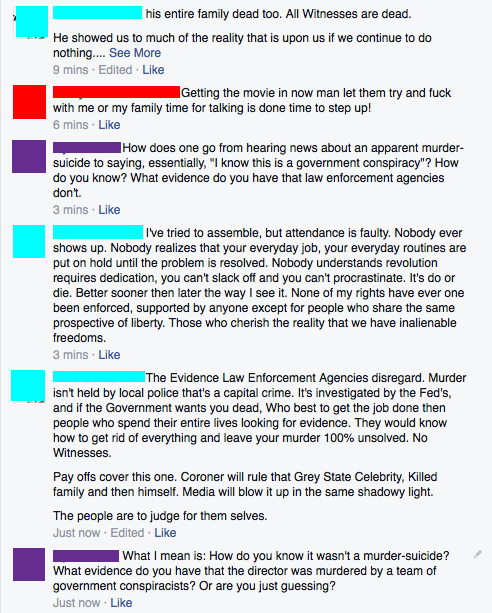
Yesterday I broke one of my cardinal rules on the Internet; I responded to a Facebook post suggesting the US government conspired to murder an unknown director and his entire family because of a Youtube video. In this post I will break down the conversation to show how maddening these kinds of discussions can be. This post is not overtly critical of religious ideas; however, the original poster is extraordinarily religious (she’ll block you for not capitalizing “God”), which kind of makes sense considering that high religiosity correlates with belief in various conspiracy theories. This (tedious) post illustrates why it’s futile to engage conspiracy theorists.

Our exchange began the usual way. A friend posted an article about a small-time film director and his family found dead in a suspected murder-suicide. Her own commentary insisted it was not a murder-suicide, but rather a government-conspired and orchestrated murder to silence dissent.

government conspiracy a

I tend to never trust someone who ends their claims with “WAKE UP!!!”

Here the claim has been laid out. Use of quotations around “killed” suggests to the reader that another explanation exists. She follows with a wild conspiracy theory: The Government murdered a man and his entire family. I read the article and, even though it wasn’t particularly unbiased, it didn’t provide me with any indication that nefarious government actors were behind this. In fact, the only indication that another explanation could exist in the article is when the author said of murder-suicide, “If indeed proven true.” So I replied, which, I confess, was a mistake. (I’m Purple).

government conspiracy b

First Blue jumps in with irrational justification to support Red’s original conspiracy theory. Some other stuff. Then my comment. For whatever reason Blue replies by suggesting he personally has evidence that law enforcement agencies disregarded. But he ignores my request that he provide it. He then claims that because the government has the capability to carry out extrajudicial killings, that means it must be involved in extrajudicial killings. But then he says something peculiar that I think best sums up his attitude.

The people are to judge for them selves.

He appears to suggest knowledge is gained only when people agree on an issue.

government conspiracy c

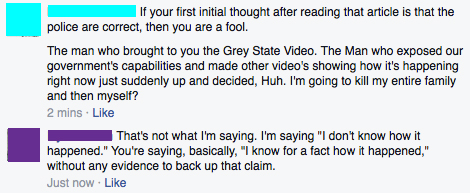
I feel like I’m being too nice to Blue. At this point I’m getting incredibly frustrated. Blue then breaks my number one commandment. He tells me I can’t prove him wrong (a classic move).

government conspiracy d

At this point Red finally jumps in.

government conspiracy e

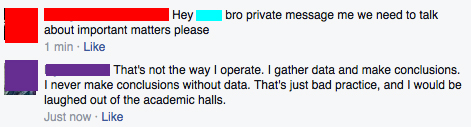
In other words, the only reason I don’t agree with her is because I’m an idiot. I next explain to her why that’s an odd statement.

government conspiracy f

Note: This should say “I gather data and THEN make conclusions.” I apologize for this oversight.

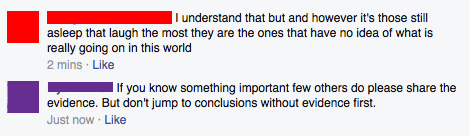
She then claims to have a lot more knowledge than the average person. My frustration is peaking, but I try to be as civil as I can about it.

government conspiracy g

Red proceeds to drop a nuclear bomb.

government conspiracy h

Holy shit. Just walk away. Slowly. 

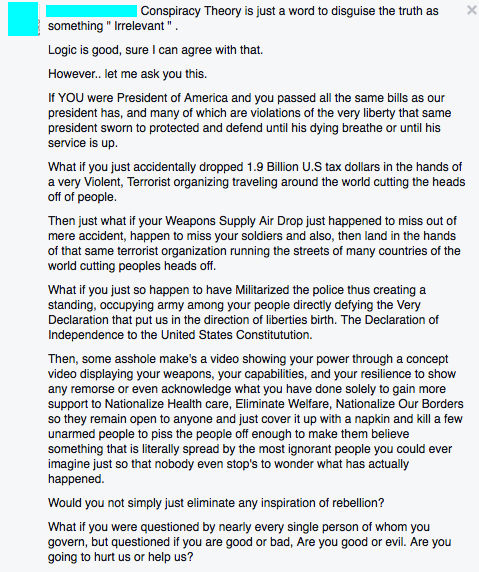
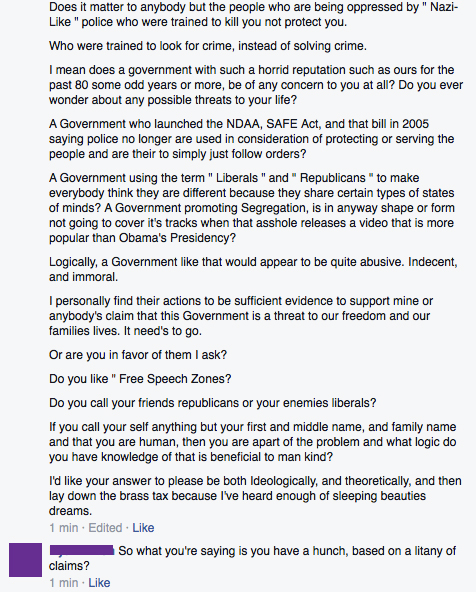
At this point I attempted to leave the conversation, but Blue (who’d spent the intervening time typing, apparently) jumped in with a schizophrenic anti-government rant disguised as a series of questions. It was so long I had to break it up into two images.

government conspiracy i

What the fuck does “nationalize our borders” mean?

government conspiracy j

I don’t expect you to read all of that. Pick any two sentences; they will sum up his entire argument.

government conspiracy k

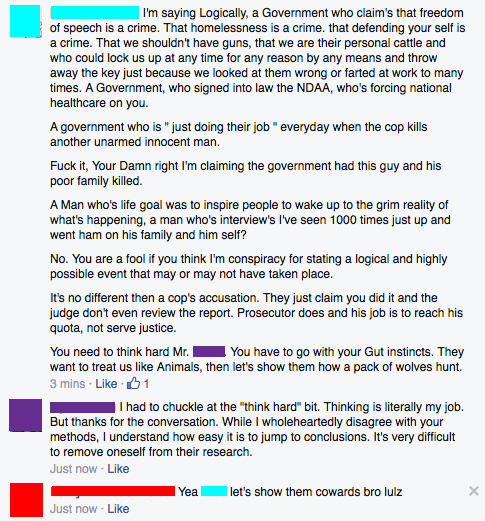
After Blue’s second rant I decided it was well beyond time to bow out of the conversation. I tried to do so respectfully. I closed out Facebook and didn’t check the status again until this evening. Blue had one final comment.

government conspiracy l

I thought about replying, “Knowing something in your heart is different from knowing something for fact,” but I couldn’t bear to continue this conversation when clearly it was impossible for me to win.

This post is not merely to show off my ability to use reason against unreasonable people — quite the contrary. I mean, look. I got pummeled by conspiracy theorists! My ability to convince them that evidence is necessary when making a claim was outmatched by their abilities to hold tight to their sincerely and deeply held beliefs. I do not feel victorious after this conversation.

And that’s my whole point. There are certain people out there — we all know one or two — who must believe a malicious and powerful force is behind everyday occurrences. When we try to reason with them we’ll only be left licking our wounds.

While most people — even religious people — are open to reason (even if they accept it with a caveat: “It’s a matter of faith”), not all are. And those who are not are not worth our time and energy. Instead of engaging them we should be ignoring them. If I had ignored this post, which was my initial impulse, I would’ve saved an hour of my life, which could’ve been spent doing something infinitely more constructive, like watching re-runs of Beavis and Butthead.

Posted in skepticism | Tagged , , | Leave a comment

Islamic Narratives of Victimhood: Terror not going away soon

In the years surrounding the US 9/11 attacks we became aware of a strange phenomenon; Islamic terrorists were discussing their plans and goals publicly on Internet forums, without any regard for who may be watching. This was a double edged sword. While law enforcement agencies certainly were able to gather intelligence from these postings, the actions of these would-be terrorists underscored how bold they had become.

Let me put it this way: It would be like two would-be bank robbers discussing their plans to rob banks while standing in a police station lobby. They have no expectation of privacy, and they would have to be pretty confident to willfully give up their privacy.

These discussions unfolded right before our eyes, and we were assured by Islamic terrorists that Mr. bin Laden was silently moderating these discussions. Sometime during 2002 al Qaeda published their final position on their website. When would the terror against the US stop? Their answer: When four million Americans, including two million children, were slain for Islam, eight million Americans displaced, and hundreds of thousands of Americans maimed.

Al Qaeda’s official spokesman, Sulaiman Abu Ghaith, delivered the decision:

According the the numbers, we are still at the beginning by the way: The Americans have not tasted from our hands what we have tasted from theirs. The [number of] killed in the World Trade Center and the Pentagon are but a tiny part of the exchange for those killed in Palestine, Somalia, Sudan, the Philippines, Bosnia, Kashmir, Chechnya, and Afghanistan.

We have not reached parity with them. We have the right to kill four million Americans — two million of them children — and to exile twice as many and wound and cripple hundreds of thousands.

He ends his murderous rant by invoking weapons of mass destruction. (For full text, see page 347 of this book).

While Abu Ghaith is in US Federal Prison serving a life sentence, and while his boss, bin Laden, is dead, it’s not my opinion that we should dismiss this as being outdated. I’m going to borrow a phrase and some of the theory from Michael Barnett in his book, Dialogues in Arab Politics: Negotiations in Regional Order. 

That is, Arab states play politics differently than how many in the West understand the game. Arab state leaders use “presentational politics” to construct a narrative. Often the narrative is one of the victim with the right to retribution. If we re-read Abu Ghaith’s statement, we see “presentational politics” at play. First, he points out just how disproportionate Muslim civilian suffering is to Americans who were affected by 9/11. This paints a picture for the reader: Yes, Muslims have suffered untold losses by American soldiers. A narrative of victimhood has been constructed. And then, while the reader feels the sting of sympathy, he makes his argument: Kill four million Americans.

This is not unique merely to al Qaeda. In many, if not all, terrorist attacks against Western interests, presentational politics is at play at both the state level and by non-state actors (terrorists themselves). When we listen to the justification for terror attacks we find victimhood in many, if not most, if not all, attacks. In the Charlie Hebdo attacks the terrorists were explicit; they felt the cartoonists committed the greatest insult against their god that one can make (psht. I’m sure I could come up with something more insulting). On 9/11 the victim was constructed because non-Muslim Americans were in Mecca. The 2005 London bombings occurred because the bombers held the British government responsible for waning existential security in the Arab World. In other words, the entire Muslim world was a victim to British aggression. The 2008 Ahmedabad bombings are rather interesting. The Muslim terrorists were the victims because they had attacked a train in 2002, killing 58, mostly Hindus, which led to Hindu riots against Muslims. That is, I’m going to attack you first, and if you attack me back, I’m the victim, not you!! In the 2012 Toulouse and Montauban shootings, the attackers said, “The Jews kill our brothers and sisters in Palestine.”

Labeling themselves as victims, terrorists justify acts of terror, even if the rest of the world condemns them.

So what?

While sometimes terrorists have legitimate complaints (e.g. killing Muslims indiscriminately), acts of terror are always illegitimate. Being labeled, or labeling oneself, a victim does not justify victimizing others. This is a rather difficult problem, however; a constructed victim always needs a constructed hero to set things right. And constructed heroes (terrorists) are not in short supply. Even in cases when terrorists have illegitimate complaints (e.g. Charlie Hebdo), we see some willing to right a perceived wrong, even if it means using violence. And we see many who understand or condone such behavior. This is the ultimate problem with Islam in regards to this article.

Even in areas where existential security runs high, we see people willing to kill and be killed to preserve the honor of their god. And right now there is no solution to this problem. Short of Islam going through a radical liberalization, I don’t foresee this problem going away any time soon.

Posted in Political Science | Tagged , , , , , | 6 Comments

Questions or Answers?: An anecdote about murder

Questions are important. I will go so far as to say many times questions are more important than answers. Answers, especially incorrect answers, mean we’ve exhausted our will to engage in inquiry. In my life I’ve suffered a tragedy that has an answer, even though in the back of my mind I still have questions. This post examines that tragedy to argue that, although answers are simple and help us move on, answers are not always correct.

[Note: This post deals with a death in the family. I’m not looking for, nor do I want, comments showing sympathy. In these kinds of situations, 9 years later, an innocent “I’m sorry to hear that” sounds insulting. Please don’t leave those kinds of comments.]

In 2005 my sister was found dead in a shared apartment. The following comes from her full autopsy report and statements from witnesses, the chief medical examiner, the chief of police, and the mayor, all of whom took interest in her case.

My sister was an intravenous drug user for much of her adult life. But after witnessing her drug dealer murder a child with a baseball bat, she realized she needed to change her life. So she quit drugs cold turkey, broke up with her boyfriend, and moved in with my dad, address unlisted. She called her lawyer and began working out her statement to the police department regarding the murder. Three days before she died her boyfriend found her. She told him she couldn’t be a part of that life and was working with the police to put the drug dealer in prison. He beat her up and sent her to the ER with contusions on her face and scalp. There she was released with an undiagnosed bleed in her brain.

On the day she died she moved into the shared apartment. She asked one of her new roommates for heroin, but he had just gotten clean himself and refused to help her find drugs. He noticed her take “two small white pills” and chase it with a 40 oz. Later that night the landlord checked on her. She was watching TV in her room. He left the apartment to buy groceries. He was gone for 30 minutes. During this time the five other roommates witnessed her now-ex-boyfriend, the drug dealer, and an unidentified female enter the apartment, go into her room, and shut the door. There was some commotion, but not enough to warrant roommate intervention. Soon the trio left her room and closed the door behind them. When the landlord came home he discovered her on the floor, unresponsive. She was dead.

The responding officer took statements from everyone, but the arrival of the boyfriend, drug dealer, and woman was not mentioned in the initial police report. When the officer, who knew of her previous drug convictions, heard about the heroin request, he wrote in his report “suspected overdose.” Her body was taken to the medical examiner’s office, where the autopsy revealed no obvious cause of death. The report also noted that the brain bleed would have caused death in days, but it was not sufficient enough to cause death at that point in time. [Note: We don’t know if the brain bleed was caused by the fight with her boyfriend. It might be a coincidence.] The medical examiner agreed with the responding officer and, pending toxicology results, listed her cause of death as “accidental overdose.” This ruling compelled the police to close the case.

My sister, per her wishes, was cremated.

Soon after her ceremony the five eyewitnesses came forward with information about the encounter my sister had moments before her death. They were able to name two people to the police: the boyfriend and the drug dealer. By then the boyfriend was in jail on unrelated charges. In jail he wrote my dad a letter and said, “Everything they said happened that night happened.” He explained how they did it: He and the woman held my sister down while the drug dealer gave her an air embolism, which is not usually fatal, except in cases of long-term intravenous drug use. She died in minutes. They did it to prevent her from telling the police about the little boy being murdered.

When all of this new information came out, I contacted the chief medical examiner and asked for the full autopsy report, including toxicology results. She took one look at the final report and said, “There’s no way your sister died of an overdose. She only had residual drugs in her system. She probably hadn’t taken any narcotics in a week.” (We don’t know what the white pills she took were). She then contacted the police with her new finding. They agreed to reopen the case if the ME’s office did a second autopsy. The only problem was there was no body. My sister had been cremated.

At my mother’s insistence, I pressed the issue with the chief of police, who was running for re-election. I pressed the mayor who had taken a tough-on-crime stance. Both of them agreed to reopen the case, despite there being no body. All this effort, however, was in vain.

Because the re-opened case rested on the boyfriend’s statement, the body was necessary. MEs, if they know to look for it, can detect gaseous embolisms, which would have backed up the boyfriend’s statement. Without the body, however, the statement was meaningless.

In other words, by all accounts I should believe my sister was murdered. There were five eyewitnesses who saw them go into her room, heard a scuffle, and leave just moments before she was found dead. The boyfriend confessed in a letter written to my dad. The chief medical examiner disagrees with the initial autopsy results; she had no drugs in her system. But is that really enough to believe my sister was murdered? Is that enough to convince a jury? The prosecutor’s office didn’t think so. No charges were filed.

In this case it’s easiest to say she was murdered. This is the best answer because it wraps everything up nicely. I even tell people she was murdered because the evidence I do have supports that claim. But I still have lingering questions that can never be answered because her body was cremated prior to a second autopsy. And these questions are sufficient enough to agree with the prosecutor; no charges should be filed. And if they were I would not expect a jury to convict the accused, not without compelling new evidence.

I wrote this anecdote specifically to show that answers, while nice to have and very useful, are not always correct, no matter how important that specific answer is to you. We cannot ignore the other evidence, and we cannot ignore a lack of evidence for the answers we have. It may be emotionally difficult at times, but it’s important to have questions, even when you think you already have the answer. In my case I accept the evidence (that is available) suggests my sister was murdered. But I equally accept that I might be wrong.

Posted in Uncategorized | Tagged | Leave a comment

Shooting Down Flying Carpets: Let’s stay on topic about Islamic terrorism

There are two major fallacies defenders of Islam make when addressing the problem of Islamic terror. In the wake of yesterday’s terror attack in Paris, I’ve seen these employed with fervor. These are the magic get-out-of-jail-free cards that can be used quite brilliantly against unsuspecting people. But these fallacies are just that: Fallacies. They don’t get us any closer to a solution to the problem, and they actually hinder our progress by pretending there’s nothing wrong at all. Let me be the final authority here:

There’s a serious problem with your religion if its teachings are routinely used to murder people in order to silence the critics! And no amount of fallacious reasoning is going to change that fact.

Fallacy 1: The Reverse-Toupée Fallacy

The toupée fallacy is often used by American rednecks who say things like, “Every time there’s a terrorist attack in the news it’s by Muslims. Therefore, only Muslims are terrorists.” Or even worse: “Therefore, all Muslims are terrorists.” These statements are just plain wrong and are nothing more than using stereotypes to affirm the consequent.

But some people have this uncanny ability to change the entire meaning of the discussion about Islamic terrorism by making hasty assumptions about people that are equally as wrong. They might say, “Not all Muslims are terrorists.” In this case they’ve reversed the toupée fallacy by stating the glaringly obvious. Of course not all Muslims are terrorists, but so what? What does that have to do with the problem of Islamic terrorism?! The answer is: Nothing. By stating this obvious fact the entire conversation is shifted, and the person trying to have a reasonable discussion about Islamic terror must now backpedal and defend against making a hasty generalization they never even made. At best the discussion risks turning into one about Islamic terror statistics. At worst the discussion collapses and zero progress has been made. And this is very similar to:

Fallacy 2: The Flying Carpet Fallacy

In discussions about Islamic terror this is one of the best known malicious devices defenders of Islam can employ to ensure there’s no discussion about Islamic terrorism. Imagine the following discussion:

Person A: Did you hear on the news about the Islamic terrorists who murdered 12 people in France?

Person B: That’s nothing. What about all the US soldiers in the Middle East and around the world murdering innocent women, children, and babies?

A: Of course that’s awful, but…

B: What those soldiers are doing is a genocide compared to the Charlie Hebdo attacks.

A: Well, yes, but…

B: The West can’t point fingers at Islam until they stop murdering innocent people.

Person A tried to have a reasonable discussion about the Charlie Hebdo attacks, but Person B whisked A away on a magical flying carpet to a foreign land that had nothing to do with the Charlie Hebdo attacks. Furthermore, he prevented A from getting back to the main discussion and shifted the entire conversation into an accusation against the US. Instead of discussing the problem with Islamic terror in a reasonable way, many people use it as an opportunity to criticize something completely unrelated. In the end we’ve learned nothing. In the end the problem with Islamic terror is still a problem.

So what?!

The problem is these kinds of logical fallacies aren’t used merely in everyday conversations between neighbors and friends; they’re used at every level of the discussion, all the way up to heads of state. If we can’t trust our presidents and prime ministers to look at the issues objectively, then we’re no closer to a solution than we were yesterday.

On the other hand, if we can’t trust our friends and neighbors to look at the issues objectively either, then there’s no point in convincing anyone else to.

It would be my wish that whenever you’re trying to have a reasonable discussion about Islamic terrorism, don’t let anyone shift the conversation away from Islamic terrorism. Don’t let anyone try to state the obvious in an attempt to put you on the defensive. If they say, “Not all Muslims are terrorists,” just say, “Yes, I know,” and move on. The discussion is too important to let anyone sidetrack it.

Posted in Politics | Tagged , , , , , , | Leave a comment

Study: Religious people more likely to believe in conspiracy theories

In the current issue of American Journal of Political Science (October 2014), two researchers from the University of Chicago, J. Eric Oliver and Thomas J. Wood, published a study titled, “Conspiracy Theories and the Paranoid Style(s) of Mass Opinion.” The pair used data from four surveys from Cooperative Congressional Election Studies that asked respondents to respond to statements about their beliefs in various conspiracy theories. I have provided the statements below:

The U.S. invasion of Iraq was not part of a campaign to fight terrorism, but was driven by oil companies and Jews in the U.S. and Israel (Iraq War)

Certain U.S. government officials planned the attacks of September 11, 2001, because they wanted the United States to go to war in the Middle East (Truther)

President Barack Obama was not really born in the United States and does not have an authentic Hawaiian birth certificate (Birther)

The current financial crisis was secretly orchestrated by a small group of Wall Street bankers to extend the power of the Federal Reserve and further their control of the world’s economy (Financial Crisis)

Vapor trails left by aircraft are actually chemical agents deliberately sprayed in a clandestine program directed by government officials (Chem Trails)

Billionaire George Soros is behind a hidden plot to destabilize the American government, take control of the media, and put the world under his control (Soros)

The U.S. government is mandating the switch to compact fluorescent light bulbs because such lights make people more obedient and easier to control (CFLB)

The results are striking: 55% of those surveyed in the US agree with at least one of these statements. In other words, over half of Americans believe in a conspiracy theory, even when insufficient evidence to support that belief exists. The researchers then use a host of variables to determine conspiracism predictors. These suggest something rather interesting about certain religious people.

The main factor in question suggests:

a propensity to attribute the source of unexplained or extraordinary events to unseen, intentional forces (Shermer 1997). In psychological studies, this tendency is often found in supernatural, paranormal, or religious beliefs (Boyer 2001; Norenzayan and Hansen 2006; Tobacyk and Milford 1983).

In other words, religious Americans who believe in supernatural causes for certain events are more likely to believe in conspiracy theories. Just because they can’t see the malevolent forces at play behind a conspiracism event doesn’t mean those forces are absent. They sum it up nicely in the concluding remarks:

Not only does half of the American population agree with at least one conspiracy from a short list of conspiracy theories offered, but also large portions of the population exhibit a strong dispositional inclination toward believing that unseen, intentional forces exist and that history is driven by a Manichean struggle between good and evil, particularly in the high proportion of Americans who believe we are living in biblical “end times.”

This is not to say merely that religious people are more likely to believe in conspiracy theories. The study and its sources suggest a natural psychological phenomenon that is responsible for both beliefs in supernatural agencies as well as unseen actors behind major events. In other words, instead of the two being causally linked, the two are linked by a shared cause, an evolutionary predisposition to draw any conclusion we can in order to protect ourselves from danger. The researchers put it this way:

We suggest this predisposition originates in a highly adaptive and unconscious cognitive bias to draw causal connections between seemingly related phenomena (Cottrell, Winer, and Smith 1996; Michotte 1963) and to presume predators are behind unknown or novel stimuli (Barrett 2004; Kassin, Fein, and Markus 2007).

Religious people, especially those who reject unsubstantiated conspiracy theories, however, should take solace in fact that this study only suggests a correlation between certain factors (including religious beliefs) and beliefs in conspiracy theories. This study does not imply that if you believe in god you must also believe George W. Bush was behind the 9/11 attacks. And furthermore, atheists are by no means immune from believing conspiracy theories. Belief in god is not a necessary variable to believe in conspiracy theories.

Of course, I am curious. Do you believe in god? Do you believe in any of the above (or other) conspiracy theories?

Posted in Uncategorized | Tagged , , , , , | 9 Comments

Neil deGrasse Tyson’s 7% problem and why it’s not a problem

I wish to open this post by reminding you all this is not a study, and it should not be viewed as one. This is merely an observation of my own setting. It comes from personal discussions with peers and students. This is merely an anecdote. (I write this because I’ve noticed my blog used increasingly as a reference in Internet forums).

If you’re an atheist and enjoy Neil deGrasse Tyson (like I), then you’ve probably heard him mention the 7% problem. You probably agree that it’s a problem. That is, 7% of elite US scientists still believe in a personal god. He’s not pulling this number out of thin air. This number comes from a 1998 poll conducted by Edward J. Larson and Larry Witham, using methods previously employed by James H. Leuba in 1913 and 1933. The results of the 1913, 1933, and 1998 surveys are below:

lawson witham study

Yes, I know the numbers don’t add up at the bottom under 1998. This is taken from the original paper. But I don’t know the cause of the discrepancy, nor do I know the actual stats. For the purpose of this post, ignore it.

SOURCE: Nature 394, 313 (23 July 1998) | doi:10.1038/28478 (See link above)

Remember, this survey polled only leading scientists. Outside of this small population, the number of scientists is relatively quite large. If we look to Pew data from 2009, we see a stark shift towards belief in god among scientists generally. The percent of scientists who believe in god jumps to 33%. That’s not a slight increase; it’s a massive surge (of course, I think evangelical types would still be dismayed that this number isn’t 100%).

Farther down the page on the Pew article, researchers break down the results by fields. We have biological and medical (32%), chemistry (41%), geosciences (30%), and physics and astronomy (29%). Missing from this list are several fields, including my own: political science (then again, to be honest, poli-sci only barely meets the qualifications to be a science).

Belief in god, to me, appears very common in political sciences. While the most elite political theorists disregard religion as having no explanatory power on power politics (or how to mitigate it), I’ve personally noticed a general trend towards belief in a personal god. This number might shift down towards 50% as level of education rises. That is, belief in god dwindles with the Ph.D, but undergraduate students are essentially a religious bunch. But still, some of my most respected peers spend the week completely ignoring the roles religion plays in international politics, but they’re at the pew on Sunday. Their Facebook posts are filled with religiously inspirational quotes. They wear religious jewelry. Indeed, at first glance they resemble the general public in regards to religiosity, even if roughly half are non-believers.

Shifting gears

Something else I want to talk about that I’ve noticed is even the most devout Christians and Muslims, et al, in political science view religion as a data point. Sometimes that data point is a point of criticism (for example, Jewish political scholars are often the first to throw Israel under the bus). In other words, despite their religious beliefs, political scientists appear to genuinely look at religious belief objectively when constructing hypotheses and testing them out. I’m very much commending these scientists for this.

While physics and biology, by definition, have zero room for religion, social scientists bring it into the discussion, but, even if they’re bible thumpers on Sunday, they do so without giving preference to their religious beliefs, and they are willing to gut their beliefs if our theories don’t support them.

The takeaway

Neil Tyson is frustrated that 7% of elite scientists still believe in a personal god. I don’t see this as a problem. In hard science it doesn’t matter if scientists believe in god. God is absent from their models. Furthermore, if we look at what is happening in the academic halls of political science, which might have significantly more believers than physics, it appears god is still irrelevant. Like I said, this is merely based on my own observations, but let’s be honest: I’ve never seen a paper published in Political Science Quarterly that claims god is the author of war (or anything). If a field chock full of believers can ignore their faith, I’m certain the 7% elite in the hard sciences can do the same. To me that’s not a problem.

Posted in Uncategorized | Tagged , , , , , | 5 Comments