Martyrs for Fundamentalism: Signaling High Costs for Religious Mobilization

By now Kim Davis is old news. She’s had her 15 minutes of fame, but several questions still linger on. Mostly the debate is settled; she broke the law and paid a very public price for it. Most of the attention has been on her faith. That is, she was motivated to break the law based on her religious teachings. But this is too easy an answer, and there are several other analytical tools we have at our disposal to further explain her actions. Here, I am employing a signaling game (in easy-to-understand language) to make a parsimonious explanation.

In signaling games there is an equilibrium where high risk players will always choose the costly action (in this case, break the law [risk] and go to jail [cost]) in order to reveal information to a target audience. And low risk players will not want to deviate from the low cost action (blogging, for example). But what does this mean in the broader context?

Well, let’s assume there’s two players here. For the sake of helping you understand, I will frame it Kim Davis’ actions. The first player is Kim Davis. The second player is fundamentalist Christians. Many of the Christians* support using religious freedom to actively prevent same-sex couples from marrying, but they do not know the extent to which the other Christians agree with them. Individually, each Christian wants to do something, but doing something is costly. Speaking out against homosexuality harms their reputations, so they keep quiet. So before they do anything, they want to know that they have support from other Christians. Kim Davis, on the other hand, wants these Christians to speak out and to actively prevent same-sex couples from marrying. How can she convince them to do this?

*For the purpose of this post, Christians means Christians who oppose same-sex marriage. Obviously many—if not most—do not oppose it, so I’m only referring to those that do.

Well, if she’s a low risk player, she will write blog posts or distribute literature, or maybe she’ll join the Westboro Baptist Church. But the payouts from this are low. It’s difficult to reveal information about the state of the world using low stakes actions. Even when she can communicate this information to an audience, the information isn’t worth much because her costs producing the literature or blog post (or whatever) are low and insignificant, and the audience knows this.

On the other hand, if she’s a high risk player, she will purposely martyr herself by breaking the law and defying court orders. This action sends a very powerful message to her audience. She’s saying, “We all agree that same-sex marriage is an awful thing.” Furthermore, she’s revealing new information about the extent to which they believe it’s an awful thing. It’s so awful, they feel, that it is better to go to jail than to submit to the new status quo. Therefore, we can say Kim Davis attempted to change the actions of the entire population of fundamentalist Christians by sending them a costly signal about the state of the world.

With this information revelation, the second player (fundamentalist Christians) can then mobilize and coordinate their responses easier. I think we saw this at Mike Huckabee’s “#ImWithKim Liberty Rally.” If not for Kim Davis’ actions, it’s unlikely the attendees of the rally would have been able to mobilize and coordinate an anti-LGBT event. [Note: If you’re interested in how this mobilization and coordination is possible, which is slightly beyond the scope of this post, read up on information cascades.]

Thankfully, Kim Davis was wrong about the state of the world. She believed the majority of Americans supported her and silently felt justified in using religious freedom to usurp the rights of others. The majority of Americans support same-sex marriage, and, by extension, they oppose efforts to curtail it. And even if that weren’t the case, it’s still unlikely Kim Davis would have succeeded because most fundamentalist Christians—even those who feel the same way Kim Davis does—are not high risk actors. Kim Davis overestimated the value of her actions.

Post Script: I’m almost certain these ideas aren’t mine; someone else has certainly thought of them before, but I’m not familiar with anyone else who has written about it from this perspective. If previous literature exists, feel free to send it my way.
Posted in Politics | Tagged , , , , , , | Leave a comment

Atheism and Non-Religion in Lebanon: More Common than Thought

As I’ve written about numerous times, I used to live in Beirut, Lebanon. To be more precise, I lived in Hamra, Beirut, Lebanon, which is the intellectual and artistic capital of Lebanon. Filled with universities, startups, cleverly-themed cafes, and a poet or musician on every corner, Hamra is also about as secular as a city can get. Although the country is sharply divided along sectarian lines, in Hamra religion is as meaningful as the choice between tea and tea with mint. I’ve also written about how many of the people I met in Lebanon were non-religious or atheist but who culturally or ethnically identified as being Sunni, Shia, or Christian. While I wrote about these things freely, deep down I suspected I might have suffered confirmation bias strictly because I was in Hamra. I secretly suspected I might view Lebanon as a lot more religious if I took samples from elsewhere in the country. Well, this hypothesis is only partly right, and it’s mostly wrong.

In 2012 WIN-Gallup International conducted a global survey of religiosity and atheism, which they broke down by country. In Lebanon, their findings suggest (aggregate information on page 15) that only 64% of Lebanese people are religious (meaning they identify as Sunni, Shia, or Christian and actively believe in god), while 33% are not religious, with an additional 2% as strict atheists. While non-religious people do not break the 50% mark, this number is not that far off from my original estimation. In other words, secularism in Lebanon as a whole is pretty much exactly what I discovered while living in Hamra.

This phenomenon as pertaining to Muslims is called cultural Muslims. This is very similar to cultural Jews, who identify as Jewish but do not believe in god, and cultural Christians, who identify as Christian but do not believe in god. This is a fairly common phenomenon.

Interestingly, Lebanon almost perfectly mimics the United States in this regard. In the same poll (see page 16) the US is only 60% religious, 30% irreligious, and 5% atheist. In real life, however, Lebanon does a better job keeping religion separate from policy.

I find these results fascinating, but I feel the answer might still be a little biased. Because of things like family ties, honor, social reputation, discrimination, and others, the actual number of atheists and non-religious people in Lebanon might be significantly higher. Given the option between “non-religious” and “atheist” might offer Lebanese atheists a way to save their reputations by avoiding the A-word. Coming out as atheist in a Muslim family might be social suicide, whilst coming out as non-religious (especially if they still culturally identify as Shia) is an easier way to express your views while still preserving your reputation. Furthermore, if your brother is an active member of Hezbollah, coming out as either non-religious or atheist might be actual suicide. So there’s probably some dishonest answers happening here, but I understand why it happens. And for now I’m happy with these numbers. It gives us something to work with.

On a side note

I decided to investigate this information after speaking to my grandmother last night. A deeply religious woman, she was shocked to learn from me that 50% of American Jews are atheists. Although she believed me, especially when I cited my sources, she couldn’t comprehend the idea of cultural Judaism. Separating theism from Judaism was not something she believed was in the realm of possibilities. I never gave it much thought before; atheist Jews are so commonplace in the US that I figured it was universal knowledge. But after discovering that she had never heard about it, I decided to do more digging, and I came upon the above-cited poll. Thankfully, this investigation answered two questions in one: How is atheism dispersed globally, and was I right about irreligion in Lebanon?

It appears that I was.

I still find it incredibly interesting, however, that non-religion can thrive in this tiny Mediterranean Middle Eastern country. But that’s a post for another day (after a lot more research).

Posted in Atheism | Tagged , , | 1 Comment

Evangelism’s Utility: Or, Lack Thereof

I think most atheists are dumbfounded by evangelical types. The odds are stacked fairly strongly against them. It’s essentially guaranteed that they’ll fail. Thinking about this absurdity, I decided to do some very basic math. How much utility does a believer get by evangelizing? But first I need to construct a payout matrix.

Convertible (S1) Not Convertible (S2)
Evangelize (A1) Atheist convinced and joins your church (C1) Frustration; status quo maintained (C3)
Don’t Evangelize (A2) Status quo (C2) Status quo (C2)

Above, I show the two possible actions a believer can take, the two possible states of the nonbeliever, and three possible consequences.

The believer’s preferences are C1PC2PC3

That is, the believer prefers the atheist changes her mind and joins the church to the status quo. And he prefers the status quo to the status quo and frustration. This is the set of ordinal preferences over outcomes.

Next, we must determine the utility the believer receives for each of the three consequences. Let’s assume that he receives a full unit of utility for convincing the atheist. That is, u(C1) = 1. Because I do not want to use negative numbers here, the rest of the consequences will contain a percent of a full unit of utility. Therefore, u(C2) = 0.5. That is, the status quo will serve as a bass line. Anything above it is a plus, and anything beneath it is a minus. Finally, u(C3) = 0.1. This is the worst utility one can receive.

Next, we need to make some assumptions about the probability that the believer will be successful. I was unable to find statistics online about evangelical groups’ success rates, so we will have to take our best guess. I’d imagine their success rate can’t be better than 1%. Therefore, p(S1) = .01, and p(S2) = .99* (because these are the only two possibilities, they must add up to 1).

Now we just have to put this into mathematical terms:

EU(A1) = p(S1)u(C1) + p(S2)u(C3) =

In English, the expected utility of evangelizing is equal to the probability of the atheist being convertible, multiplied by the utility of the atheist changing her mind and joining your church, plus the probability that the atheist is not convertible, multiplied by the utility of being frustrated and maintaining the status quo.

To solve:
(.01)(1) + (.99)(.1) = ~0.11

Next,

EA(A2) = p(S1)u(C2) + p(S2)u(C2) =

That is, the expected utility of not evangelizing is equal to the probability that the atheist is convertible, multiplied by the utility of maintaining the status quo, plus the probability that the atheist is not convertible, multiplied by the utility of maintaining the status quo.

To solve,
(.01)(.5) + (.99)(.5) = 0.5

The expected utility of evangelizing is a mere ~0.11, whereas the expected utility of leaving atheists alone is 0.5. In other words, they have more to gain from not evangelizing.

Discussion

To be fair this is not taking into consideration the believer’s future utility. In many religions it is a duty to spread the word. Therefore, they have hope for a future reward in a life after this one. Unfortunately, that’s just not the way utility works. Generally we speak of utility in terms of how much we can get while still alive. There’s no way to measure utility in any hypothetical afterlife, so it’s pointless to try.

I’m sure some evangelical types will maintain that, yes, they receive their reward after this life, but with no way to demonstrate the reward, we have no way to measure the reward.

*After playing around with the numbers, trying to find a point where the believer gets more utility from evangelizing, I found that if we change p(S1) = .1, and p(S2) = .9, it’s more rational for the believer to try to convert atheists, but those probabilities are way off of reality.

Posted in Atheism | Tagged , , , | Leave a comment

Migrants and Their Tragedies: Yes We Can Fucking Share

Pope Francis. Love him or hate him, every once in a while he does something rather remarkable. The Catholic Church’s official position on the European migrant crisis has been consistently impressive. From an initial plea to Europe to get off their asses and handle this human tragedy to—just last week—calling on every European church and community to take in one family, the Pope is reminding Europe that humanity is contingent upon how we help one another reclaim stability amid calamity.

Europe has been through this before. They’ve witnessed both sides of this issue: Genocide and the ensuing migration that genocide begets. The final (let’s hope) 30 year war from 1914 to 1945 was the bloodiest period in Europe’s history. No longer content with waging crusades and colonialism, murdering people of different religions and skin colors, in the first half of the 20th century they turned on each other and suffered a very heavy price. And so it’s not difficult to imagine why—then—Germany has done a better job handling refugees fleeing from genocide than it has done handling Greece’s economic crisis.

Of course Germany can’t do it alone.

Germany wasn’t the only country to suffer during the 30 year war. Every single European state faced a shocking loss of life. In some cases a quarter of their male population aged 18 to 25 were wiped out. And yet every European country has survived, reborn from the Old Europe as a collective of shared responsibility and universal identity. This can never happen again, they say. And they’re right. The Old Europe that died in 1914 is gone forever. The rest of Europe has no excuse for ignoring this problem. This can never happen again, they say, but it can happen to others. No. No it fucking can’t. You have a basic responsibility to humans. Meet that burden.

And then there’s Israel, the pride of White Protestant Conservatism (in the US) and the bane of pretty much every other social group who values human dignity over ethnic and religious identity. Last week Prime Minister Netanyahu rejected calls that Israel take in some of the migrants fleeing war and persecution. His actual response:

[Israel is] a very small country that lacks demographic and geographic depth.

This should shock the conscience of any reader. In other words, Netanyahu worries that if Israel allows these migrants to take refuge in the Jewish country, the country will become less Jewish!! So what? Who fucking cares? And he’s willing to risk innocent civilians’ lives to preserve Israel’s Jewish identity? Shame on him. A country founded in response to the greatest tragedy to ever fall on humans has no room in its heart for people facing their own horrors. A little empathy is all I ask. Israel knows what it’s like. It should fucking know better.

And my country, the US of A. Although far, far isolated from the wars, we seem to be taking our sweet time. Shame on us too.

Look, my point is that we’re all sitting here arguing over whether or not we can fucking share, ok? Meanwhile, these migrants are traveling sometimes from as far away as Afghanistan to escape intolerable conditions, walking on foot through Islamic State-controlled territories, facing death every step of the way, for the hope—the possibility—of a chance at a better life… in Greece. What does that tell you? Of course we can fucking share!!

I don’t care what it takes. Just get it done. As a species we’ve survived too many horrors to still be treating our fellow human beings as if they come second to our comfort. There’s no excuse for dragging our feet any longer.

Posted in Politics | Tagged , , , , | Leave a comment

The Islamic State Blows Up Sand: Time to Pull Out the Jokes

As many of you know, the Islamic State has resorted to destroying ancient architecture in Palmyra, a UNESCO World Heritage Site. Apparently buildings that predate their prophet are offensive. So, in addition to murdering innocent civilians for not following the same god—or not following that god hard enough—they’re taking their frustration out on innocent piles of rock. Am I the only one who finds this ridiculously childish? Not merely childish, but childish to so far an extreme that the only logical reaction is to mock the Islamic State?

I’m serious here. After reading about yet another attack against an abandoned city, I’m starting to feel like we’ve gone way beyond the point where mere condemnation is appropriate. I mean these are men whose feelings are so fragile that they are insulted and outraged because ~4,000 years ago a non-Muslim civilization existed. Keep in mind this was ~2,500 years before Islam was born. They’re throwing a tantrum over something that couldn’t possibly have been built to challenge their beliefs. Besides, the paganism that began the city was eventually replaced with Christianity, which was in turn replaced with Islam for about 1,100 years until the city was abandoned!!!

The Islamic State’s emotions are so feeble that they can’t even coexist with symbols of their own history. They’d rather bomb uninhabited piles of sand and rock than to live in a world where sand and rock had non-Islamic meaning more than a thousand years ago.

This, ladies and gentlemen, is worthy of and deserves the highest form of mockery.

Posted in Uncategorized | Tagged , , , , , | Leave a comment

Google Searches for “ISIS” and “Join ISIS” Compared

The other day I posted about a remarkable surge of people using Google to search for ISIS at a rate that dwarfs the previous 11 years of searches for other terrorist organizations. I discovered this using Google Trends. The visual representation of people’s lopsided interest in ISIS is below:

terror org searches

When discussing the possible cause of this phenomenon, fellow blogger siriusbizinus commented:

It would be most interesting to find the source of the volume of searches. I know that there are some other atypical things about ISIS, like westerners trying to join its ranks. Could this also be a product of their media outreach? I mean, despite the fact that they publicly behead people and commit other atrocities, you have people trying to join that organization.

I responded by amending my post to reflect an almost identical surge in Google searches for “join ISIS,” which appears to support this idea. This is shown below:

terror org searches 4

Initially I noted how similar the peaks and valleys are between “ISIS” (represented by green in the first image) and “join ISIS” (represented by blue in the second image). A side-by-side comparison should lead anyone to draw similar conclusions. But then I remembered that little administrative headache in Google Trends.

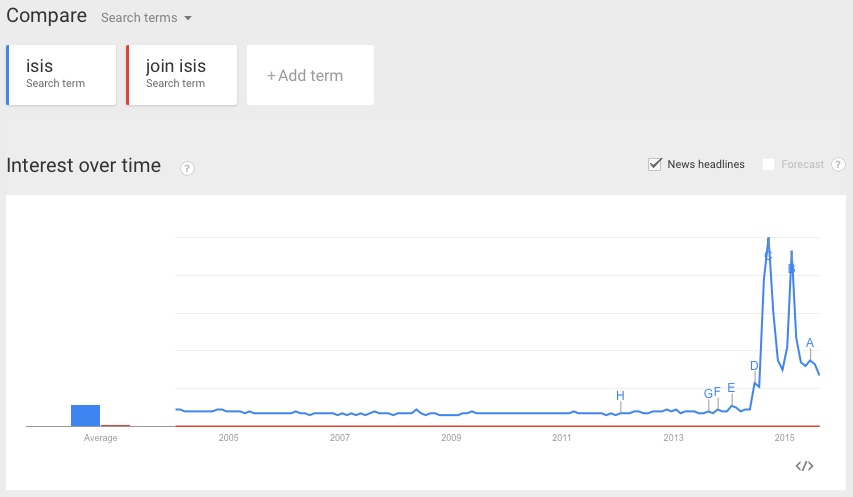
Rather than show frequency (or hard numbers), Google Trends shows us a value on a linear scale, from 0 to 100. No score can exceed 100, meaning that a comparison between the two becomes problematic. If the frequency of searches for ISIS is sufficiently greater than the frequency of searches for “join ISIS” then the y-axis will be skewed in a manner sufficient to make “join ISIS” no greater than 0. Indeed, this is exactly what happened when I tested this out today:

isis join isis

Because interest in ISIS is so great, it is impossible to compare them along a linear scale. For example, even if searches for “join ISIS” were at an actual frequency of 10,000 in any given day, merely searching for “ISIS” at a rate of 1,000,000 during any other day would make the results for “join ISIS” register as 0. Any value of one result 100 times greater than even the highest value of the other result would nullify our ability to compare the two results.

In other words, I can find no evidence using the method above to support a hypothesis that increased interest in ISIS is partly due to increased interest in joining ISIS. (The independent and dependent variables can also be swapped, and the effect would still be nil.) Of course, this is not exactly what siriusbizinus meant.

Siriusbizinus appears to suggest that the effects of ISIS’s public recruiting campaign draws attention to the organization in ways Hezbollah, Boko Haram, and others haven’t done. This leads to increased Google searches for the organization. Reversed, siriusbiznus also appears to suggest the fact that people want to join ISIS encourages others to research the group. Either hypothesis appears to be reasonable.

[NOTE: None of this addresses the public beheadings part of the comment.]

Of course all of this is meaningless. Why people are searching for ISIS on Google has no discernible predictive qualities. I might be wrong, but I can’t think of anything significant we can learn from understanding why people are interested in the group. To me this is merely a very interesting phenomenon—something to talk about over drinks.

Posted in Atheism | Tagged , , , , | Leave a comment

Interest in Islamic State Unprecedented: And Why Do We Care So Much?

[NOTE: Most of this was originally posted to my personal blog yesterday. For this post I’ve made some alterations appropriate to this blog’s theme.]

Today I started playing around with Google Trends, a web search analysis of Google searches in real time, going back to 2004. This tool has been used in some very interesting scholarly research, particularly because of its ability to “detect regional outbreaks of influenza 7–10 days before conventional CDC surveillance,” which is pretty darned cool, if you ask me. Given that I’ve only been playing with this thing for a day, I’m nowhere near that level of expertise. But I can do basic things, and therefore I decided to pick five different organizations designated as terror groups by the US Department of State and compare their search volumes.

First, I should get some administrative matters out of the way. Google Trends reveals search results by volume instead of by frequency. This occurs on a linear scale from 0 to 100. Searches appearing most often during a specific time period are ranked at 100, while searches appearing less often score below 100. This is somewhat frustrating. Moving on.

The groups I chose are:

  1. Hamas
  2. Hezbollah
  3. Boko Harum
  4. The Islamic State (ISIS)
  5. Al Qaeda

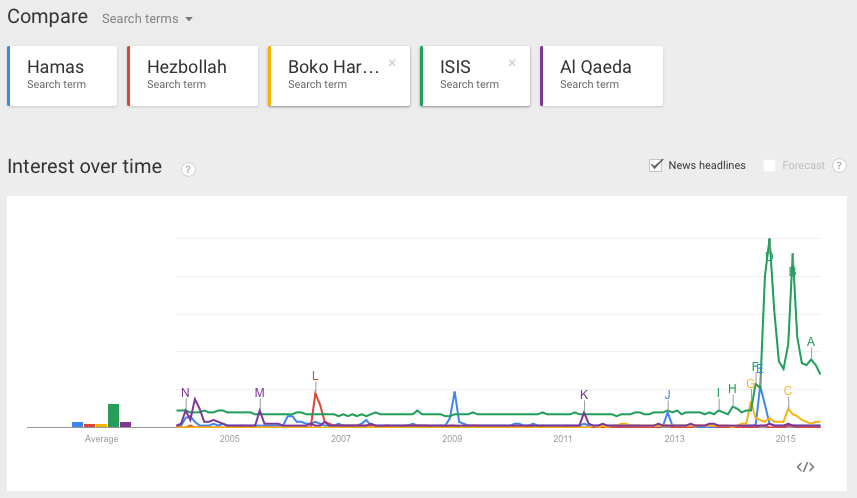
The results that came up were rather surprising:

terror org searches

Hamas, Hezbollah, Boko Haram, and al-Qaeda searches occur in relatively similar volume clusters along no discernible pattern. Searches for Hezbollah peaked during the 2006 Summer War and then fell into relative obscurity (more on Hezbollah in a bit). Searches for al Qaeda appear to occur in a few major clusters, but nothing remarkable since 2011. Searches for Hamas appear to occur each time Israel engages military action in the Gaza Strip. Boko Haram was relatively ignored by Google searchers until the last two years. But searches for ISIS since 2014 have exploded… more than once!

Not only have searches for ISIS gone up and remained relatively high, searches for the group are also so frequent compared to the other groups that they dramatically skew the y-axis. [NOTE: Most pre-2013 searches for ISIS have nothing to do with the Islamic State. Isis is a given name, the name of a goddess, and the name of a few other non-terrorist organizations. This explains the relatively stable horizontal green line traveling the span of 2004 to 2013 along the x-axis]. Let’s put this into perspective by examining Hezbollah by itself.

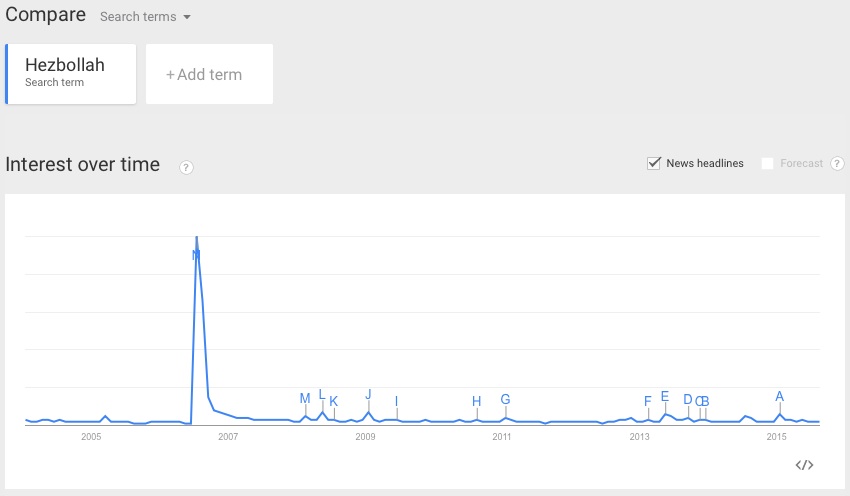
terror org searches2

In the first image searches for Hezbollah peak in 2006 during the Summer War. From there on out searches for Hezbollah drop to essentially zero, relative to the other search results. But when we focus only on Hezbollah, we rescale the results where the 2006 peak is at 100. This reveals a few minor peaks in subsequent years. But if we change the date range of the query, we see that these peaks aren’t necessarily trivial.

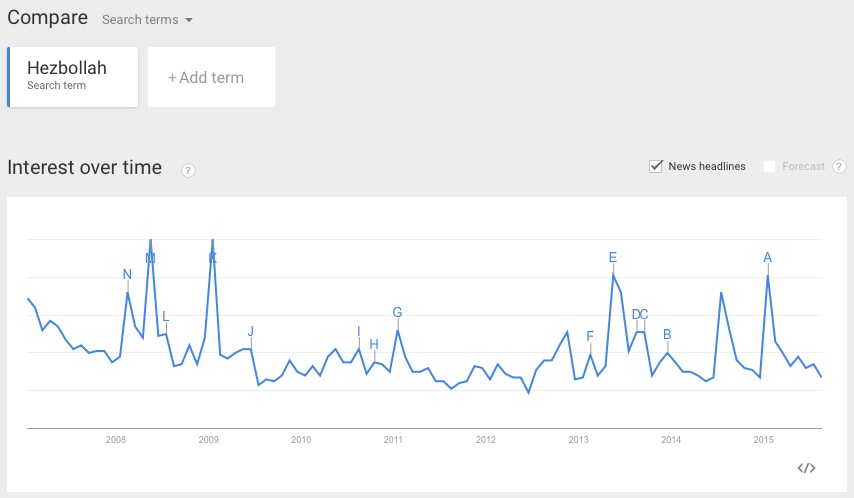
terror org searches3

Here I’ve begun the query on January 1, 2007, as opposed to 2004, and we see these peaks can get pretty high. And we know these aren’t trivial because each letter corresponding to a peak is a major event published in major news articles, such as truck bombings and Israeli air strikes against the group.

In other words, Hezbollah is a household name, not just in Lebanon, but also globally. Yet Google searches for the group come nowhere near the rate at which people are currently using Google to search for ISIS. Even searches for the most dramatic event in Hezbollah’s history don’t come anywhere close to the number of Google searches for the Islamic State.

I don’t know what any of this means other than that people appear more interested in ISIS than Hezbollah and the other groups. I don’t know what we can do with this information. It might just be trivial, but it’s very interesting.

Why Do We Care about ISIS so Much?

To be honest (and to not contradict myself in the paragraph above), I don’t know the answer to this. I can take some guesses:

  1. The Islamic State’s brand of cruelty is unique and very public. But that’s not necessarily true. During 2004 al Qaeda carried out a campaign of public and filmed beheadings. The Islamic State is merely copying the methodology.
  2. The Islamic State’s brutality is an everyday occurrence. This one might be true. We could almost set our watches to the release of news stories about IS’s latest act of genocide.
  3. The Islamic State is engaged in total holy war, intent on dismantling the secular Westphalian State Model in the Levant and across large sections of the globe, and that scares the crap out of us. This one might also be true, but I don’t think most people are searching for ISIS to read up on their international relations platform.

The Islamic State is doing something unique that has peaked a lot of people’s interest, and my actual guess is it has something to do with its unique bastardization of Islam. It’s my hope that this increase in search activity is happening because people are disgusted with the group and are seeking to confirm their beliefs by keeping up to date with the Islamic State’s inhumane atrocities. At least, the best source for accusations against the Islamic State is your nearest newspaper. Any story about IS is inherently a story about evil.

EDIT:

As commenter siriusbizinus pointed out, this unprecedented interest in IS could “be a product of their media outreach,” which could inspire, for example, “westerners [to try] to join its ranks.” Well, this compelled me to do another Google Trends query, and wouldn’t you know it; Google searches for ISIS match perfectly with google searches for “join ISIS.” Could this be a research project? Probably not, but my interest is definitely piqued.

terror org searches 4

Posted in Atheism | Tagged , , , , | 2 Comments

Reason for Absence and New Material

Lately I haven’t been posting… well, anything. When it comes to religious beliefs, practices, and idiotic policies I have a lot to say; however, I really haven’t had time to formulate coherent blog posts. I have a lot of fun with this blog, so naturally I’m a little disappointed. But there is a reason for this lapse in creative writing:

My university offered me a Graduate Research Assistant position, which I happily accepted.

This also means I did not have a chance to finish my summer research into the religious contexts of self-immolation. Therefore, like many academic ventures, it goes to the back burner. I am also a little disappointed in this, but perhaps I can persuade a professor interested in narratives to help me with this research in the future. My new position might help facilitate such a collaboration.

During the last year I have put a lot more thought into these blog posts, which have increasingly been used to facilitate a discussion about aspects of religion and atheism through a scientific lens. I am beginning to think, however, that between my Modeling and Simulation studies in International Studies, my graduate research position, and my full time PhD workload, I should lay off of the depth—maybe focus more on criticizing current events as they unfold. Or maybe I could get back into my Bible/Quran contradictions posts.

This blog is a lot of fun to write, so don’t read between any lines. But my university also started a WordPress site specifically for students to write about their academic studies, so I think I’ll also be able to write about my research, my assignments, and the discussions I have with peers. That should be just as fun. Unfortunately, I won’t be sharing any of that here; however, if you’re interested in reading these posts, I am more than willing to point you toward the new blog (as long as I’m previously familiar with you as a blogger).

Of course, every once in a while something in-depth will make an inevitable appearance here.

Posted in Uncategorized | Tagged | Leave a comment

Sicarii, Assassins, and the Islamic State: A Pattern Emerges

Total holy war and suicide attacks are nothing new. History has kept a long list of organizations popping up, committing atrocities in the name of god, and then suffering absolute defeat—sometimes these campaigns are coupled with ironic consequences for the crusaders. And I use that word—“crusaders”—because there’s a lot of talk about the similarities between the Islamic State and the Crusades. That’s obvious, and I could easily spend 10,000 words pointing out those parallels. But instead I want to talk about different similarities I’ve recently started recognizing. The Islamic State shares interesting closeness with two other groups: the Zealots-Sicarri and the Assassins.

The Zealots-Sicarri was a short-lived (25 years) group of Jewish extremists in Jerusalem, operating around the 7th decade CE. The Assassins was a group of Islamic extremists in Persia and much of the Levantine Middle East, operating during the 11th through 13th centuries. Both groups used terror to spread their messages and begin a holy war to purge the land of non-believers.

[Note: “Non-believers” here merely denotes people who don’t follow the extremist groups’ religious beliefs; it doesn’t necessarily mean atheism.]

Interestingly, both groups also suffered humiliating defeats. The Zealots-Sicarii initially enjoyed major victories, such as taking control of the Temple of Jerusalem; however, when the Romans fought back, they wiped the Temple from the map, causing mass suicide at Masada, and—after a subsequent Sicarii revolt—the removal of the Jews from Judea, which lead to a Jewish dispersion throughout the Roman Empire. In other words, this tiny radical Jewish group was ultimately responsible for the Jewish Exile.

The Assassins, too, suffered a humiliating defeat when they tried to assassinate Möngke Khan. He sent his army to retaliate, and the Mongols crushed the Assassins, killing essentially all of them.

The Islamic State should take note of this pattern: Small and weak religious extremist groups who attempt to radically change the political landscape through acts of public violence against innocent civilians and military members while engaging in total holy warfare tend to suffer demeaning defeats that—at least in the Jewish case—have the opposite effect than was intended.

Below I’ve made a table comparing the three groups. I must confess that the similarities are not perfect, and I’ll let you decide how strongly they resemble each other. But to me it’s beginning to look like a pattern. The technology might have changed, but the methodologies and goals share some qualities.

  Zealots-Sicarii Assassins Islamic State
Ideology Jewish extremism Islamic extremism Islamic extremism
Goal Force Romans and Greeks into war with Jews in order to purge non-believers from their land and spread Judaism Spread “pure” version of Shia Islam; create Islamic totalitarian kingdom Spread “pure” version of Sunni Islam; create Islamic totalitarian republic
Methods Daggers and swords: Murdered innocent people in public; waged massive and total holy war against Roman soldiers Stabbed innocent victims in public, compelling military reaction. Assassins’ missions were often suicide missions. Early form of suicide terrorism Total holy warfare: Public executions, territorial conquest, murder of innocent people in addition to foreign and domestic soldiers
Unforeseen Consequences Utter defeat and destruction of Jewish temple, beginning of the Jewish Exile Completely annihilated by Möngke Khan’s army of the Mongol empire Only time will tell

Also please note that my descriptions of all three groups are very, very brief and general. For much more detailed information, feel free to Google these groups or, even better, visit your public library, which probably contains really great literature about the Zealots-Sicarii and the Assassins. There you will probably find a lot of information that contradicts the similarities between them and the Islamic State. With that said, feel free to point out where I’m wrong.

Posted in Politics | Tagged , , , , , | 6 Comments

Confessing Atheism to Christian Love Interest

In a followup to my last post, where I discussed an interesting theology presented to me by a romantic interest, I have some more interesting news.

To recap: I’m seeing a religious black girl who worships Jesus as a personal savior, but is non-religious, secular, and, paradoxically, believes in other gods. To expand on my previous post, she accepts the existence of any god you throw at her. The millions of gods in Hinduism, for example, are real, but they are not her god. Her inclusive beliefs about other deities—upon further conversation—sum up her views on people who don’t follow Jesus; all religions are true.

When the topic came up I informed her I’m not religious, but refused to use the A-word because of previous bad luck. I figured I’d get to know her a little better first because atheism in the black American community can be a major obstacle to overcome.

But yesterday I had her over for dinner, and she asked the question.

Are you an atheist?

My heart stopped, and I fumbled over my words for what felt like minutes, even though only a few seconds passed. We were in the middle of preparing a meal, and I worried that if I confessed my theological position, the food would remain half cooked, and the meal would be over before it even began. This is not an irrational fear. I mean I really like this woman, and I’ve lost many relationships during their infancy by uttering that one ominous word. And I’ve only ever dated one black atheist because every other black woman I’ve courted has ranked faith fairly high. Anyway, I begrudgingly answered because previous experiences do not necessarily dictate the present or the future.

“Yes, I don’t believe in god,” I was finally able to say.

I was surprised by her response.

“It’s not like it matters, I just wanted to know,” she said with a nonchalance that confirmed the words she was speaking.

In other words, her inclusive beliefs about all supernatural beings doesn’t exclude a void of god either. Her open-mindedness about people with other faiths leaves plenty of room for people without faith. And even though I disagree with her about the existence of all of the gods she believes in, I cannot help but offer her the utmost respect for her position.

I think some religious people could take a cue from her. I don’t mean they should accept the existence of any god; I mean they should accept the different opinions as being unimportant, especially in interpersonal relationships, even if they vehemently disagree. Her response to me—“It’s not like it matters”—was beautiful, and she’s right. Whether or not I believe in Jesus, Zeus, or any other god—or no god—doesn’t matter when forming relationships.

Now I just have to confess to her that I’ve written about her here. Thankfully, I think she’ll agree with these posts about her and enjoy reading them.

Posted in Atheism | Tagged , , , , | 2 Comments