Bible Contradictions #35: Is it ok to make images?

Bible contradictions 35

Some people believe that Moses’ serpent staff in Numbers 21:8 is part of the inspiration for the symbol for medicine. This is, of course, false. The symbol comes from Hermes. Sometimes it’s easy to get Moses and Hermes confused. They were both “messengers of god,” and they both healed people. Then again, some might argue that Moses and Hermes were actually the same person (or at least living at the same time) (see page 27 in the link for Frances Yates’ thoughts about this claim, which I find rather interesting). Anyway, that topic is for another post, and I digress.

Despite from where the medical symbol came, Moses did indeed have a serpent staff. And through the transitive supernatural properties that all graven images possess, it was supposed to heal the sick, as prescribed by god in Numbers. But that’s not the only time god commanded the construction of an idol. Remember the ark of the covenant? As Exodus 25:18, 20 notes, “You shall make two cherubim of gold; you shall make them of hammered work, at the two ends of the mercy seat.” And, “The cherubim shall spread out their wings above, overshadowing the mercy seat with their wings. They shall face one to another; the faces of the cherubim shall be turned toward the mercy seat.” Y’know, images of heavenly creatures.

But doesn’t this violate one of the ten commandments? In both Exodus 20:4 and Deuteronomy 5:8 god forbids us from making any image that resembles anything in heaven, on the earth, or in the seas. Basically god told Moses to break a commandment. Twice. There are other verses forbidding the making of images, but I don’t want to belabor the point.

Some have argued that this is not a contradiction. The serpent staff was constructed to heal the sick, not to be worshipped. (Apparently god can’t heal sick people without earthly objects). And the ark of the covenant was built to literally house god’s face. But this misses that people have been kneeling before images of the image of the ark and the serpent for thousands of years. The bible is full of ark worship. And the church is full of relics and images and execution tools. If their claim is that there is no contradiction in the bible, then the contradiction lies with them. Their religion contradicts the bible.
Posted in Atheism, Bible Contradictions | Tagged , , , , , , , , , , , , | 4 Comments

Why are there no baby saints?

The newly-recognized Pope Saint John Paul II was a canonizing cannon during his earthly tenure. A quick look to Wikipedia reveals at least 362 (I might have miscounted) saints ordained by our Polish friend. That’s a lot of dead people performing “verified miracles” on behalf of sick Catholics. In fact, it’s a world record. No one has ever canonized that many saints either before or after Pope Saint John Paul II. But throughout the complete list of saints recognized by the Catholic church, only one of these dead miracle workers (as far as I can tell) was younger than the age of reason. And she’s not a full-fledged saint. So why are there no baby saints?

The problem, some might argue, is that it is unclear whether or not dead babies — especially unbaptized babies — go to heaven. We can look to the Blessed Pope Pius IX for some guidance (paragraph 7):

Because God knows, searches and clearly understands the minds, hearts, thoughts, and nature of all, his supreme kindness and clemency do not permit anyone at all who is not guilty of deliberate sin to suffer eternal punishments.

In this quote the Pope clearly states that those without “deliberate sin” are exempt from hell. In other words, we can rule out one hell for babies because they are too young to commit “deliberate sin.” Original sin is automatically forgiven, I suppose. Then we can look to this:

God has bound salvation to the sacrament of Baptism, but he himself is not bound by his sacraments.

This catechism reveals that the Catholic church believes that although god requires baptism in order to be saved, he is not bound to necessarily damn any non-baptised people. Unbaptized dead babies (and their aborted brothers and sisters, by extension) are at the very least sent to limbo. But this catechism also leaves open the possibility that god can do anything he wants, including taking the souls of dead, unbaptized babies to heaven.

Then there is 2 Samuel 12:23, in which David, lamenting the death of his infant son, says,

But now he is dead; why should I fast? Can I bring him back again? I shall go to him, but he will not return to me.

In other words, David believed he would be joining his deceased child in heaven.

The Catholic church greatly stresses the importance of baptizing your children in case they die before reaching the age of reason, just to be on the safe side. It should follow that if a saved infant dies, it should immediately get a free ride to heaven, where it will be given the same opportunity to conduct miracles on earth as the newly sainted John Paul II. With the number of Catholic babies that have died, it would not be a stretch for the Vatican to say, “there are some baby saints.”

But this is not what we see. All modern saints have relics and performed “good” deeds while alive. Babies don’t usually go around doing good deeds. So it’s almost like the canonization process is based on living works rather than strictly “miracles.” The baby is prematurely robbed of life, only to find it robbed of recognition in death.

One last thing. If, as was claimed by some above, unbaptized babies indeed go to heaven, why are there no aborted baby saints? Maybe it’s because that would read more like an endorsement for the pro-choice movement.

Posted in Atheism | Tagged , , , , , , , , , , | 5 Comments

SCOTUS: Christians can monopolize “short” prayers in city halls (Don’t worry non-Christians, it’s no big deal)

Yesterday, the US Supreme Court ruled that short prayers lead by “chaplains of the month” (in other words, civilians) do not violate the separation of church and state, even if those prayers are strictly Christian. By the same vein, those prayers could also be strictly Islamic or Satanist, but that’s neither here nor there. The court’s decision was quite narrow, despite being called a decision that “strikes down the main reason the country was started.” Town halls or city councils still cannot endorse any specific religion, and they cannot explicitly write Christian prayers into the town meetings. Furthermore, the scope of this decision only applies to “short” prayers at the beginning of meetings, not long invocations, such as what we’d see at church. All that this decision means is that city councils and town halls are free to limit the short prayers in any way they see fit. They don’t have to allow short prayers from anyone and everyone.

While I do not agree with the ruling, this is one of those cases where I urge believers and non-believers alike to not throw the baby out with the bathwater. If we become angry over this decision, we are undermining the value of decisions that we enjoy. For example, this is relatively small compared to the repeal of DOMA.

The Supreme Court might not be a perfect system, but it’s the closest thing to perfection that we are going to get in the United States. We do not — none of us — agree with every single SCOTUS decision, but we — all of us — agree with some of them. We win some, we lose some. And neither winning nor losing should make us feel any more or less confident about our future. The slippery slope doesn’t exist until we find ourselves at the bottom of it. If we keep that in mind we are less likely to suffer from our losses and more likely to continue towards progress.

In other words, Christians who feel that the separation of church and state should be narrow should take their small victory and pat themselves on the back. Secularists who feel that equal representation should be practiced by local governments should not view this as a defeat. We are not living in a Christian police state. The next SCOTUS decision might land on our side.

Posted in Atheism | Tagged , , , , , , , , , , , | 23 Comments

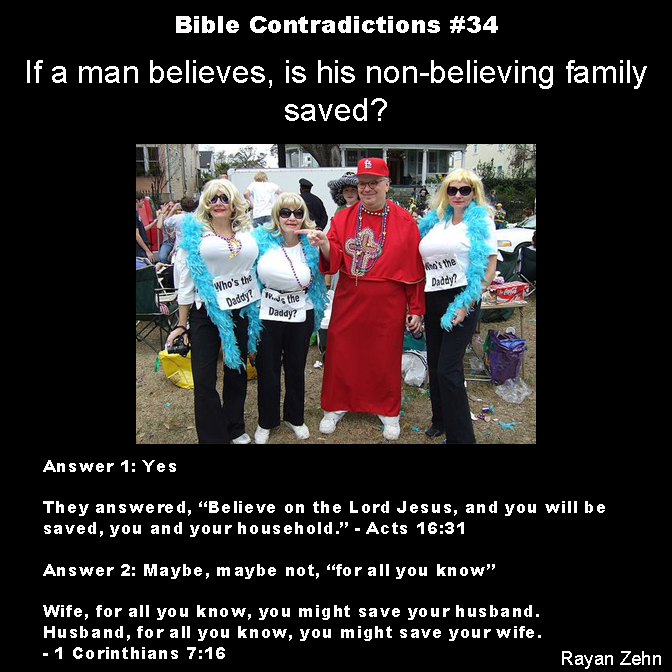
Bible Contradictions #34: If a man believes, is his non-believing family saved?

Bible contradictions 34

Both Acts 16:31 and 1 Corinthians 7:14 teach us that when Christian husbands marry atheist wives, they are saving the immortal soul of the wife. Indeed, Acts takes it a step further, alleging that his entire family will be saved. Indeed, 1 Corinthians 7, which deals with the laws of marriage, explicitly forbids the husband from divorcing his atheist wife because doing so will cause her to be damned. Interestingly, the reverse is also true. Christian wives cannot divorce their atheist husbands. See verses 12-14. Yay for gender equality??

But then merely two verses later in 1 Corinthians 7:16, the bible is less confident about its earlier claims. In the latter verse the bible essentially says, “Look, we may be wrong, but maybe we’re right.” The “for all you know” is an interesting little phrase to throw into the bible. Apply it elsewhere or anywhere (here included), and it’s basically saying “the bible might be wrong.”

So basically, reading Acts is straightforward: Christian husbands, by virtue of being Christian, save the immortal souls of their entire family (as long as they live under the same roof). 1 Corinthians says pretty much the exact same thing, but then it adds a caveat: It may be wrong “for all you know.”

This contradiction also appears in my video:

Posted in Atheism, Bible Contradictions | Tagged , , , , , , , , | Leave a comment

Bible Contradictions #33: Who were David’s sons born in Hebron?

Bible contradictions 33

This contradiction deserves a caveat: Chileab and Daniel (as a son of King David) are technically the same person. They have two different names. There is no reason for us to think that Chileab and Daniel are two different people. I am not claiming that this is a contradiction in that sense. But it’s still a contradiction in the broader sense of the word.

1 Chronicles 3 lays out for us the issue of David’s love making in Hebron in order of birth, showing that Daniel is clearly the second-born. You might remember Daniel because, following the death of Annon, his seat on the throne was stolen from him by Solomon, the much, much younger 10th son of David.

2 Samuel 3:2-5, on the other hand, changes Daniel’s name to Chileab, for reasons that are never explained. Indeed, the name Chileab is never mentioned in the bible again. There is also no reason for us to believe that Chileab is a second or variant name for Daniel. The bible doesn’t say, “Chileab, also called Daniel…” It offers no explanation for the name change.

As we could expect, it’s likely that Daniel’s name was changed throughout many years of the game of telephone. Daniel is not an important bible character, so there was little reason to protect his name (or maybe his name was originally Chileab? Eh, doesn’t matter either way). But dumbfoundedly, when the Old Testament was compiled no one bothered to cross-reference these lists of David’s sons.

It’s almost like early bible compilers didn’t care whether or not one list contradicted the other.

Posted in Atheism, Bible Contradictions | Tagged , , , , , , , , , , | 4 Comments

When Christians say we don’t believe in anything, they’re sort of right

When I defended my thesis, one of my committee members asked me, “Why do you believe hope is a more important variable than the others?” I wrote my thesis on the genesis of self-immolation. Anyway, I gave him a long-winded answer highlighting how suicide is rarely the product of a hopeful person. In short, if an altruistic individual thinks he/she can affect change without committing suicide, they will probably not commit suicide. That’s all I’m going to write about that. If you want more you can read my thesis over on ProQuest, I’m sure.

What I should have said is, “I don’t believe [blah, blah], I accept that the evidence suggests [blah, blah].”

We atheists — many of us — are skeptics. Many of us are educated, some higher than most people. We understand how observations lead to hypotheses, and how testing hypotheses can lead to theories. But our understanding of how knowledge is formed does not mean we actually believe what we are saying.

Belief is a rather firm word. It’s difficult to change beliefs. For example, I believe my car is blue. It would be difficult for me to change that belief. I would have to paint my car, which is something I don’t want to do. So my car is blue. So what? It doesn’t mean anything.

But when it comes to important matters, we don’t have beliefs. Now it’s a given that atheists don’t believe in god, but we also don’t believe in the big bang, in evolution, in germ theory, in Kepler’s laws of planetary motion, or even in the theory of gravity. We don’t believe them because we know that someday science might prove them wrong. Rather, we accept that the evidence suggests that they are true.

When Christians, or otherwise religious people, say, “atheists don’t believe in anything,” that’s sort of true. As I mentioned before, we believe in trivial things (I believe I will get drunk if I drink a lot of beer), but we don’t believe in the big things because the evidence is not perfect. But despite it not being perfect, it’s the best we have right now.

On the god matter, on the other hand, we have no reason to accept that evidence points to a divine supernatural agency. We definitely have no reason to believe in one. So the point that religious people are trying to make is true, just not in a way that is very flattering to religious belief.

Posted in Atheism | Tagged , , , , , , , , | 7 Comments

Bible Contradictions #32: Who gave the law to Moses?

Bible contradictions 32

After leaving Egypt, Moses and his gang went on a lot of wacky adventures. At some point Moses took it upon himself to try his hand at mountain climbing. When he got to the top of Mount Sinai he received the Decalogue, as well as some other words of wisdom. But from whom did he receive the law? The bible gives us two answers from which to choose.

First, in Exodus 19:20, god summons Moses to the top of the mountain. Skip to verse 20:22 and we see that god tells Moses to tell the Israelites that he received the law directly from god.

But when Paul recounted this story to the Galatians, we get a different answer. In verse 3:19 Paul says that Moses (as the “mediator”) was given the law by angels.

This is a striking contradiction because Galatians is a book of the New Testament. Paul should’ve had a copy of Exodus at his fingertips. He could’ve easily cross-referenced his own work with the Old Testament, but for whatever reason he didn’t.

Posted in Atheism, Bible Contradictions | Tagged , , , , , , , , | 1 Comment

Bible Contradictions #31: Can we eat animals?

Bible contradictions 31

This is a personal favorite of mine, but that’s probably because I’m vegan. But I’m not here to discuss the ethics of eating meat; this is an atheist-themed blog, not a blog for veganism. What makes this question so interesting is the fact that the bible can’t seem to give a definitive answer. In the image above, I purposely threw in a New Testament verse that supports not eating meat to get that whole “Jesus changed everything” trope out of the way. Let’s examine this more closely.

First, we have several bible verses that prohibit eating meat. In Genesis 1:29, god explicitly lays out what humans can eat. That is, he says humans can eat any plant “for meat.” There is no mention of animal flesh. Proverbs 23:20 warns us not to be meat eaters. And finally Romans 14:21 (y’know, the New Testament) says that eating meat will cause us to stumble. In other words, eating meat is ungodly.

Second, we have several verses that allow for the consumption of animals, but only some animals. Both Deuteronomy 14:7-8 and Leviticus 11:2-4 tell us that what kind of animals are forbidden. These verses are why Jewish people (and for some reason Muslims too) don’t eat pork. Of course, most Christians ignore these verses. This might be because they prefer to cherry pick the last set of verses.

Meat eaters delight! Here is what you’ve been waiting for! The bible says you can eat any god damned thing you want! Here goes. Genesis 9:3 is the most straightforward. Here god says that all animals, in addition to all plants, are fair game, literally. Mark 7:18-20 explicitly makes “all foods clean” because (and I’m not making this up) anything unclean we eat is made clean by pooping it out. Luke 10:8 tells us to eat anything offered to us. That necessarily means meat as well. In Acts 10:9-13 Saint Peter is commanded by god to go out and kill a bunch of birds, lizards, and some four-footed animals for food. 1 Corinthians 10:25 says to abandon your conscience when eating meat. Romans 14:2 calls vegans (I guess myself included) “weak.” And finally 1 Timothy 4:1-3 calls vegans and vegetarians “liars whose consciences are seared with a hot iron.”

So how do you choose? The bible gives us no direction. If you want to eat meat, you have a lot of biblical references to support that decision. If you don’t want to, you can pick from several verses to support that decision. Personally, I don’t eat meat strictly for ethical reasons, and my decisions do not come from bible teachings.

I have heard several attempts to reconcile these teachings (which I anticipate will be listed below in the comments). All of these include adding things to the bible that aren’t in the bible, such as a psychoanalysis of Paul. Furthermore, every attempt to reconcile these contradictory verses lies on the proposition that a favorable verse is the correct one. Vegan Christians, for example, put all of their emphasis on Romans 14:21, whereas the more carnivorous-type Christians put emphasis on Romans 14:2. They will invariably disregard the rest of the biblical teachings.

Followers of Jesus should take no dietary direction from the bible. Either eat meat or don’t, but look not to the scripture.

This contradiction was highlighted in the following video:

Posted in Atheism | Tagged , , , , , , , , , , | 31 Comments

Paul literally likens the Jews with Satan in his first epistle to the Thessalonians

The Christian persecution complex goes way, way back. Even in Paul’s day, he blamed the Jews for his difficulties in spreading Jesus’ words. We must look to 1 Thessalonians 2 to understand how frustrated Paul was. Skip to the end, beginning with verse 13. First, Paul reminds his readers that the Jews killed the son of god. And it’s these Jews who also go out of their way to stop Jesus’ teachings from reaching a wider audience. This sets up the basic premise of this letter to the Thessalonians; Paul cannot make it to them on account of the anti-Christian Jewish police force.

But worry not. As we see in verse 16, god is working on a plan to smite his chosen people once and for all. (Some crazies out there might say that this was foreshadowing for the Holocaust.)

While Paul waits for god’s wrath to fall upon the Jews, Paul laments in verse 18, ” For we wanted to come to you—certainly I, Paul, wanted to again and again—but Satan blocked our way.” But just two verses earlier Paul said it was the Jews? So which is it, the Jews or Satan who stopped Paul from reaching the gentiles? It seems to me that Paul was comparing the two. The Jew is Satan.

This is evidence of what might be called racism (they were all of the same race, so it’s not exactly racism, but we don’t have a word for this in english). In other words, Paul constructs an enemy that must be overcome. And this enemy is both Satan and the Jews at the same time.

Perhaps these verses are historically accurate. There’s no reason to not think that Jewish-gentile relations in Paul’s time were tense. They probably were. But this is no different than using race or religion as a justification to slaughter people, wage war against them, or anything else. This is pure racism, plain and simple. Paul is likening the entire Jewish population (who murdered Jesus, by the way) to the very essence of “evil.”

That doesn’t sound very Christ-like to me.

Why put stock in Paul? He’s quite the bigot.

Posted in Atheism | Tagged , , , , , , , , , , , | 1 Comment

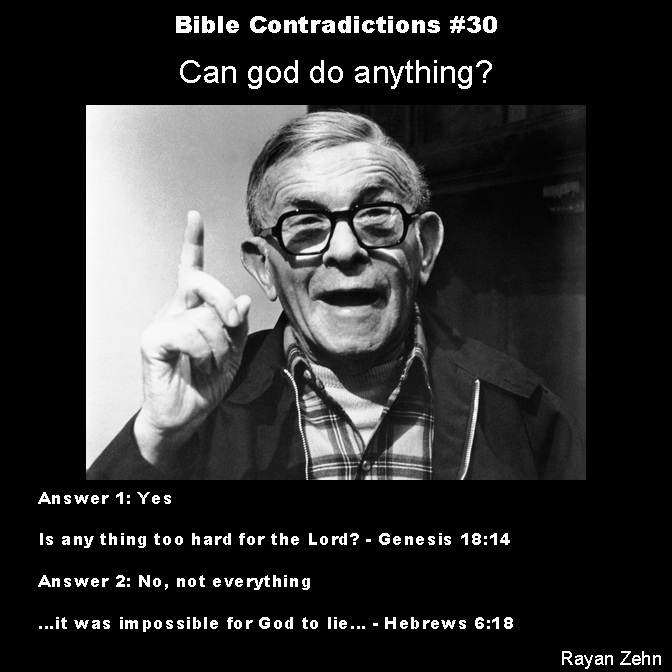
Bible Contradictions #30: Can god do anything?

Bible contradictions 30

The god that revealed himself to Abraham is literally the most complex thing imaginable, as his followers will tell you. He’s been constructed into a being that knows exactly everything you will ever do, yet still finds a way to give you free will so that you can do something that might surprise him. That’s some great power right there. Indeed, as the bible tells us, god can do anything and everything.

Except the things he can’t do. First, as shown in the image above, god cannot lie. (But that’s a contradiction too. I covered it before). Second, he can’t do mighty work, which is a pretty lame handicap for an all-powerful deity. And third, we all know the story of the iron chariots; god couldn’t defeat them. That’s a lot of stuff that god can’t do, despite the fact that he can do anything.

Of course, apologists will probably say that god can do anything; he just chooses not to. That’s pretty convenient of them.

Posted in Atheism, Bible Contradictions | Tagged , , , , , , , , , | 14 Comments