6 things about Christians I learned by living in a Muslim country

Atheists (and everyone else) in the U.S. often fail to notice Christian behavior because it’s normal, even if some of these behaviors are absurd. For example, women wearing gaudy dresses with oversized matching hats to church is quite common in the south. No one pays it any attention. But when we remove ourselves from the U.S. and spend some time living in a Muslim country, our expectations are shattered by the culture shock, and this gives us the opportunity to see Christianity in a new light.

As I’ve mentioned 100 times, I used to live in the Hamra section of Beirut, Lebanon, a cultural and intellectual paradise (where beer and booze are served from endless taps and bottles). During my stay in Lebanon I travelled the country, visiting ancient Orthodox churches in the mountains and even ancienter Mosques in the South. I ventured into Hezbollah territory south of the Litani River, all the way to Sur (Tyre), a biblical city that, according to biblical texts, should not exist at all. I spent many evenings and nights pampered by Sunni and Shia homeowners with Almaza beer, red merlots, and mujaddara, hummus, olives, and tabbouleh. And we argued over the Quran and Islam. We spoke about science and evolution. Politics. Israel. And The Beatles. During this time I discovered a wonderful culture of inclusion (even though they knew I was atheist), and it afforded me the opportunity to look at American Christians more objectively. Here’s a list of observations I made about Christians while living in a Muslim country. NOTE: Not everything on this list is a criticism of Christianity. NOTE 2: This in no way applies to all Christians or, in many cases, even most.

1. American Christians are passive-aggressive.

In Lebanon if a Muslim doesn’t agree with you he says, “I don’t agree with you,” and you both accept this and move on. But in the U.S. Christians appear to go out of their way to be nice to you, while uttering demeaning comments like, “I pray that you’ll be saved.” This comment is translated into, “You will burn in hell for eternity if you don’t accept Jesus as your savior.” As an atheist I hear it all the time. But in Lebanon no one says, “I pray you’ll come to Islam.”

Another one I hear often from a friend is, “I wish you could see the beauty of Jesus.” In other words, “I think you’re blind for not seeing what I see.”

2. American Christians are not always preoccupied with sex (unless it’s homosexuality, and then only sometimes).

One of the great tragedies in Lebanon is the sexual repression that dominates social behavior. Sex among the youth is everywhere, just not in safe places. Young lovers must resort to sex behind the bushes, in questionable hotels, and at their friend’s seedy apartment next to the university (guilty!). And if they get pregnant, it’s a guaranteed way to be condemned and kicked out of your family, maybe even arrested, the child be damned! But in the US Christians are more tolerant of premarital sex. They don’t condemn their sons and daughters for shacking up. And although we have a long way to go before homosexuality is accepted, many Christians are coming to that understanding already. I just wish the Muslims would too.

3. American Christians bring their Christianity with them everywhere.

In the U.S. we see signs of Christianity everywhere we look. From bumper stickers to jewelry, symbols of Jesus pop up at every twist and turn. Talk about scripture invades many conversations between strangers. And t-shirts quoting Matthew, Mark, Luke, and John are worn with pride. Aside from a very few select Muslims wearing religious outfits, Muslims don’t showcase their religion for all to see. In fact, in Lebanon I’ve had long conversations with people without ever learning their religion. I don’t even know the religion of most of my Lebanese friends. But in the U.S. I am well aware of my friends’ Christianity.

4. American Christians are intolerant of atheists.

We’ve all seen the stories in the news about atheist oppression in Middle Eastern and some African countries. I’m not saying that American Christians treat us that poorly. But American Christians would generally prefer me to be anything else but atheist. In Lebanon, no one cared that I don’t believe in god, even Hezbollah members.

5. American Christians have a blind love affair with Israel.

Without getting into politics, I’ve noticed that most American Christians support Israel no matter what, even without getting their “boots on the ground.” The reality in Palestine is a lot more complicated than many Christians are willing to admit. And even when Israel errs, Christians often look the other way and blame the Palestinian people. In Lebanon even the Christians understand what’s going on across the border and are highly critical of the Jewish state.

6. American Christians are not very hospitable, especially towards “others.”

Outside of metropolitan areas, many American Christians don’t care about cultural diversity. They want outsiders to conform to their cultural norms. They shun, especially in rural areas, anyone who breaks those norms. I noticed this in the U.S. but it becomes glaringly obvious when I stepped back from America and looked at it from the outside. In Lebanon everyone wanted to learn from my experiences in the States. I was once riding shotgun through the mountains with a friend. She asked if I was hungry. I was, so she stopped at a stranger’s house, knocked on the door, and said (in Arabic), “This is my friend from America. He’s hungry. Can you cook him something?” The woman invited us in, fed us, gave us wine and beer, and asked me countless questions about my travels, America, and atheism. She was genuinely interested in our differences. In the U.S. if a strange foreigner with a different religion knocks on your door asking for a traditional American meal, they might get shot. American hospitality doesn’t exist the way it does in other parts of the world.

There are countless other examples I have of the differences, and I’ll probably make a new post about those later. This post was getting kind of long, so I wanted to cut it short. Also, sorry if anyone feels this is a straw man. I’m merely writing about observations and not trying to necessarily make an argument. I welcome criticism.

Posted in Atheism | Tagged , , , , , , , , , , | 2 Comments

Bible Contradictions #40: Does god dwell in light?

Bible contradictions 40

We have this image of god in our mind, perched up in heaven on a golden throne, suspended by white fluffy clouds, light of unknown origins haloing his head. We often associate god with light. Indeed, the bible teaches us that god “dwells in unapproachable light.” But what if I told you this was the only time in the bible that it mentions god dwelling in light? And what if I told you there were far more verses claiming that god actually dwells in darkness? Well, here you go.

First, in 1 Kings 8:12 Solomon claims that god dwells in darkness. This verse is copied verbatim in 2 Chronicles 6:1. Next, Psalm 18:11 shows us how god made it dark. Apparently he used clouds and water. Couldn’t he have just turned off the light? Anyway. Finally, Psalm 97:2 tells us that god is surrounded by darkness and clouds.

In other words (if you’re one of those people who use the bible as evidence to prove the bible), we have more reason to suspect that god is a brooding god, dwelling in solitary darkness, his hair unkempt as he listens to Joy Division and cuts himself.

Posted in Atheism, Bible Contradictions | Tagged , , , , , , , , , | 6 Comments

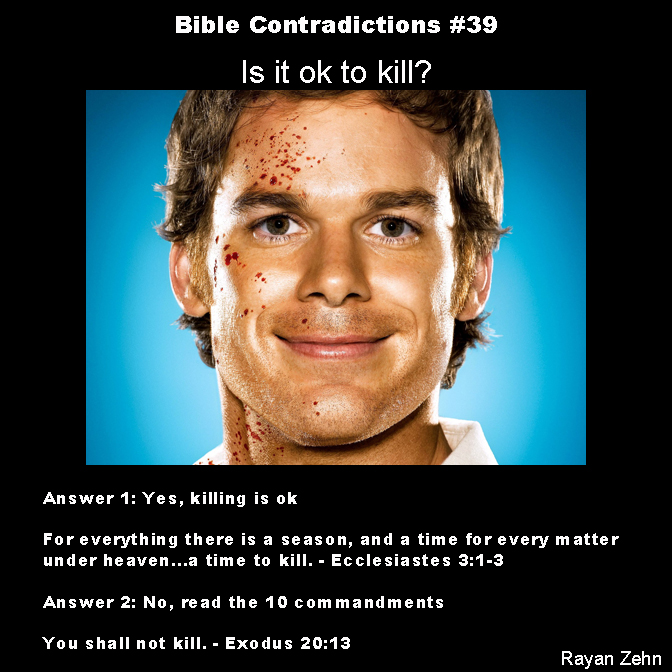
Bible Contradictions #39: Is it ok to kill?

Bible contradictions 39

The Byrds’ 1965 classic “Turn! Turn! Turn!” captured well the biblical narrative that killing is sanctioned by god. Here, go ahead and play the song while reading this post.

The song quotes Ecclesiastes chapter 3, which states — paraphrased — that everything has its time, and murder is no exception. The verses in question can be found here. But the bible doesn’t stop there. It’s chock full of offending quotes sanctifying killing (and I’m not even counting all the verses where god is culprit). Kill witches (only the female kind). Kill your brother, friend, and neighbor. Execute sabbath breakers. Murder innocent babies, women, and animals. To be fair, all of these links take you to the Old Testament. But let’s not get confused about this. Jesus had no problems with OT cruelty. Furthermore, in the NT Jesus condemns parents for not killing their misbehaving children. So this approval of killing is pervasive throughout the bible; it’s not limited to the OT.

But the bible contradicts these verses several times. First, the ten commandments clearly say not to kill (here and here). Mark repeats these words. So does Luke. In Matthew Jesus confirms the prohibition against killing.

If you look to the bible for guidance when deciding whether or not to kill someone, you have a 50/50 shot of ruining your life and spending the rest of it behind bars. Don’t take that chance. If you ever get the urge to kill someone, don’t do it. This is one of those “sins” that’s easy. You don’t need the bible to tell you it’s wrong. But if you use the bible, it might make you think murder is ok.

Posted in Atheism, Bible Contradictions | Tagged , , , , , , , , , , | 1 Comment

Bible Contradictions #38: Does god work on the sabbath?

Bible contradictions 38

When people say that Jesus got rid of the old laws or changed them, what they are saying is that Jesus contradicted his father (or himself). That’s what we have here. In the Old Testament god rested on the sabbath, and, indeed, anyone caught working on the sabbath was executed. That’s how seriously primitive people took this rule.

But when Jesus comes around and gets caught working on the sabbath, he’s like, “chill out, bro. Even my dad works on the sabbath,” thus contradicting Genesis.

What’s interesting about this contradiction is that this is precisely the reason why Christians work on the sabbath today. In other words, they live by this contradiction (except the Jehovah’s Witnesses and a few other small cultish sects). It’s incredibly easy to break one of the ten commandments when Jesus says it’s ok.

(Note: I borrowed the comic in the image above from Jared MacPhee. His website can be found here).

Posted in Atheism, Bible Contradictions | Tagged , , , , , , , , , | 7 Comments

“Dark Girls” documentary: God plays no role in skin color

DARK-GIRLS-MOVIELast night I watched the documentary Dark Girls, a fantastic narrative of how dark-skinned black women feel ostracized from within the black community for being too dark and pressure to unnaturally lighten their skin. It’s a wonderful piece — with absolutely nothing to do with religion or atheism — that I recommend everyone watch (personally, I don’t care if you’re as white as a ghost or as black as coal; I think all skin tones are beautiful). If you have Netflix stream away. It’s short, only 71 minutes.

During the film there was an interview with a young woman, perhaps no older than sixteen. A dark-skinned girl who would surely grow to be a stunning example of black beauty, she had already embraced her skin tone and thought of it as a strength instead of a weakness. Kudos to her! But at the end of the interview she said something that struck me. I forget the exact words, but it was something like, thank god for giving me dark skin!

I must take her to task for this statement because it dismisses two very, very obvious realities: genetics and social constructions.

First, skin color is largely, although not solely, a product of genetics. Two dark-skinned parents are likely to produce a dark-skinned child. Mutations and recessive genes (i.e. still genetic) might account for the birth of a light-skinned child. Other factors might include the environment. Growing up in a sunny area might lead to darker pigments, for example. This has nothing to do with god, but instead to do with the colors of the skin of the parents.

Unfortunately, some Christians might point to the “curse of Cain.” Two to three hundred years ago biblical scholars argued that the curse was dark skin. That is, blackness is a curse and therefore absolutely the product of god’s will. That’s a fairly racist statement that, again unfortunately, is still accepted by some fundamentalist Christians. Why would a young girl thank god for a curse?

Second, our perceptions of skin color are not real. They are made up, invented, or, to use the correct term, socially constructed. There are no actual differences within the spectrum of skin tone. There are no actual differences between a dark-skinned black person and a light-skinned black person. We should take that further by saying there are no actual differences between a white person and a black person (or any of the other five inventions of race). Any differences are socially constructed, most likely, as argued in the documentary, to appeal to whiteness.

If the girl in the documentary embraces her dark skin, then good for her! But I would not chalk her color up to divine will. It’s her parents’ genes that account for her blackness. And she should be thanking herself instead; she’s the one with the strength to ignore damaging social constructions and see her true beauty instead.

Posted in Atheism | Tagged , , , , , , | 3 Comments

Quran Contradictions #5: Is slavery ok?

quran contradictions 5

The Christian bible makes no qualms about slavery. It condones it at every twist and turn, even condoning returning runaway slaves to their brutal masters. But the Quran is a little less certain about the morality of slavery.

In Surat Al-Baqarah verse 2:178, Allah appears to condone slavery, at least in regards to how legal code is interpreted. The Quran makes no attempts to condemn slavery in this passage, which is in keeping with the other branches of Abrahamic religion.

But if one skims backwards one verse, they would find that the Quran explicitly calls people who free slaves righteous.

At least in the case of that verse, the Quran exhibits more morality than the bible.

Posted in Atheism, Quran Contradictions | Tagged , , , , , , , , , , | 3 Comments

Quran Contradictions #4: Is alcohol ok?

quran contradictions 4

When I lived in Beirut I was surrounded by booze. From the nightclubs in Gemmayze to the pubs in Hamra, alcohol was a part of a balanced breakfast (quite literally). Although not technically legal to drink on the streets, the police never even bothered us for getting trashed on the street corners. So pervasive was the act of getting drunk that anise permeated the air after sundown (anise is a main ingredient in arak, a Levantine spirit boasting about 60% alcohol). And all this in a Middle Eastern country with a population of about 66% Muslims (split roughly equal between Shia and Sunni).

So why is it that the Lebanese people drink so excessively? To illustrate this point, my Algerian roommate says there is a joke in Algeria about the Lebanese. Muslims always thank Allah for the food they have before they eat a meal. The Lebanese thank Allah for the booze! The reason might have something to do with the contradictory verses in the Quran about the consumption of alcohol.

First, in Surat Al-Baqarah verse 2:219, the Quran likens alcohol consumption to gambling: they are both sinful because (as you can see in the complete verse linked) people go overboard. They drink too much and gamble too much. I’ll cede their point here. Gambling too much is a good way to lose your house. Drinking too much has other dangers (health, safety, etc).

But next we see in An-Nahl verse 16:67 that — at least — some alcohol is good because it helps you reason! That is, the verse basically says that wine is good for you. It doesn’t mention liquor or beer; however, those might also be implied because they have the same “intoxicant” effect as wine.

So there you have it. The Quran is confused about alcohol. And because of that confusion, leave it to the Lebanese to pick and choose which verse they will follow. Kesak! Bottoms up!

Posted in Atheism, Quran Contradictions | Tagged , , , , , , , , , , | 5 Comments

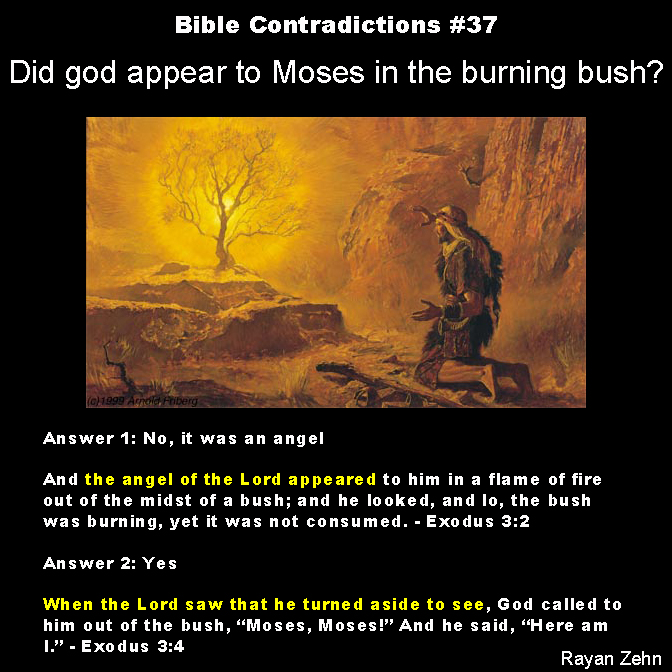
Bible Contradictions #37: Did god appear to Moses in the burning bush?

Bible contradictions 37

Everyone knows the story about when Moses ate some psychedelic mushrooms and saw god in a burning bush (or something like that). But not everyone knows that the bible is confused about whether or not it was god or an angel in the bush. (Don’t worry. It’s just a fantasy tale).

First in Exodus 3:2 the bible is quite clear. It was an angel in the bush. This is reinforced by Acts 7:35, which states that god sent an angel down to deliver a message. Apparently god was too busy to do his own dirty work, so he set a pyromaniacal angel to earth and told him to hide in a bush.

But then we look at Exodus 3:4 and see that the angel suddenly disappears and is replaced by god, who delivers the message to Moses. Of course, this is not explained in the bible. In one sentence Moses is looking at an angel, receiving a divine message, and in the next the angel is inexplicably absent, god in its stead, message in hand. This is supported by Mark 12:26.

In other words, in merely two verses the bible gets confused, saying it was both an “angel of the Lord” and god himself. And both verses have supporting verses found in the New Testament. The NT didn’t even catch this contradiction and try to fix it. It merely repeated the mistake.

Posted in Atheism, Bible Contradictions | Tagged , , , , , , , , , | 1 Comment

When god is not there: Faith and prayer are meaningless in the face of tragedy

I’ve been absent from the Atheist Papers for a little over two weeks, my longest stretch without making a post yet. Without getting into too many personal details, I’ll sum up the story like this: On 30 May 2014 my family and I suffered a tragedy of such great proportions that we might be correct to label it as a PTSD-inducing event. Actually, it’s better defined as TSD, because the tragic event is still occurring, and it will for at least two more weeks. Thus far, there is no post-trauma; it’s straight up trauma. I’m withholding almost all the details because the person who did this to us did so out of misguided anger. And I forgive them because they don’t understand sufficiently how damaging their actions can be. Also at some point there will be a lawsuit, so I think it would be inappropriate to get into the details before we’ve even been able to go to trial. Thanks for not asking questions about what is happening. Anyway, moving on.

Throughout this ordeal I’ve heard many prayers and insistence that god has a reason for either A) letting all of this happen to us or B) making all of this happen to us. That’s right. I met with a pastor after he insisted (he didn’t know I’m atheist, but I told him, and he was polite enough not to try to convert me). He said, “God is testing you.” In other words, he believes that god forced another person by ending their free will to traumatize me and my family in order to test our faith. Oh right, Job. I forgot. The pastor actually believes that god had a hand in making my family suffer.

Family members and friends have turned to prayer to help us through this. I’m here to tell you all that prayer is meaningless right now. (It’s actually always meaningless). Right now my family and I need two things: 1) tangible items that show people care, even something as small as a fruit basket or as big as a meal at a fancy restaurant. And 2) a shoulder to lean on. Praying to an invisible unknowable god does absolutely nothing to help me, my family, or a few friends who’ve been impacted by this. When someone says “I’ll pray you’ll get through this,” I want to smack them in the face and say, “So help us get through it!” Prayer doesn’t help at all.

My mother is fairly devout in her faith in Jesus. She believes her faith in god will not only guide her through this, but that it will actually make the traumatic event magically disappear, as if it never happened. I’ve called her out as well. Do something about it, don’t pray! Nothing gets fixed if all we do is talk to ourselves about it.

What this has shown me is that most people (those with faith) are largely unwilling to lend a hand when we need it most. Instead they believe that prayer and faith in the lord will mend us our broken hearts. But the cold, hard, and brutal truth is that when tragedy strikes, it doesn’t matter how much faith you have or how much you pray; nothing will make things better for you without getting your hands dirty. It takes hard work, not religion.

Posted in Atheism | Tagged , , , , , , , | 11 Comments

Church in Norfolk has no idea how Facebook works

The other day I was at the grocery store loading my trunk with cheap beer, where I was accosted by an evangelical Christian, which, although extremely annoying, is expected and trivial. Unfortunately public Christian proselytization is not only common, it’s also socially acceptable. For whatever reason when people take one look at me they immediately (and accurately) predict that I’m a musician. That’s where this all began. “Hey, man, you’re a musician, right? Awesome! Hey, we’re having a jam session tonight at our church and afterwards we’re gonna have a conversation with Jesus. You should come along and bring a guitar!” Now, I want you all to know that I don’t engage Christians on the street. I don’t mention anything religious or anti-religious. I merely take their literature, thank them, and, in this case, offer a vague response that does not in any way indicate my willingness to attend his shindig. I handed the flyer to my girlfriend and got in my car. She read it, handed it back to me and laughed. Then I noticed what was wrong with it. Here’s a picture of the flyer. Even though this flyer reveals my current city of residence (a temporary stay, mind you), I have left it unaltered, not even cropping out the church’s website.

church friends2

The Potter’s House Christian Fellowship of Norfolk makes an incredibly absurd claim about Facebook friends. That is: How many people do they think have 3,073 friends on Facebook?!! According to the Pew Research Center (released 2014) 85% of all Facebook users have fewer than 500 friends. Most have fewer than 100, nowhere near 3,073. Furthermore, why 3,073? It’s a rather specific number. I can’t think of any biblical significance for the number.

Ok, so the Potter’s House seems to believe enough of us have an incredibly large number of Facebook friends to justify making an entire flyer purporting that. But then it goes on to say something even more ridiculous. I’ll quote it, even though you can skim back up and read it yourself in the image. “3,073 Friends on Facebook and nobody to talk to!” Later, after quoting a boring verse from the Amplified Bible, it adds “Get a real Life” (arbitrary capitalization of “Life” is theirs). All this, flanked by a stock image of an incredibly annoyed woman. This is quite absurd.

Facebook has a zero tolerance for adding friends you don’t know. A quick google search reveals that this practice has led to terminated or frozen Facebook accounts. Indeed, a fellow musician friend of mine had her account suspended when she tried to network with other musicians by adding them without ever meeting them. In order to amass 3,073 Facebook friends you have to go out, personally network with a sufficiently large number of people, and convince them to add you as a friend. In other words, having 3,073 friends on Facebook precisely means that you have “a real life” and people “to talk to.”

Also there’s this: “Aren’t you tired of browsing social networks online and gazing at other people’s lives? Find a meaningful life of your own. Discover destiny.” Sure, but anyone who wants to get out of the house more can do so without attending a church. There are bars, libraries, the aforementioned grocery stores, reading clubs, golf courses, nightclubs, bowling alleys, and a plethora of other places to go to have a meaningful life. Church is not a necessary variable.

The Potter’s House Christian Fellowship of Norfolk is out of touch with reality. The spirit of their message is asking people to step away from their computers, go out, and meet new people and form real friendships and create new and real experiences. The message itself is admirable and good. But the method of delivery is laughable because it completely gets wrong our social media experiences and makes foolish assumptions about our ability to physically interact with fellow human beings.

Potter’s House, what the hell?!

Posted in Atheism | Tagged , , , , , , , , , | 7 Comments