Bible Absurdities: Solomon needs massive workforce to build tiny church

Solomon was one of those rich eccentric fellows. Although he murdered almost as many people as god during his tenure on this earth, he also liked to give back, by building tiny churches.

1 Kings 6:2 gives us the measurements of his temple: 60 cubits long (one cubit is 1.5 feet, so that makes this 90 feet long), 20 cubits (30 feet) wide, and 30 cubits (45 feet) tall. As far as churches go, it seems kind of small, especially given Solomon’s wealth. He could have afforded to build the first mega church. To put its size in perspective, in baseball the plates are 90 feet apart. The length of the church was merely the length of running to first base.

In 2 Chronicles 2:1-2 we are shown the size of the workforce Solomon employed to build this church. He “assigned 70,000 men to carry loads and 80,000 men to quarry stone in the mountains and 3,600 to supervise them.” That’s 153,600 men just to build a church. I’m not saying it’s easy for iron age men to carve stones out of mountains, but 153,600 men seems massively absurd. That’s about the total population of Springfield, Massachusetts! Imagine if everyone in Springfield suddenly quit their jobs to build a church that could only seat–at best–a few hundred.

Solomon’s temple was sacked a few hundred years later. It was so utterly destroyed that not a trace of it has been seen since, even though archeologists have searched and searched and searched.

Posted in Atheism | Tagged , , , , , , , , , | Leave a comment

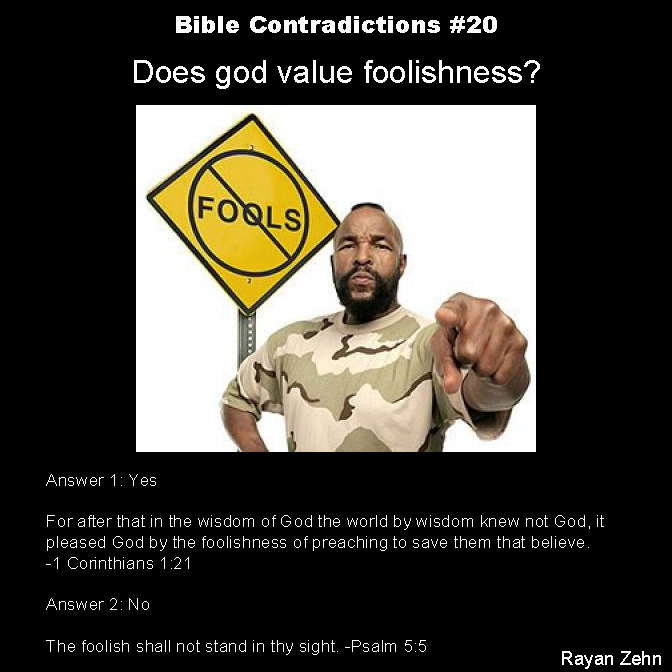
Bible Contradictions #20: Does god value foolishness?

Bible contradictions 20

Paul’s first letter to Corinth was a rave review of how awesome it is to be a fool. We have three different verses in which Paul insists that god really likes foolish people. 1 Corinthians 1:21 (god loves preaching fools), 1 Corinthians 3:18 (in order to be wise, you have to become a fool), and 1 Corinthians 4:10 (religious idiots are wise in Christ). The last one seems to support the idea that science and Christianity are incompatible: “We are fools for Christ’s sake, but ye are wise in Christ.”

That’s how Paul feels about foolishness. What about god? Psalm 5:5 has the answer to that: Foolish people will not stand before god. Paul also wrote a letter to the Ephesians in which he says don’t walk like an idiot. Walk like a wise guy!Ephesians 5:15 (paraphrased).

This contradiction might be explained by the idea that Paul really was a wise guy. That is, some people insist that Paul liked to use sarcasm in his writing. Essentially, he was being a jerk in his letter to the Corinthians. If that’s the case, why include his letter in the Epistles? The average reader (pretty much 100% of them) won’t be able to tell the difference between serious matters (what the bible is supposed to be) and sarcastic humor. It also casts doubt on the seriousness of the rest of his letters. For example, in 1 Corinthians 4:16, Paul calls on the people of Corinth to join a new cult that he was forming. Sarcasm or seriousness? With Paul you can never tell the difference.

Posted in Atheism, Bible Contradictions | Tagged , , , , , , , , , , , , | 1 Comment

Bible Absurdities: The biblical demonic pandemic

Call me a skeptic, but I don’t believe in demonic possession. There is absolutely zero empirical evidence of any kind to support the hypothesis that demons exist and sometimes set up shop in your lower intestines. Yet we see time and time again stories of Jesus casting out demons from sick people.

This post may be more of a jab at Christianity than it is at the bible. That’s because to this day we still find Christians who claim that demonic possession is real. Recently there was even a story in the news about a catholic priest who claims that demonic possession is 100% fact.

Let me set the record straight. Because there is zero evidence to corroborate the demonic possession hypothesis, we are left with two non-mutually exclusive theories to explain claims of demonic possession:

  1. The “victim” of demonic possession suffers from some kind of severe mental or neurological disorder.
  2. The “victim” of demonic possession merely wishes to mitigate the seriousness of crimes they’ve committed by claiming to have committed those crimes because satan made them do it.

There is no divine theory in academia that can explain “demonic possession.”

So why is it so prevalent in discussion? It’s because the bible shows Jesus walking around in a world quite literally littered with people who had demons living inside of them. Let’s take a look at the gospels.

Matthew 8:28-34 tells the story of Jesus coming across two thugs hanging out in a grave yard. They used physical violence to make sure no one could enter the tombs. They saw Jesus and were like “Naaww he di’n’t! It ain’t the apocalypse yet! You can’t touch us!” Then for some reason demons came out of their bodies and begged Jesus to trap them in pigs. Jesus was like “word” and cast them into the pigs. Then, for reasons unknown, the pigs promptly committed suicide, and the thugs ran away.

Then in Mark 5:1-17 we have the story of a man suffering from rabies and PCP overdose or something. He became so violent that he was bound by chains, but broke them and started howling and hitting himself with rocks. Then he saw Jesus, ran up to him, and reminded him that he could not be judged until the book of Revelation. Jesus once again casted the man’s demons into pigs, who then committed suicide.

Demonic possession also appears in Mark 1:23-26, Mark 1:32-34, Mark 1:39Matthew 12:43-45, James 4:7, and tons of other places (including the Old Testament). Especially in Jesus’ world, it seems that every other person has a demon living inside them.

This might explain why, even today, some Christians are quick to blame strange behavior on demons. In extreme cases, not only is demonic possession blamed for murders, but people believed to be possessed by demons might be murdered themselves. And as we’ve seen in the news quite often lately, some people suspected of demonic possession die during their exorcisms. In less extreme cases, blaming something on demonic possession is ignoring the true root of a problem. Going back to the two theories to explain claims of demonic possession, we can make some recommendations.

  1. The claimant might have mental illness or neurological problems, which can be treated by medication, therapy, surgery, or other proven methods. An exorcism will do nothing to help the underlying problem, and it may be dangerous.
  2. The claimant might be trying to justify their behavior. For example, a murderer might claim that he wasn’t responsible for his actions because he was possessed by demons. Indeed, this has happened. Simple education goes a long way here. Teaching criminals to take responsibility for their actions and not blame it on the devil might reduce recidivism.

The point is the bible was written during a time when people had few resources to explain natural phenomena. Simple illnesses were blamed on devils. Today we know that cancer has no demonic explanations. But for some reason, there are many Christians out there who have retained these millennia-old hypotheses, and when things get really bad, they whip them out like they’re full-fledged theories and call it a day. Here it would be much more healthy to find the true causes of life’s problems.

Posted in Atheism | Tagged , , , , , , , , , | Leave a comment

Bible Absurdities: Very awkward conversation Moses MUST have had with god

Most people know the story of Moses. He was a Jew, kidnapped by the Pharaoh and raised a royal, decided he liked gefilte fish more than those grapes you always see pharaohs eating, sat idly by while god committed mass infanticide along gender lines, and then ate some mushrooms on top of a mountain and found some “magic rocks” (or something like that).

It’s this last part that piques the interest. According to Jewish rabbinical tradition, the Torah (the first five books of the bible) were recited to Moses on Mount Sinai and at the Tabernacle. Moses wrote down the entire Torah. But if you read the Torah, you find out that Moses dies at the end without ever entering the promised land!

So basically, Moses knew that he would die after committing tons of selfless acts in Exodus, and that he was given no promise of eternal reward. Before the Jesus myth, there was no concept of salvation or life after death. To this day most religious Jews do not believe in the concept of heaven. Anyway, I’m assuming Moses must’ve paused for a moment when he got to the story of his death in Deuteronomy. I imagine it went something like this:

God: “And Moses was one hundred and twenty years old when he died…”

Moses: “Wait a minute god. You mean to tell me that I’m doing all this hard work without getting anything in return?”

G: “Why yes, my son. Oh and you will spend 40 years wandering in the desert before you die.”

M: “So you’re sending me on a death march?”

G: “Yup.”

…awkward silence…

G: “Don’t worry, my son. You get the best gift of all, a sense of accomplishment. Oh! And in thousands of years little children will learn about your story by playing a Nintendo game!”

…more awkward silence…

I’m sure Moses had a few choice words with god after this revelation.

So god totally used Moses for his own amusement and then even admitted to Moses that Moses would die without tasting the fruits of his labor. This again raises the question: Why didn’t god just zap all the Jews out of Egypt and into the promised land? But I digress.

This view is not the monopoly of the Jewish faith either. Many Christian groups view Moses as the author of the Torah. I once spent a couple years hanging out at a Kingdom Hall (I wasn’t religious, but going to the services was the only way my childhood girlfriend’s mom would let me see my girlfriend on Sundays). They teach the same thing: Moses was a prolific penner! But they never noticed: The author of a large part of their most sacred book was forced to accurately predict his own death. Indeed, the first verse in Deuteronomy seems to justify this belief: “These are the words which Moses spoke unto all Israel on this side of the Jordan in the wilderness…”

This leaves three possibilities:

  1. God is completely insane and subjected Moses to cruel amounts of stress, with knowledge about his own death, much like a victim on death row,
  2. The bible is wrong (Moses did not write the Torah), which leaves the question, who wrote it?, or
  3. The whole story is BS.

My money’s on #3.

Posted in Atheism | Tagged , , , , , , , , , , , , | 1 Comment

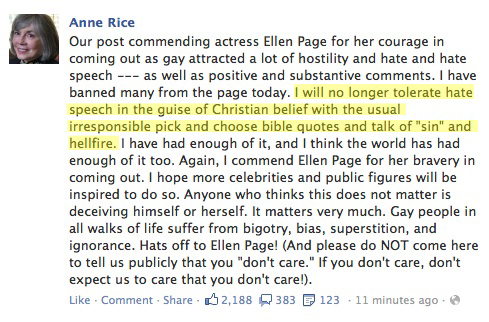
Anne Rice calls out Christian bigotry on her Facebook page

I saw this today on Anne Rice’s Facebook page.

anne rice - gay marriage

I don’t read fiction that often (except for religious books), but I think Anne Rice is beautiful.

Posted in Atheism | Tagged , , , , , , , , , , , | Leave a comment

Husband beats wife to death, plays recording of Quran in the background

Because I used to live in Beirut, I tend to keep up with the news coming out of Lebanon. Last week I came across this article about a man in the Beirut neighborhood of Al-Tariq al-Jadideh who beat his wife to death. Her name was Manal Assi. At first glance this article appears to be nothing out of the ordinary. Men beat their wives to death all the time all over the world. It hardly qualifies as internationally important news. But then there’s a sentence in the article that made me pause.

From the woman’s young daughter about what happened:

He had a recording of the Quran being read aloud when my grandmother and aunt got to the house.

The article implies that he was still attacking her when the relatives showed up. Playing the Quran while beating his wife does not mean that he killed her because of his religion, but it does not shut that possibility out either.

Perhaps he did kill his wife because of the teachings of Islam. For example, the Quran states that beating your wife is allowed.

But those [wives] from whom you fear arrogance – [first] advise them; [then if they persist], forsake them in bed; and [finally], strike them. But if they obey you [once more], seek no means against them. Indeed, Allah is ever Exalted and Grand. -Quran 4:34.

And then there’s this:

The Prophet (peace be upon him) said: A man will not be asked as to why he beat his wife. -Abu Dawud 11:2142.

This Hadith gives blanket immunity to Muslim men to beat their wives without any punishment.

And the the Quran explicitly says it’s ok to murder your wife if she is lewd.

Those who commit unlawful sexual intercourse of your women – bring against them four [witnesses] from among you. And if they testify, confine the guilty women to houses until death takes them or Allah ordains for them [another] way. -Quran 4:15.

Even Muhammad beat his prepubescent wife, Aisha, as shown in this Hadith:

He struck me on the chest which caused me pain. -Sahih Muslim Book 004, Hadith Number 2127

Finally, there’s this Hadith, which tells the story of a husband who beat his wife so badly that her skin turned greener than her green veil.

Rifa’a divorced his wife whereupon ‘AbdurRahman bin Az-Zubair Al-Qurazi married her. ‘Aisha said that the lady (came), wearing a green veil (and complained to her (Aisha) of her husband and showed her a green spot on her skin caused by beating). It was the habit of ladies to support each other, so when Allah’s Apostle came, ‘Aisha said, “I have not seen any woman suffering as much as the believing women. Look! Her skin is greener than her clothes!” -Sahih Bukhari, Volume 7, Book 72, Number 715.

While we cannot definitively say that the husband in Beirut beat his wife to death because Islam teaches men that it’s ok to beat their wives, we can say that Islam teaches men that it’s ok to beat their wives!

While there are many stories of domestic violence, rape, and murder of women and children in the Christian bible, Islam seems to bring it to a frightening level. It’s because of these teachings that women in many parts of the world are subjugated–sometimes daily–to some of the most inhumane treatments imaginable.

Posted in Atheism | Tagged , , , , , , , , , , , , , | 3 Comments

Atheists and the indefinite article: Maybe we should drop the ‘an’

The indefinite article is used to show that there is something else available. For example, we might say, “I am a male,” as opposed to “female.” We could also say “I am male,” dropping the indefinite article. Both are correct, but one is categorical, and the other is descriptive.

I also subscribe to a vegan lifestyle. When I describe myself I could either say, “I’m a vegan,” or drop the article altogether and say, “I’m vegan.” Both are perfectly acceptable, per our grammar rules. But one denotes something that the other doesn’t. And we can apply this to atheism as well.

By saying, “I’m an atheist,” we are categorizing ourselves, saying that there are other groups out there, but we are a part of this group. We belong to the atheist group. The indefinite article creates an “us vs. them” idea. There is no real atheist group or community. We atheists are alike only in one very finite aspect of our lives. Many of us feel no special connection to other atheists solely because they are atheists.

If we say, on the other hand, “I’m atheist,” and omit the article, then it is merely a description. “Hi, I’m Rayan. I’m vegan. I’m bearded. I’m white. And I’m atheist.” This sounds better to me because it only provides a description of me.

This is not to say that people won’t imagine categories when we say, “I’m atheist.” They probably will. And some may even say in their heads, “Oh, he’s an atheist, one of them!” as if we really were a group. That just comes with the territory. Many people will judge us the same based on uttering either statement until such a time that religion truly doesn’t matter. But for now, implying that we are part of this group or that group instead of merely describing ourselves might be perpetuating the negative stereotypes against people who have no belief in god.

It should be noted, on the other hand, that this idea just now popped into my head. I created a quick opinion on the matter. It’s subject to change. And to be fair to everyone, I might not even know what I’m talking about on this one because I might not have thought this all the way through. Feel free to ridicule this idea, offer alternatives, support it, or anything else you may feel the urge to do.

Posted in Atheism | Tagged , , , , , | 1 Comment

An atheist in Beirut: The beauty of Islamic music

I’ve mentioned before that I used to live in Beirut. I lived in Hamra, in an awful apartment called Residence Haddad, off of Makdessi Street. My room was on the second floor, and I learned to drown out the roar of the streets below. I usually slept through much of the day, awake for most of the night.

Religion was often the topic of conversation in a neighborhood that prided itself on its secularity. I was always quite blunt about the fact that I don’t believe in god. To my (initial) surprise, the Lebanese people couldn’t care less whether or not I was a believer. In fact, the few people who cared about my religious affiliation were atheists who were happy to make fun of Christianity and Islam with me.

Lebanon is about 1/3 Christian, 1/3 Sunni, and 1/3 Shia. The country has been plagued by sectarian violence for generations and generations. Evils in the name of Christ and Allah have found a sacred home in this Middle Eastern Mediterranean state. The shatters of religious difference fought a 15 year civil war, the effects of which can still be seen and felt. Drive to any neighborhood in Beirut, and you’ll still see bullet holes in the facades of skyscrapers.

Not only am I atheist, but in general I’m an anti-theist. That is, I’m against religion.

Yet, because I slept through the day, I was subjected to an alarm clock five times a day. The Muslim call to prayer (Adhan) is a public address that everyone can hear. You’ve heard it before, even if you’ve never been to the Middle East. Maybe you’ve heard it on TV.

The speakers that played this music were literally right outside my window. There was no escaping its decibels. They woke me up every time. But it was not a bad thing. I grew to love the music, eventually, despite it symbolizing faith in a very dangerous religion.

Despite all the dangers of Islam, I think we can agree that it is responsible for making some very beautiful music. This is actually quite true for all religions. Religion seems to have at one time held a monopoly on beautiful music, from black gospel and soul music to Irish folk hymns, I think even many anti-theists can agree that religion was responsible for one good thing. On the other hand, thankfully religion no longer holds such a monopoly. In the West, at least, blues and rock music of the ’40s and ’50s largely secularized all future vocal incarnations of the pentatonic scale.

Posted in Atheism | Tagged , , , , , , , , , , | 3 Comments

The alternate god: Why can’t religious people worship the god they wish existed?

A few months ago I conducted a totally legit scientific poll* of my Facebook friends. I asked a simple question to my friends of faith: “Let’s assume that god exists, but he exists in a different form from what you believe. What do you think this means for your afterlife if you are wrong about which religion is true?”

*I might stretch the truth a little here.

I left the question open for interpretation, hoping to get answers from people of all faiths. I don’t have many Hindu friends, so I received no answers from them. All of the answers came from Christians and Muslims. I won’t post all of the answers, but here’s one that sums up the general consensus amongst all of those who responded to my question:

answer to poll

This answer is interesting because of what it omits: punishment. Christianity and Islam both promise eternal hellfire for not believing. Yet when I asked my question, both Christians and Muslims alike threw punishment out the window and focused instead on god’s compassion toward people, their works, and their hearts.

In other words, the people who responded to my question saw their alternate vision of god as a being who is nothing like their religions’ descriptions. They saw a god of truly unconditional love, unconditional forgiveness–a god not plagued by petty human emotions such as greed, jealousy, and anger. They saw a god who would welcome them to the afterlife with opened arms, even if they rejected his teachings. Everyone agreed that if they are wrong god will forgive them.

So that leaves the question: Why can’t they give up their religions and worship that god instead?

Posted in Atheism | Tagged , , , , , , , , , | Leave a comment

Don’t like your circumcision? Sin. It’ll grow back (according to the Apostle Paul)

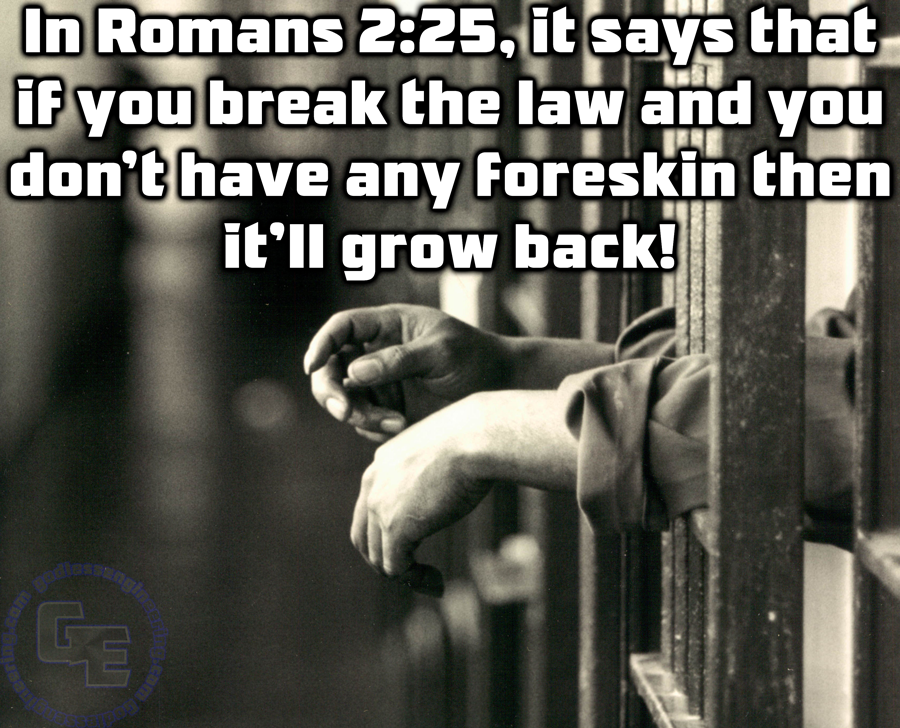
On Facebook I follow a page called Godless Engineer. Said “Godless Engineer” often posts humorous criticisms of religion. A few days ago they posted the following image:

1779669_469659266489347_2026432690_n


Of course, knowing me, I looked it up. And it’s there. The Apostle Paul writes, “For circumcision verily profiteth, if thou keep the law: but if thou be a breaker of the law, thy circumcision is made uncircumcision.” –Romans 2:25. This is one of the most absurd things in the bible, so I did some digging.

This verse has been interpreted to mean that being a Jewish man alone isn’t enough. Being circumcised is merely a ritual. Getting to heaven requires righteousness. On the other hand, being righteous alone is not enough; as Romans 4:11 shows us, a righteous man must also cut the tip of his junk off. But that’s just an interpretation. If this interpretation is correct then the people who wrote the bible went out of their way to throw absurdities into it. Couldn’t they just say, “Circumcision is not enough” and be done with it? Why the imagery of the foreskin growing back, Paul?!

Bible literalists have not the benefit of interpretation. The bible literally says that if you are circumcised and break god’s law, then you will no longer be circumcised. Your foreskin will grow back. Unfortunately for Paul, there is no mention of this phenomenon in the medical literature.

Posted in Atheism | Tagged , , , , , , , , , , | 5 Comments