Why the Atheist Papers is more honest than the bible

This website is not meant to be taken seriously. I’m no authority. No philosophical matters pertaining to theism or atheism should ever be taken seriously by anyone for any reason. They are, by definition, non-starters, and there are no authorities over matters of the supernatural because, by definition, supernaturalism cannot be observed. Without observation, there is no study to form authorities. But shortly after I started this website an associate professor of physics and noted bible critic linked this website to his bible criticism page as a legitimate resource in the debate. I was flattered, but I don’t think that’s a fair evaluation of my website. Despite this, it got me thinking: Well, at least my website is more intellectually honest than the bible.

First, I turn your attention to the Pauline epistles. These are thirteen canonical books in the bible, allegedly written by Paul. But these aren’t biblical books at all; they are merely the personal correspondence of one or several evangelical Christians to spread Christianity. Let me reiterate this. These are claimed to be the inspired words of god, but in reality they are little more than primitive letters to the editor. But for reasons unexplained, early Christians decided personal opinionated correspondence was of equal legitimacy as the pentateuch. That would be like me saying my personal e-mails are just as valid in science as my thesis. This is not intellectually honest.

On the Atheist Papers, I would never say, “My friend sent me an e-mail agreeing with me, and that proves my hypothesis!”

Second, the bible is chock full of leading-question-type statements that force you to come to a single conclusion — no room for discussion or debate. On the Atheist Papers — and indeed everywhere in my daily life — I go out of my way to use phrases such as “this might suggest…” blah blah. In other words, I never claim a monopoly on absolute knowledge. Anyone who does, including the bible, is being dishonest. Besides, the bible was wrong at the very beginning. The bible can’t claim to be 100% correct if it’s also wrong.

Where the bible does open itself for interpretation, it does so in a way that causes everyone to fight over what exactly is meant. Parables are useful at very specific points where there is no chance for misinterpretation. For example, the bible’s Prophesy of Tyre, which I’ve covered a few times, is sometimes argued to be a parable, but no one can agree on what it’s supposed to mean. If I use metaphors, I attempt to use them precisely. If they are weak, I’ll usually acknowledge that in the comments.

If you have to choose between this website and the bible for objective knowledge, you’re going to have a difficult time finding it. But at least my website is honest about its shortcomings. So I’d choose this website. Besides, I leave my comments open. The bible says god will “rebuke you” if you attempt to have a discussion about the bible.

Posted in Atheism | Tagged , , , , , , , , | 6 Comments

Bible Contradictions #47: Did Enoch die?

Bible contradictions 47

I previously tackled the does-everyone-die contradiction. I briefly mentioned Enoch in that post. This one expands on Enoch and raises another contradiction.

In order to answer the question of whether or not Enoch died, all we must do is read Hebrews 11. Most of the contradiction is found in this chapter, although the non-death death of Enoch also appears in Genesis 5:24.

This book begins by making examples out of Abel, Enoch, and Noah to show how faith is rewarded. In verse 5 Enoch’s faith is so strong that god rewards him by making him vanish into thin air. Instead of dying a physical death, god takes him (and his physical body) up to heaven.

By verse 8 we bring Abraham and eventually Sarah into the conversation. Now we are talking about the rewards of faith of five people.

But then in verse 13 everyone mentioned in the previous verses dies, including Enoch.

This is one of the funnier contradictions because it’s made in a single breath. I’m not quite certain why it wasn’t caught prior to publication. All they had to do was insert “except Enoch” in verse 13. It’s as simple as that!

Posted in Atheism, Bible Contradictions | Tagged , , , , , , , , , , | 1 Comment

You think creationists use bad science? Try talking to the anti-GMO crowd!

There are few things in this world that annoy me more than religiously-based scientific ignorance. While creationists such as Ken Ham and William Lane Craig deserve our ridicule for their attempts to use science to prove science wrong, they might be — in a very minor capacity — forgiven because they speak from deep seated religious conviction. They speak from a dichotomy of eternal reward or eternal suffering. They use millennia-old institutionalized dogma and doctrine to which they must so desperately cling. While their willful ignorance about science has societal harm, we can understand from where they’re coming. “I have a book” — in this sense — is a thousand times more understandable than the absurd claims of the anti-GMO crowd. Their comparable cry is, “I’ve seen a documentary.”

Willful ignorance about the science behind genetically modified organisms (in this case food) cannot be forgiven by the insistence that they’ve seen Food, Inc. or Seeds of Death. These films are biased misrepresentations of the food industry that rely not on the scientific community.

Anti-GMOers often claim science on their side. At first glance they might appear correct. They cite the contentious study, “Long term toxicity of a Roundup herbicide and a Roundup-tolerant genetically modified maize” (Food Chem. Toxicol. 50, 4221–4231, 2012) that found a correlation between certain kinds of cancer and a specific kind of genetically modified corn. Under even a single second’s worth of scrutiny, however, one finds a massively important word at the front of the study: RETRACTED. In other words, the study was yanked from academia because it was wrong. In the link I’ve provided, you can also find replies to the study where the scientific community guts this research.

The scientific community has produced a wealth of information regarding GMOs. The community is essentially universally in agreement: We have no evidence to suggest genetically modified organisms are harmful if consumed. Scientists from academia (great bib in link), private firms, governmental agencies, and non-governmental agencies all stand in agreement. GM foods are at least just as safe to eat as their non-GM counterparts.

Being a living thing, I have particular interest in eating. I too once looked at GMOs with skepticism, but — like any rational person — I looked to the scientific community and read through their findings and methodologies. I watched the aforementioned documentaries as well. In the end, however, I came out on the side of testable results. GMOs are beneficial.

If you read this and completely disagree with me, this is not necessarily a bad thing. The great thing about science is you can test it. You can personally recreate the scientific studies. You can even build one yourself and have it submitted to peer review. We are open to the possibility that we’ve been doing it wrong all this time, and I’d even change my mind if you could provide compelling evidence for why I should. What is a bad thing, however, is when people grow hysterical over GM foods without bothering to read what the scientific literature has to say about GM foods. They should know better!

In my daily life I have had more arguments about GM foods than I have about religion. While religious people cling to a book that — they believe — has mortal, eternal, and supernatural significance to back up their unscientific claims, anti-GMOers cling to documentaries and conspiracy theory websites to back up their unscientific claims. One of these is more egregiously intellectually dishonest than the other. I would much rather argue with a religious person and come to an impasse than an anti-GMOer and come to an impasse. We have thousands of scientific studies that debunk your documentaries!!

Posted in Atheism | Tagged , , , , , , , , , , | 4 Comments

Questions for Christians about apostasy in Islam

Lately it’s become a minor trend to anonymously — but publicly — announce one’s irreligion in countries where apostasy is criminalized and atheists are often imprisoned or worse. Here is a photograph I saw yesterday from the Atheist Republic that nicely illustrates this phenomenon.

The photo was captioned: “This picture was sent to us from a very brave atheist girl in Saudi Arabia.”

In case you can’t tell, this photo was taken at the most sacred site in Islam. It’s a fitting place to take such an image.

This isn’t the first time I’ve seen images such as this. I’ve seen numerous others. A few months ago I had a conversation with a Christian about apostasy in Islamic countries. He was clear when he said he was happy people were coming out as atheists in Islamic countries for two reasons: 1) People shouldn’t have to be afraid of who they are spiritually, and 2) it shows shifting standards within countries known for hard-lined Islamic practice.

Absent from this conversation was any mention of apostasy in Christianity. So this raises a few questions.

Because my sample size is 1, I’m definitely not going to assume most Christians think it’s a good thing to leave Islam and become an atheist. But I should assume there are others. In any case, I will leave my questions open for people of all religions (or no religion).

First, is my Christian friend right? Is apostasy in Islamic countries something that should be embraced for its liberalization effect? Or does this not reflect your spiritual values?

In the same vein — if you’re Christian — would you rather see someone maintain a belief in god as a Muslim, or would you prefer they leave Islam, even if he or she becomes atheist?

If you’re pro-apostasy in Islam, would you support apostasy in any religion, even if it leads to irreligion?

This last question is perhaps the most important. Although this was not part of the discussion I had with my friend, American Christians lament the dying church in the UK and fear the UK’s growing irreligion. Every year we read poll results that show irreligion in the US is growing rapidly, and we read news articles about the churches desperately trying to retain as many Christians as possible. I find it rather difficult to imagine that — if this woman took this photograph in front of the Vatican — she would have many Christian supporters.

Then again, she probably wouldn’t need many supporters. Getting caught taking a picture like this in front of the Vatican might garner a few rolled eyes. Getting caught in Mecca — at the Kaaba, no less — might be the last thing she ever does.

But the threat is not the issue. It shouldn’t matter if she left Islam or Buddhism or Judaism or Hinduism. And it shouldn’t matter if she left Christianity. I would hope support for one form of apostasy is support for all forms of apostasy. I’m not naive enough to think this is so, but it’s something interesting to ponder.

Posted in Atheism | Tagged , , , , , , , , , , , | 3 Comments

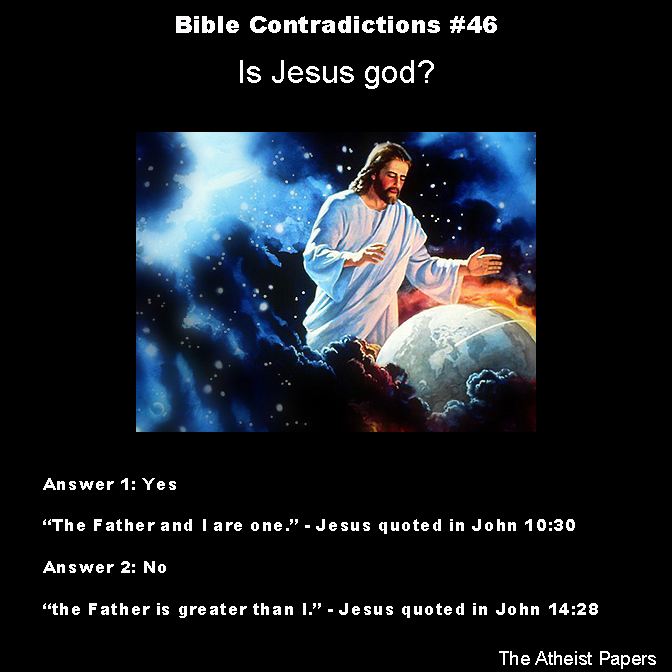
Bible Contradictions #46: Is Jesus god?

Bible contradictions 46

Most Christians claim Jesus and god are the same being. Indeed, it’s pretty much the core of the entire religion. Few will argue against this point because doing so takes Jesus’ divinity away from him, leaving him merely a man whose “sacrifice” to save mankind is irrelevant. Saying Jesus is not god is to call Jesus just another execution victim. This makes the Jehovah’s Witnesses all the more strange for claiming Jesus is not god. In other words, this is a pretty important question to Christians: Is Jesus god? The answer, unfortunately, is yes and no (depending on what verse you read).

The gospels are chock full of verses where Jesus is going around claiming to be god. It would take me half the day to list them. So I’ll just leave a link here with all of those verses.

But Jesus also made it clear that he is not god. Once again, the list of these verses is quite long. Here is a link to them.

I’ve read some apologists’ interpretations of the verses where Jesus claims he is not god. These were probably ex-military folk, because they claim that Jesus as the son was a lieutenant of god the father (a lieutenant of himself) without total authority and power. So in this sense Jesus would not be god, per se, but would retain his position as god upon his death. If this is the case, then why didn’t Jesus just come out and say that?

Posted in Atheism, Bible Contradictions | Tagged , , , , , , , , , | 25 Comments

Making fun of vegans and atheists!

I’m both vegan and atheist, so I thought it would be funny to apply atheist arguments to veganism. The result is absurdity.

Posted in Atheism | Tagged , , , , , , , | 2 Comments

God is not alive: He does not meet the basic criteria for living things

In biology the definition of life is a little tricky. It’s rather difficult to make a single, coherent statement about what life is. Instead, biologists have a list of descriptive traits that define life. For the purposes of this post, I will use teaching materials from New Mexico Tech, but this is a commonly used list that can be found in several sources.

Biologists say living things have the following seven characteristics: 1) They are composed of cells. 2) They have different levels of molecular and cellular organization. 3) They use energy. 4) They respond to their environment. 5) They grow. 6) They reproduce. 7) They evolve.

Let’s examine each of these and apply them to the concept of god as characterized in the Abrahamic religions (Judaism, Christianity, and Islam) and see if god is alive.

1. Living things are either single-cellular or multicellular 

Is god composed of cells? Many claim god made humans in his own image, but that doesn’t mean he’s composed of one or more cells. Indeed, he’s supernatural, and cells are natural. Plus if he’s omnipresent, we would be able to see his cells everywhere. Philosophically speaking, I can understand the argument that god does have cells, but I doubt anyone would ever make such a claim.

Result: God does not have cells.

2. Living things have different levels of molecular and cellular organization

Because god does not have cells, it’s unlikely god’s “body” can organize simple materials into complex materials in order to build tissue, his organs, his organ systems, and ultimately his own organism.

Result: God does not have different levels of molecular and cellular organization.

3. Living things use energy

The Abrahamic concept of god is an omnipotent god. Omnipotent beings have no need for an energy input. Indeed, this god’s energy happens all by itself. Followers of this god claim god is transcendent, which means he existed way before energy existed. A god like this likely has no need for energy.

Result: God does not use energy.

4. Living things respond to their environment

What the hell is god’s environment? That’s never really been clarified. In any case, if god is omniscient then he knows everything in advance, even his own responses. His behavior is therefore likely to be beyond his free will. If a change in his heavenly environment occurs beyond his control, his actions have already been pre-determined. Although changes beyond his control negates the omnipotent thing.

Result: God does not respond to his environment.

5. Living things grow

This one’s easy. The Abrahamic concept of god is transcendent and omnipresent. There is no need to grow. Besides, the growth of living things is based on cell division, which takes us back to the first point.

Result: God does not grow.

6. Living things reproduce

Well, god knocked up a teenage girl, so maybe he can reproduce. But he did it with magic, not sperm. I’ll give god this one.

Result: God can reproduce, but it’s irrelevant.

7. Living things adapt and evolve

Need I comment on this one?

Result: God does not adapt or evolve.

Scorecard

The Abrahamic god scores 1 out of 7, only having the characteristic of reproduction. But that’s not relevant because fire can reproduce, but it’s not alive. Viruses also reproduce, but they are not alive.

Clearly, based on the seven characteristics of life as defined in the biological sciences, god is not alive.

It would take an extraordinarily compelling argument with extraordinarily compelling evidence to suggest that god can somehow be alive without having the basic descriptive traits of living things.

Postscript

This is merely a tongue-in-cheek article. I’m aware that theists will always reply to this kind of statement with a “goddidit” argument. Besides, I don’t pretend to understand the concept of god. I take the ignostic approach when talking about the definition of god.

Posted in Atheism | Tagged , , , , , , , , , , , , | 24 Comments

Why I’m anti-theist and not merely atheist

People become anti-theist for a reason. Through observation and experience, atheists sometimes cease being merely non-believers and take it upon themselves to criticize and condemn religion, particularly religious practices. As I’ve mentioned numerous times, I’ve been atheist all my life, but it wasn’t until I was 15 that I started to understand precisely how dangerous religion can be. It took — what I call — a fringe sect of Christianity to bring out the anti-theism in me.

When I was 15 I dated a non-believing girl (I’m not sure if she’s atheist). Her mother was fairly strict. She belonged to the local Kingdom Hall — the Jehovah’s Witnesses church. In order to spend Sundays together, the mother demanded that I dress up, pull my long hair back, go to “church,” and sit for an hour bored out of my fucking mind. It was a small sacrifice to be able to see my girlfriend. But I observed several instances of personal and social harm at the hands of an oppressive religion.

The first occurred weeks after our first date. An unmarried couple was disfellowed (ex-communicated) for having sex out of wedlock. This was a couple deeply devoted to the Jehovah’s Witness religion. They had dedicated their lives to it. They owned up to their “mistake”* and wanted the church to forgive them and help them move forward. Instead, the church — without a second thought — cast them out as social pariahs. Instead of providing for this couple’s spiritual needs, the church made a lesson out of them: Don’t break our rules!

*Sex out of wedlock is not a mistake. It’s a social necessity.

The Jehovah’s Witnesses church also has a strict ban on smoking. Since 1973 the church has either refused to baptize smokers, or they will actively disfellow smokers. This in itself is not a terrible thing. I think it’s a stupid rule to have, but it’s not as harmful as the above example of harm. What really got to me was on Good Friday — the most important holiday to the JWs, and the biggest day of the year for church attendance — the JWs installed ash trays outside the door of the Kingdom Hall. In other words, smoking is a major sin in their religion, large enough to remove you from god’s good grace. But they don’t mind smokers coming to the church on Good Friday because that’s their biggest payday! And trust me; it’s a small religion. They can use all the money they can get. Hypocrisy.

The church actively tried to remove me by continuing to make it more difficult to attend. The first time I came wearing a polo t-shirt and slacks. I was relatively underdressed, but these were my nicest clothes. They told me I needed to wear a shirt and tie. So I went shopping and next time I came wearing a shirt and tie. Then they told me I needed to wear a full suit. I told them I would not do that. They told me to cut my hair. I told them no. My girlfriend’s mother was starting to feel social pressure, so she hid us from the church. We were finally able to spend our Sundays together without first spending an hour learning about how Jesus wasn’t really god.

These experiences were not only sufficient to make me criticize the Kingdom Hall, they were also more than sufficient to turn me from an atheist into an anti-theist. This compelled me to begin criticizing all aspects of any religion that I felt were unjust, idiotic, or cruel. And from my experience, no religion is immune from being unjust, idiotic, and cruel.**

**The religions associated with Wiccan beliefs might not necessarily be unjust or cruel, but they can be idiotic.

Posted in Atheism | Tagged , , , , , , , , , , , | 6 Comments

All babies are born Muslims (and other Islamic nonsense)

Four points:

  • All babies are born Muslims.
  • All humans are at least subconsciously Muslims.
  • Atheists don’t exist (because my roommate says so).
  • Allah tricked Christians into being Christians.
Posted in Atheism | Tagged , , , , , , , , , , | 11 Comments

How I survived the clown revolution in Beirut

I don’t often make political statements on this blog. But the wars in Syria and now between Palestine and Israel sometimes hit a little close to home. At first glance this video looks like merely a statement about the strength of the Lebanese people through years of conflict. But really it’s a statement about the ongoing conflict between Palestine and Israel. And yes, I do blame religion.

Posted in Atheism | Tagged , , , , , , , , , | 4 Comments