Bible Contradictions #29: Did all the Egyptian cattle die during the fifth plague?

Bible contradictions 29

We all know the story. Moses wanted to take the Hebrews on a weekend getaway, but god forced the pharaoh to reject Moses’ request in order to try out his new toy: a set of plagues he just purchased from FAO Schwarz. If you want a refresher, here’s a quick rundown of the plagues in order. One of the moral problems with this story is the fate of thousands of innocent bystanders. I’m not just talking about the deaths of innocent babies caught in god’s crossfire (although that is an unforgivable crime); I’m also talking about the fate of all the cattle of Egypt. Did they all die?

The bible — once again — is not that clear. During the fifth plague god killed all the cattle of Egypt. That is, not one cattle survived. His abilities to kill every cattle in sight is more efficient than any modern day slaughter house.

During the final plague, however, god kills all the firstborn of Egypt, including innocent human babies and innocent calfs, even though there were none to be found, according to the earlier plague. This is quite a remarkable contradiction. I’m quite surprised it made it by the copy editors.

I haven’t heard any attempts to explain this contradiction, but I can venture a guess of how someone might attempt to explain it. Because these plagues, particularly the fifth plague, was aimed only at the Egyptians and not the Israelites, then could it be that the Egyptians merely stole all the Hebrews’ cows after theirs were wiped out? Sure. Of course it is. But that’s not in the bible. Indeed, if that was in the bible, it would give Moses more credibility. Early Jewish scribes would have definitely used that to further highlight their persecution.

Nope. This is precisely what happens when people go around just making up stories. They forget about the details and later contradict themselves.

Posted in Atheism, Bible Contradictions | Tagged , , , , , , , , , , , | 10 Comments

Proof that the bible is fallible: early Christians confess to changing the bible

Even as far back as the third century CE, numerous Christians began noticing bible contradictions. They largely accepted these inconsistencies and believed there must be a reason for their existences. What they couldn’t accept, however, was how the early church dealt with these contradictions; the church changed the bible to get rid of them.

Linked in the above paragraph (see chapter XXVII) is a confession by Origen, an early Christian scholar, in which he says that he changed the bible to “answer objections.” He also exposes the “followers of Marcion, and those of Valentinus, and, I think, also those of Lucian” of doing the same. Here we clearly see that 1) early Christians were aware of inconsistencies, and 2) the bible was changed numerous times in order to fix these problems. Of course, they missed countless other contradictions.

Does Origen put Christianity to task for these inherent problems that were whitewashed away? No. Instead he blames people who read the problematic verses and took them to heart, saying that they corrupted the gospels. In other words, because people believed in the problematic verses, those verses had to be erased.

Origen’s actions underscore perfect evidence that the bible is manmade and fallible. If it were not then Origen and his conspirators would not have needed to make any changes to it.

Posted in Atheism | Tagged , , , , , , , , , | 16 Comments

Buddhism vs. Christianity: They’re not as different as you might think

If you’re a skeptic and think that Buddhism has some worthwhile teachings, you’re right. Actually, all religions have something worthwhile, but we can whittle them down to different ways of saying the golden rule. Buddhism is replete with doctrines and teachings that give me pause and decapitate from it anything worthy of affection. But for now I will focus only on the fantastical.

Might I draw your attention to the Lotus Sūtra, probably the most important and influential book in the Mahāyāna tradition. Here I will show similarities between Buddhism and Christianity according to one phenomenon: Prayer. Thumb to the fifth chapter to find this:

Even if there is a man, whether guilty or guiltless, whose body is fettered with stocks, pillory, or chains, if he calls upon the name of the Bodhisattva He Who Observes the Sounds of the World, they shall all be severed and broken, and he shall straightway gain deliverance.

It sounds familiar, doesn’t it? Parallel this with Matthew 11:28: “Come to me, all you that are weary and are carrying heavy burdens, and I will give you rest.”

Or 2 Chronicles 7:14: “if my people who are called by my name humble themselves, pray, seek my face, and turn from their wicked ways, then I will hear from heaven, and will forgive their sin and heal their land.”

In other words, the Mahāyāna tradition of Buddhism calls out to mythical creatures, namely, in this case, the Bodhisattva He Who Observes the Sounds of the World. Buddhism has living supernatural beings who, when prayed to, help you through tough times, very much like Christianity.

But that’s not all. Both religions focus on the suffering on the here and now (life on earth, or samsara in Buddhism), and both offer bliss in the hereafter (it just takes quite a few more cycles through samsara to reach paradise in Buddhism).

The essence of this post is that as skeptics we should laugh at Christianity. But we should also laugh at ridiculous beliefs held by Buddhists. This doesn’t just include prayer; it includes the concept of the cycle of rebirth and karma, the entire concept of the Three Jewels (compared to the Trinity in Christianity as well as Faith, Hope and Charity), and the belief in both that desire causes suffering (karma in Buddhism; in Christianity, sin causes god to smite you).

It’s true that many Buddhist practitioners reject any notion of the supernatural, and they use the teachings of the Buddha as a means to achieve happiness in life. This should not be mocked. It’s no different than contemplation or physical exercise. There’s nothing absurd about that. But when, like in Christianity, Buddhism begins to make wild claims, we should laugh.

Posted in Atheism | Tagged , , , , , , , , , , | 3 Comments

God kills millions because of their private thoughts (also, angels and humans get it on)

I’ve recently been tasked to read an analyze Genesis 6 (particularly verse 5, but I’m not going to cherry pick a bible verse here). A little background info: In a recent post there was a back and forth between a fellow atheist and the ubiquitous SOM. At one point I chimed in because SOM made a ridiculous statement, which is screen capped below:

som-1

Let’s highlight the offending quote: “God did not commit genocide by exterminating evil.” To this, I finally replied in the usual manner; I called SOM out. This is found below:

som-2

SOM insisted that if I read Genesis 6:5 I will experience a sudden conversion and understand why the Christian god does what he does (but… I thought he acts in mysterious ways!) So without further ado, here is my analysis. You can follow along here if you don’t have a bible ready. (Sigh, I promise to never feed the troll again).

Genesis 6:1 begins in the usual way for a bible book: a bunch of men having sex with women. Then suddenly in verse 2 the angels get in on the action by having sex with the daughters. I’m not making this up. Look it up and see! (By the way, “Sons of god” in the bible is generally accepted to mean angels).

Verse 3: God gets pissed for absolutely no reason and shortens the human lifespan to 120 years. On a side note, only one person has ever reached the age of 120, and she died in 1997.

Verse 4: Suddenly the daughters who’d been shagging the angels started giving birth to giants! (This verse seriously came out of nowhere).

Verse 5 (the main reason SOM sent me here): God looked down into people’s imaginations (that is, he read their thoughts). He didn’t like what humans think about so he decided to kill everyone! Basically, god wiped out the entire human race because he didn’t like their private thoughts.

Verse 6: And then god was like, “Man, I regret making humans,” even though the bible clearly shows elsewhere that god cannot change his mind.

Verse 7: Because the private thoughts of humans were so evil, god decides to kill everything, including innocent babies and kitty cats.

Verse 8: But Noah? He was a good guy.

… ad nauseum. The rest of this is god saying he’s angry and telling Noah how to build a boat.

This is by far the easiest chapter of the bible to criticize. Why anyone would think that this chapter would suddenly make me a believer is beyond comprehension. This should instead compel believers to leave their religion and join more peaceful religions. That anyone would attempt to justify murder on this scale is ridiculous. I find it especially difficult to believe that SOM was being serious when he challenged me to analyze Genesis 6.

SOM, you definitely failed to redeem yourself when you said that god exterminated evil. Because evil is still here according to followers of the god of Abraham! (Actually it’s not because evil is a religious construction. It was invented by scared humans.) If you mean to say that god exterminated evil humans, then you need to explain why god thought that fetuses, infants, and kittens were evil too. That part’s not in the bible.

Posted in Atheism | Tagged , , , , , , , , , , , , , | 3 Comments

Christians, you aren’t Eastering hard enough!

Easter is–hands down–the most important holiday in all branches of Christianity. Easter represents precisely everything that is fundamental to the Christian religions: A man venerated as the physical embodiment of god is resurrected. Without the resurrection, the death of Jesus is nothing more than a passing obituary. Because most Christians believe that Jesus was resurrected, the idea is self-reinforcing. That is, Christians believe that Jesus was resurrected, therefore they believe in Christ, and because they believe in Christ, they believe that Jesus was resurrected. I cannot stress this enough. Easter represents the very essence of Christian doctrine.

Yet, most Christians (in the US at least) are rather blasé about the entire holiday. But I should put this idea into perspective first.

From Black Friday through the New Year, Christians celebrate the birth of Jesus. We could even be forgiven if we scale this back to 1 November through the New Year. But births are not very remarkable. I’ve had one. You’ve had one. Everyone alive and everyone who has ever lived and died had one (except one person, according to the bible). Yet, despite the relative insignificance of a single boy’s (alleged) birth, Christians dedicate an insane amount of time, money, and energy to celebrating Christmas, complete with gift giving, caroling, tacky decorations, charitable donations, and massive Christmas feasts. The celebration of Christmas is treated like an absolute monarch who demands 100% attention. Yet, Easter, on the other hand, is barely a footnote in the book of celebrations.

I have never been a Christian, so please forgive me if my interpretation of the holiday is inaccurate. But it appears to me that most Christians don’t put nearly the amount of effort into celebrating the resurrection of their god as they do into celebrating the mere birth of Jesus. In April, there are no long, protracted displays of seasons greetings, “tis the season’s,” gift giving (outside of candy to children), or any other phenomenon associated with Christmas. Indeed, most department stores are open on Easter, while virtually all US department stores are closed on 25 December.

There are some similarities, however. For Christmas, a fat man dresses up in red, pretending to be a supernatural being, and takes pictures with children in every shopping mall in America. For Easter, some bloke dons a bunny costume, pretending to be a supernatural rabbit, and takes pictures with children in the same malls. But outside of that, the holidays are miles apart. Christmas even has its own album collections by Nat King Cole and Elvis Presley. Easter gets a song by Carrie Underwood.

This divorce between Christmas and Easter celebrations has always seemed like a baffling absurdity to me. Despite the fact that Easter represents the core of Christian belief, it’s treated with less reverence than 4 July, Valentines Day, or even (Jehovahs Witnesses, you better cover your eyes) Halloween.

I’m not criticizing Christians for dedicating so much attention to Christmas and barely any to Easter. I think they’re both block-headed holidays. But this has always troubled me. So dear Christians and former Christians, please shed some light on this. Why not put the same amount, if not more, effort into celebrating the resurrection of Jesus as you do in his birth?

Posted in Atheism | Tagged , , , , , , , , , , | 2 Comments

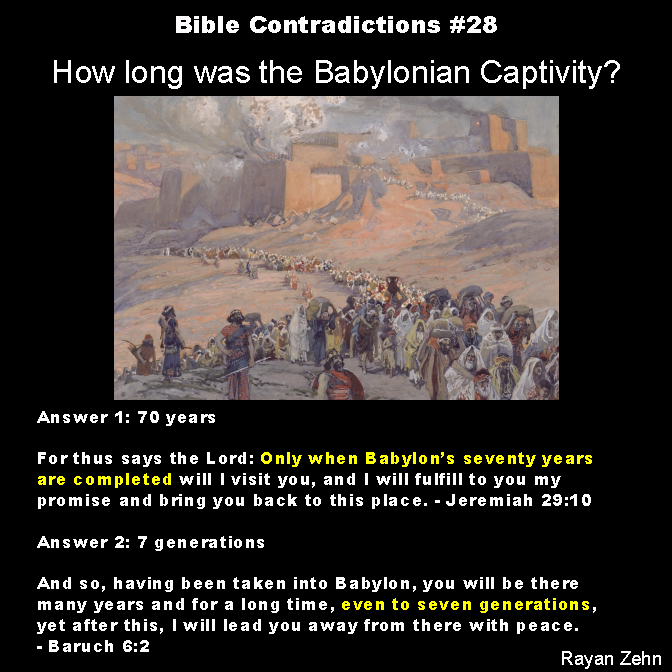
Bible Contradictions #28: How long was the Babylonian Captivity?

Bible contradictions 28

God has a funny way of treating his “chosen people.” Apparently, the Jews were misbehaving and being ungodly. After several years of some other shenanigans in Babylon, god decided it was time to put his foot down and end the free will of the king by having him take the Jewish people captive. This was in ca. 597 BCE. First I’d like to ask the following questions: Shouldn’t god have known that his “chosen people” were going to act like brats? Couldn’t he have chosen a better, more well-behaved group of people to whom to deliver his word? Anyway, moving on.

So how long did the Babylonian Captivity last? Well, we have to look to Jeremiah 29:10 and Baruch 6:2.

In Jeremiah it is foretold that the Jews will not be able to leave Babylon for 70 years. That’s a fairly long time. It’s an almost guaranteed life sentence for most people.

In Baruch…

But wait! What’s the book of Baruch? It’s a deuterocanonical part of the apocrypha that is widely quoted in the bible. It’s also a major part of Jewish, Christian, and Catholic canon. I have linked the Catholic text above. The book of Baruch is generally considered just as infallible as the rest of the bible.

Ahem, in Baruch, we are told that the captivity will last seven generations, not merely 70 years. In order to reconcile these two disparate numbers, the Jews would’ve had to be having children at the age of ten or younger! That’s far too young, even by biblical-day standards.

Of course, they are both wrong. In “reality”* the Babylonian Exile only lasted 60 years.

*In real reality we have no idea whether or not the Babylonian Exile actually took place. It might be just another piece of bible fiction.

Posted in Atheism, Bible Contradictions | Tagged , , , , , , , , , , , , | 26 Comments

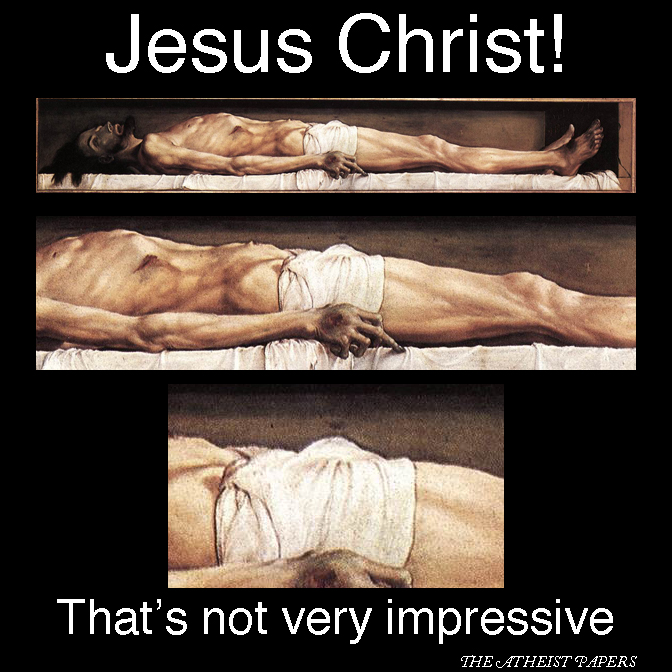
Jesus Christ! That’s not very impressive.

jesus not impressive

So I created a meme.

Happy Good Friday!

Posted in Atheism | Tagged , , | 2 Comments

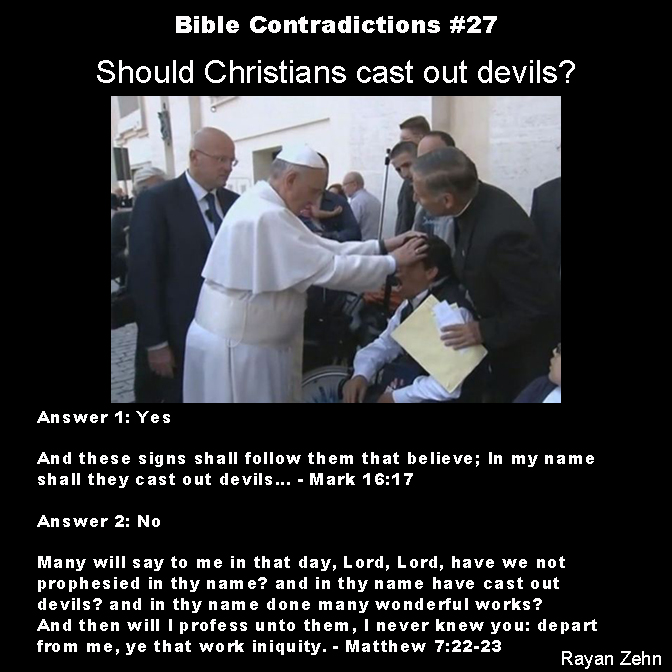
Bible Contradictions #27: Should Christians cast out devils?

Bible contradictions 27

It seems everywhere I go those silly Christians are casting out devils. I can’t make it to the corner market without getting spritzed by holy water and having a lesson in Latin. But is it truly the Christian thing to do?

According to Mark 16:17 it is. It is a sign of a true believer. Jesus is quite the fan of people who cast out devils in his name.

But not so fast! There are two tales in Mark 9:38 and Luke 9:49 that tell a different story: Casting out devils in Jesus’ name should only be done by true Christians. “And John answered and said, Master, we saw one casting out devils in thy name; and we forbad him, because he followeth not with us.” Apparently doing Jesus’ work in Jesus’ name is not enough to be a Christian. You have to follow John too.

Finally, Jesus changes his mind. In Matthew 7:22-23 Jesus makes it quite clear that if you cast out devils in his name, he’ll disown you. In other words you’ll go to hell. This is a very interesting verse here, because Jesus says that casting out devils is the work of iniquity. That is, it’s immoral mumbo jumbo. Even Jesus knew exorcisms were rubbish, yet, despite this, even followers of Christ still believe that devils need to be cast out of people.

This contradiction also appears in my video:

Posted in Atheism, Bible Contradictions | Tagged , , , , , , , , | 7 Comments

Are you saved or damned? God decided before you were born

The bible has a lot to say about what you must do to be saved. I’m not going to list them all here (that would make for a very long post), but the various books of the bible list about 200 different hoops through which one must jump in order to be saved, including burning your life’s work and never getting married. In order to make your way to heaven, you have to lead a fairly miserable life. But it’ll all be worth it in heaven, right? Every ounce of suffering you feel in your devotion to god will make paradise all the more wonderful, right? Your actions here on earth in this life have a direct effect on the afterlife, right?

Nope.

It turns out that Peter wrote a couple books of the bible, which is no easy feat considering he was illiterate. In his first book, Saint Peter is very blunt about who is saved and who is damned. That is, god predetermines who goes to heaven and who doesn’t:

Elect according to the foreknowledge of God the Father, through sanctification of the Spirit, unto obedience and sprinkling of the blood of Jesus Christ: Grace unto you, and peace, be multiplied.

In other words, despite your acts, your beliefs, and your faith–despite anything you do–god has made up his mind about your fate before you were even born. You have no say in the matter. His foreknowledge makes anything you do irrelevant in regards to your immortal soul.

This pretty much means that you’re wasting your life if you try to adhere to the almost-200 different rules for getting to heaven. Since god has already decided your fate, there’s no point in trying to please him.

Posted in Atheism | Tagged , , , , , , | Leave a comment

Sharing a prophet’s grave: An accidental resurrection in the bible

According to Acts 26:23 and 1 Corinthians 15:20, Jesus was the first person to be resurrected. But actually, if you go by the bible, many, many people were resurrected before Jesus rose from the dead. I’m not here to point out another contradiction (I’ll save that for another time). I’m here to address one of the many resurrections that predated Jesus’ alleged “first” resurrection.

Open your books please to 2 Kings chapter 13.

Here we have the prophet Elisha, who, while on the battlefield (it’s always a battle with these guys), grows sick with what will prove a mortal illness. Despite his importance, his funeral is summed up in the bible as follows: “Elisha died, and they buried him.” That’s it. There’s no mention of ceremonies or location of his plot. What is interesting, however, is what happens next.

In verse 20 we find that the Hebrews are burying a nameless man. The ‘brews see a group of Moabites (their enemies) approaching and hastily throw the body into a grave… but… it’s Elisha’s grave! Essentially, Elisha’s followers decided Elisha’s grave was a good a place as any to bury a nameless nobody. And then this happens in verse 21:

“the man was thrown into the grave of Elisha; as soon as the man touched the bones of Elisha, he came to life and stood on his feet.”

A decomposing corpse is thrown onto another corpse so sufficiently decomposed that its bones are all that’s left. And when the recently deceased man’s body touches Elisha’s bones, he springs to life. And it was all an accident!

Basically, to misuse this phrase in its colloquial vernacular, by the transitive property of whatever divine spirit guided the living Elisha, his bones sent some of that into the nameless man and restored his body to its fullest. And then the story ends with the ‘brews returning to battle

But wait a minute! That’s a really huge deal! A man came back from the dead! Seriously, why does 2 Kings 13 stop there? Shouldn’t it have dedicated at least several more pages of text to this story? Who was the returned man? Did anyone ask him what death was like? What did he do after he came back from the dead? When did he die a second time? Is he still alive today? These are questions that any reputable bible would’ve addressed. Why they left it out is testament to the ridiculousness of these stories.

But the main lesson here, guys and girls, is not that god sometimes works in mysterious ways; sometimes he does miracles by accident!

Posted in Atheism | Tagged , , , , , , , , , , , | 1 Comment