Stem Cells and Parkinson’s Disease (SS#7)

Do you remember when “stem cell” was a bad word in the American religious context, conjuring fears of mass abortions to fund mad scientists “playing god”? Thankfully that was a long time ago and human embryonic stem cell research in the US has prospered, giving us much insight into the mechanisms of treating abnormal human pathological conditions. But this expansion of research funding came too late for many American scientists, and therefore the void was filled in countries with leaders who weren’t afraid of scientific discovery. And ironically, these non-US scientists discovered that stem cells need not even come from an embryo! If stem cell research was fully funded in the US fifteen years ago, we would have discovered that on our own. If we had gotten over our religious fears in the 1980s and 90s, research would have put our religious fears to rest.

In 2006 a Japanese researcher named Shinya Yamanaka discovered that “mature cells can be reprogrammed to become pluripotent” (quote from the Nobel Prize in Medicine he received for this discovery). In other words, our understanding of stem cells has come so far along that we can now take adult cells and convert them into something identical to human embryonic stem cells. This new stem cell is often referred to as an induced pluripotent stem cell (iPSC).

The Latest Research in Parkinson’s Disease

In the 5 March 2015 edition of Cell, a group of researchers published a paper titled, “Successful Function of Autologous iPSC-Derived Dopamine Neurons following Transplantation in a Non-Human Primate Model of Parkinson’s Disease.” This team harvested cells from crab-eating macaques and derived iPSC neurons and transplanted them into the macaques with Parkinson’s disease.

Their results were not perfect, but some of the macaques who received this treatment experienced a reversal of symptoms. Positive results included gained motor activity and, most interestingly, in my opinion, large-scale growth of dopamine neurons in the transplanted areas. Not all macaques responded to the treatment in this way, and the researchers do not yet fully understand why some macaques respond more positively than others, but this research still highlights rapidly advancing treatment options for Parkinson’s disease patients.

I should also note that this doesn’t mean if you have a friend or family member who suffers from Parkinson’s disease, a cure is just around the corner. This kind of research has a long way to go, and an even longer way to go before we’re ready to begin testing this kind of treatment on humans.

The sad truth is, however, that if not for religious fears stunting the progress of American scientists, we’d be a lot closer to a cure for Parkinson’s than we are now.


Posted in Science Sundays | Tagged , , , , , , | Leave a comment

Request for Help Finding Medical Article: “Evidence supporting the biologic nature of gender identity”

My university is a liberal arts university with an extraordinarily small medical school that doesn’t offer anything resembling an MD. At best we offer a Bachelor of Science degree in nursing. Therefore, my school has not joined in any partnership programs with journals that would give students or faculty access to medical-related articles. This can sometimes greatly frustrate me. I filed an interlibrary loan request, but usually that takes a day. After waiting a week, I checked with the library, and it turns out only two universities in the country have access to the article right now. Princeton and Brown. Therefore, I turn to you in hopes that at least one of you has access to a specific article published in Endocrine Practice this week. I would be forever grateful if one of you send me a copy. Furthermore, I hope this request piques your own interest. If you’re a student, faculty, or alumni [or if you just have the article saved on your hard rive for some other reason] please forward it. I’m dying to read it.

What I’m Looking for

“Evidence supporting the biologic nature of gender identity”

Published in Endocrine Practice [full title Endocrine Practice: Official Journal Of The American College Of Endocrinology And The American Association Of Clinical Endocrinologists]

Issue: 2015 Feb 1; Vol. 21 (2), pp. 199-204.

Why I Want It So Badly

I’ll let the abstract answer that question. You can fill in the gaps in how that relates to religious discussions.

Objective: To review current literature that supports a biologic basis of gender identity.
Methods: A traditional literature review.
Results: Evidence that there is a biologic basis for gender identity primarily involves (1) data on gender identity in patients with disorders of sex development (DSDs, also known as differences of sex development) along with (2) neuroanatomical differences associated with gender identity.
Conclusions: Although the mechanisms remain to be determined, there is strong support in the literature for a biologic basis of gender identity.

Finally, here’s a recent news article from Science Daily that turned me on to the study.

I’m very excited to read their methodology. Maybe there’s a future blog post in there if I can get my hands on the article.

You can send it to theatheistpapers at gmail dot com.

Posted in Science | Tagged , , , , , , | 3 Comments

Self-Immolation and the Threat of Hell: Why Is Hell Insufficient to Prevent Altruism?

In my academic life I’ve been called a person who is interested in the “strange.” While most people in my field research the international political economy or diplomacy, I’m out there researching suicide protest and — the latest interest of mine — how the DIY biohacking community might introduce genes into the scope of scrutiny.*

*There’s a Science Sunday post waiting to happen. A friend of mine in the engineering management field and I are drafting a paper on this topic.

Back to self-immolation. When I finished my major study on self-immolation, I was left with many unanswered questions, which is to be expected considering I can’t get into the minds of dead people. One of these questions was: What role does religion play in compelling people to set themselves on fire to protest a social wrong? Unfortunately, if you’re here looking for answers, stop reading now. Currently, I have no answers. This is merely to show a gap in our knowledge.

Out of the data for I collected on 488 cases of self-immolation from 1963 to 2012, all of them professed a religious component to their decision. I should clarify. Not all of them left suicide notes, but those who did were explicit in the religious aspect of their suicidal act of protest. This is very interesting if we look at who are killing themselves.

self-immolation by region

The vast majority — upwards of 70% — committed suicide by self-immolation in states with Indic religions. Almost 30%, however, committed suicide by self-immolation in states with predominantly Abrahamic religions. Since we’ve already determined that all of the victims of self-immolation who left suicide notes professed a religious aspect to their suicides, this raises very interesting questions, which I will present by quoting my research (which quotes from Michael Biggs).

This religious theme uncovers interesting questions. First, is belief in god correlated with the decision to self-immolate? Michael Biggs notes that the vast majority of self-immolations from 1963 to 2002 were “most frequent in countries with Buddhist or Hindu religious traditions…” Additionally, he points to belief in a supernatural being as a motivational factor in the decision to self-immolate. He writes, “Self immolation is an exchange: in return for the sacrifice, a supernatural agency will intervene on behalf of the cause.” While this might indeed be a motivation for believers in the Eastern gods, it cannot definitively be stated that it serves as a motivation for believers in the god of Abraham; the Abrahamic god promises no eternal reward for suicide, but rather eternal suffering.

That last sentence is the important one. Why did roughly 150 Christians and Muslims commit suicide — even altruistic suicide — when the teachings of their faiths had them believe suicide was an eternal sin?

Let me break this down and give some context.

These are people who kill themselves because they believe their deaths will have a positive impact on the society in which they live. This is altruistic suicide, not selfish suicide. They believe this so much that they are willing to spend eternity in hell in order to better serve their fellow human beings. In other words, not even the threat of hell can dissuade them from acting in a self-destructive manner. Additionally, these were all very religious people who surely must’ve known about the teachings of hell within their respective religions.

To put this into context, zero known cases of self-immolation were carried out by self-professed atheists (which raises yet another question, but that’s beyond the scope of this post).

That is, self-immolation appears on the outside to at least withstand the idea of eternal punishment, but it does so in a strictly religious context. If the opposite were the case, we might expect more atheists to commit suicide protest. At most we might be able to say the victims of self-immolation acted because they believed their suicides would not only make the world a better place, but also god would look favorably on them for their sacrifice. Unfortunately, we can only speculate this because dead people aren’t very good at telling us the answers.

This is a very interesting topic to me, and I expect I will continue examining this phenomenon in the future. There is a lot more research needed, and I hope I will be able to provide some insight into how we can make better sense of these acts. The very, very unfortunate reality of my research is, however, that in order to better understand self-immolation, more people will regrettably die. That is, I need more data points, and I must confess, that’s a reality I struggle with every time I add a person’s name to my database.

Posted in Research | Tagged , , , | 3 Comments

Why Fight the End Times? Same-Sex Marriage and the Return to Eden

Today I read this article in Huffington Post by Michelangelo Signorile titled “USA Today Columnist Cal Thomas: Gay Marriage Is A Sign of the ‘End Times.'” In the piece Signorile quotes conservative columnist Cal Thomas, who says, paraphrased, if the Supreme Court rules in favor of same-sex marriage, that’s just a sign of the end times, before adding, “everything is right on schedule.” In other words, Thomas has at least reluctantly given up his fight against marriage equality because the bible prophesied this would happen and that this would be a sign of the “end times.” In other, other words: If this is what god wants, there’s not much we can do to stop it.

While I wholeheartedly disagree with Thomas’ stance on bible prophesies, the “end times,” or any of the supernatural claims of his religion, I feel like his statement is a breath of fresh air, validating a conundrum that’s always plagued me.

See, I stand dumbfounded whenever a follower of an Abrahamic religion warns us against doing something — particularly a social thing — because doing so would be a sign of the end times. So what? Isn’t that what you want to happen anyway? Isn’t the end of the end times precisely the point where Jesus will return to earth to begin the process of restoring it to Eden?

If same-sex marriage brings about the end times and leads to Satan’s defeat and the destruction of evil, I don’t see why more Christians and Muslims aren’t quick to accept it as legal.

Well, I can, actually. Unfortunately many people conflate accepting something as legal with supporting it. They feel accepting same-sex marriage is the same as supporting same-sex marriage. This can’t be further from the truth. For example, I accept it’s legal to stockpile assault rifles in the US (within a legal framework often involving permits, but that’s beside the point), but that in no way means I support the idea of stockpiling assault rifles. I accept my neighbor has a right to those weapons, but I’m not excited about the idea of him having them.

In other words, when I say, “If same-sex marriage brings about the return of Jesus, isn’t that a good thing? And therefore wouldn’t it be better to just accept it?” the common retort I hear is, “If I don’t fight against gay marriage then god will judge me.” This retort bastardizes acceptance for outright supportive embrace of same-sex marriage. The two are not the same, and they ought to be reminded of that.

Don’t worry though. The worst thing that will happen to society post same-sex marriage is same-sex divorce. It’s extraordinarily unlikely that the end times are manifestable.

Posted in Atheism | Tagged , , , , | 2 Comments

The Armoured Skeptic: The Best Youtube Channel? Yes.

I’m taking this opportunity to turn you all on to my favorite Youtuber, the Armoured Skeptic, North America’s funniest and greatest contribution to online videographers’ take on religious claims. If you’re not familiar with him, please, please take a half hour out of your day to watch one of his videos. This one is particularly good.

Screenshot AS

The Armoured Skeptic is a project of Canadian filmmaker Sir Skeptalot. In his often 30 minute short films, he takes on the claims of creationists and religious fanatics who bastardize scientific findings to support their beliefs. He breaks them down and debunks them point by point, using comedy to deliver the deadly blows.

His videos are also some of the highest quality videos you’ll find in the genre. Instead of crappy webcam videos, like I make, Sir Skeptalot dedicates immense talent to create highly visually stimulating shorts. He only produces one or two videos a month, but once you see the workmanship that goes into each video, you’ll realize why it takes so long. Plus his videos are so good that they’re worth the wait.

The Armoured Skeptic’s full Youtube channel can be found here.

Posted in Atheism | Tagged , , , | Leave a comment

“Nones”: The Rise of Religiously Unaffiliated Americans (SS#6)

In this episode of Science Sunday, I’m going to examine “U.S. Religious Landscape Survey: Religious Affiliation: Diverse and Dynamic,” a recent publication by The Pew Forum on Religion and Public Life. There’s a lot of data to sort through, and the methodology is quite robust. If you’re interested in perusing or even merely glancing at the data and methodology, visit the above link. For the purpose of this post, I’ll only be focusing on some overlooked results.

There’s a lot of news sites out there that immediately picked up on the fact that the polling data shows “Unaffiliated” representing the largest religious group in 23 states, which is very interesting. But that is not as interesting as a short blurb written on page 5.

The survey finds that the number of people who say they are unaffiliated with any particular faith today (16.1%) is more than double the number who say they were not affiliated with any particular religion as children. Among Americans ages 18-29, one-in-four say they are not currently affiliated with any particular religion.

In other words, this survey appears to suggest that — not only are the majority of non-religious in America previously religious — but also that young Americans are either leaving or not adopting religion in vast numbers. Roughly one quarter of all young Americans find mainstream religion irrelevant in their daily lives. Why do I find this so interesting? Because this trend was predicted in 2004 by Ronald Inglehart and Pippa Norris. These findings support their hypothesis that as existential security increases, the importance of religion decreases.

Furthermore, the data suggests the US is “on the verge of becoming a minority Protestant country” and that “Catholicism has experienced the greatest net losses as a result of affiliation changes.” In other words, while irreligion is increasing in the US, it’s the major American religions that are losing members at the highest rates. This is, of course, to be expected. Protestant and Catholic branches of Christianity no longer provide comfort and security to many Americans who can find comfort and security on their own. The church is losing its monopoly on predictability.

Note that these numbers do not include atheistic branches of Buddhism, Jainism, Judaism, Confucianism, and Taoism. And it definitely doesn’t include non-believing Americans who culturally identify as belonging to a particular religion but are too afraid to publicly express their disbelief.

I want to leave this post open-ended because this is fresh data, and a lot of work has to be done before we can make better sense of it. But, of course, you are more than welcome to join in the discussion.

Posted in Science Sundays | Tagged , , , , | 2 Comments

Morality and Ethics Are So Simple, I Don’t Need to Write a Damned Thing

I think most atheists and otherwise non-religious people would agree; one of the most common questions we’re asked is “Where do you get your morals from?” Often the question is an honest inquiry, a question open to discussion and open to the possibility that morality and ethics are constructed. But more often than not the question is meant as a challenge — surely morality can only come from a supreme lawmaker, right? I don’t have to get into the obvious answer here. The answer is so obvious that my cognitive dissonance makes it difficult for me to believe cognitive dissonance is strong enough to shield the answer from certain people.

Let’s take murder. The answer is so obvious that I don’t have to write a single word about how we know murder is wrong without god. The answer is so obvious that all I must do is attach a single image of a murder victim to this post and be done with it.

Avijit Roy

Source: Wikipedia article Avijit Roy

Posted in Atheism | Tagged , , , | Leave a comment

Getting to Know Me: A Brief Bio

The weatherman last night called for three to six inches of snow, a minor inconvenience. I was surprised when I got up this morning to find my car buried under a foot of snow, which is unusual for this coastal city. Thankfully I had nowhere I had to be today, so I promptly turned around, walked back inside, and put the tea on. Since I’m not doing any work today, I thought I might take this opportunity to introduce myself to many of you. I always wonder about the bloggers whose posts I read almost religiously. What do they do? What are their hobbies? Kids? Careers? Etc. So just in case one of you wants to know a little more about me, here goes.

After high school I joined the US Navy as a Cryptologic Technician (Administrative), which meant I mostly focused on security clearances and physically safeguarding classified information. My Navy career is rather unremarkable. I worked my way up from E-1 to E-4, passing the E-5 exam days before my separation date, but never getting frocked. My End of Service award was a Flag Letter of Commendation. I only had five medals, having never been deployed due to my job, my highest award being a Good Conduct Award. I “jumped ship,” so to speak, after then-Senator Jim Webb started talking about designing a new GI Bill.

Immediately after the Navy I went to work for PETA in the literature department, handling about 30-50,000 literature requests a week. But the job lacked any challenge, and I was beginning to regret not immediately going back to school. Thankfully, I got fired for using PETA computers for personal gain during my lunch breaks, so I was left with few options.

I enrolled into a political science undergraduate program, using the Montgomery GI Bill. During this time I also worked in a delicatessen to pay my tuition. Halfway through the program the Post-9/11 GI Bill came out, and I abandoned the old bill for the one that would allow me to focus solely on schoolwork. I graduated cum laude and immediately went into a graduate program in international politics.

During my MA program I traveled extensively, living for a while in Lebanon during the beginning of the Arab Spring in neighboring Syria. I conducted research at the American University of Beirut but quickly abandoned that research because it seemed the whole Arab World was on fire, and I wanted to understand the changes that were rapidly occurring. At the heart of the fires sat human beings who had willfully set themselves ablaze as an accusation against the state.

I came back to the US to finish my thesis, which I titled “Human Torches: The Genesis of Self-Immolation in the Sociopolitical Context.” I made a 20 minute video detailing my findings, if you’re interested. Shortly after finishing and defending my thesis I was awarded my degree, but not before a stern warning from my thesis advisor. “You’re not meant for a nine-to-five,” she said. “You belong in research.”

So I thought about it for six months, during which time I mainly volunteered and delivered pizzas for a living. There was no reason to rush into a career I might have to leave in six months if I decided to pursue my PhD. At the end of the six months, and about a week before the application deadline, I contacted my advisor, who happened to run the program, and she was happy to have me back.

That brings us up to the present. Depending on who you ask, I’m two years into my work, hopefully a year left of being a student and becoming a candidate. I’m about to begin some really cool research funded by NATO and the US military in (possibly) the only Modeling and Simulations research center in the US that can handle the amount of data necessary to make accurate predictions about wars. I look forward to seeing what kinds of algorithms we’re going to be using. I’d imagine they’ll look strange.

After I get my degree? I hope to go back to Beirut. I fell in love with the city. And the music.

Posted in Atheism | Tagged , | Leave a comment

Republican Primary Voters’ Polling Data: Let’s Make the US a Christian Nation

Today I came across this report from Public Policy Polling after the group polled a few hundred Republican Primary voters. A brief methodology is attached to their report:

PPP surveyed 316 Republican primary voters from February 20th to 22nd. The margin of error for the survey is +/- 5.5%. This survey was conducted through automated telephone interviews and interviews over the internet to voters who don’t have landline phones.

The margin of error is to be expected in a poll of this size, so don’t let that trouble you. Furthermore, if we skew the data in either direction towards the marginal error extremes, it doesn’t look much better. Nevertheless, this is very interesting data. Here are some highlights.

One Quarter of Republicans Polled Identify as Tea Party Members

27% of those polled profess membership with the Tea Party. 60% claim no membership with the group. 12% were unsure (how can you be unsure whether or not you’re a member of the Tea Party anyway?).

This is rather troubling because this is the group that most rejects same-sex marriage and supports a biblical view of the universe, the earth, the origins of life, and the environment instead of a view based on the evidence around us.

Two Thirds Do Not Believe in Global Warming

Only 25% of those polled accept that the evidence supports a warming global climate. 10% were uncertain (I’ll let them have that, as long as they consult the academic literature prior to voting on issues related to global warming). But 66% of those polled completely reject the scientific consensus and the fact that the earth’s climate is becoming hotter.

Half Do Not Believe in Evolution

49% flat out reject evolution. This is not surprising, but it’s extremely frustrating. Interestingly, 37% of Republicans polled do believe in evolution, and 13% are uncertain. We can call this a glass-is-half-full scenario. It’s nowhere near an optimal level, but at least a third of Republicans understand and accept basic biology.

Over Half Literally Want to Nullify the First Amendment 

57% of Republicans polled are in favor of “establishing Christianity as the national religion,” despite the First Amendment’s clear language assertion that (the very first thing it says), “Congress shall make no law respecting an establishment of religion.” 30% oppose it, and 13% are unsure.

There are a lot of things about our laws with which I disagree, but I accept them because I’m willing to take the bad with the good. For example, I don’t own firearms. I think guns are rather blockheaded. But I do not support laws aimed at curtailing gun ownership because, despite the Constitution being an imperfect document, it’s the best set of laws we have. I would never support changing the Bill of Rights just to force people to live by my own beliefs. If Christians want a Christian nation, they can have one after they die (which is what they believe is going to happen anyway).

The Takeaway

This data would seem to suggest many Republicans in the US completely reject science and believe their religion is special enough to justify dismantling part of the most important American document ever written. While I’m not afraid of these people — the slow march of progress tends to make them irrelevant — it frustrates me greatly to see these results.

Posted in Politics | Tagged , , , , | 5 Comments

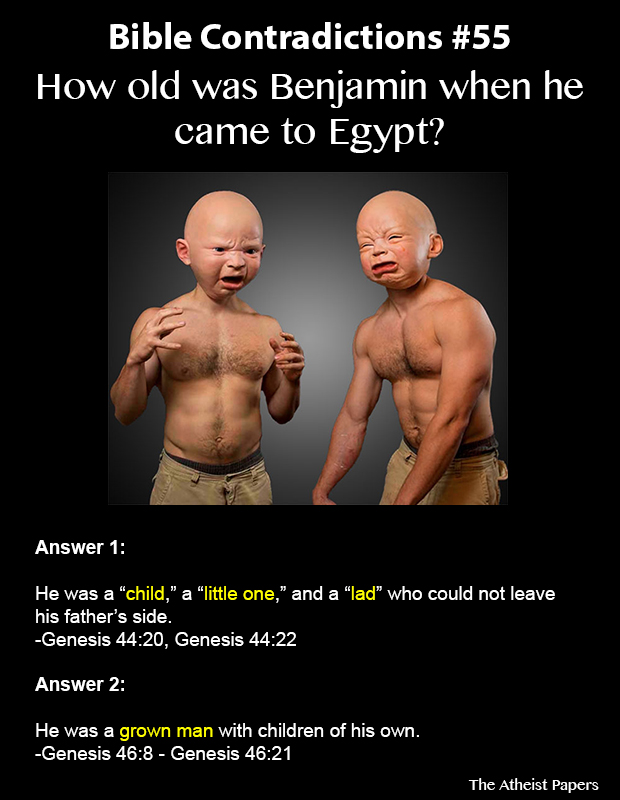
Bible Contradictions #55: How Old Was Benjamin When He Came to Egypt?

Bible Contradiction 55

In this episode of the Bible Contradictions, I’m going to expose a contradiction that often — by most efforts to understand the bible — goes unnoticed. The question we will ask the bible is how old was Benjamin when he came to Egypt? Unfortunately the bible gives us different answers.

First, if we look to Genesis chapter 44, we find two verses that claim Benjamin was a small child — maybe even a baby — when he came to Egypt. In verse 20 Benjamin has been kidnapped by Joseph. Judah comes to beg for his release and calls him a “young brother” or a “child,” depending on the translation. This is followed by verse 22 where Judah tells Joseph that if “the boy” or the “lad” is taken from his father, the father will die. This second verse tends to imply that the father will die of heartbreak from being separated from his infant son. It’s doubtful the father would die from being separated from a grown son because, as we see in chapter 46, Benjamin’s father came to Egypt with a long list of family members.

So we skip ahead to chapter 46.

The chapter begins by listing all of the Israelites who came to Egypt. The list is quite long. And for the sake of this post, all we need to do is to focus on two verses. Verse 8 tells us that this is the list of people who came to Egypt in the story in chapter 44. In other words, this is not a second coming to Egypt. Verse 21 tells us that Benjamin was a grown man with children of his own when he came to Egypt.

This is a very, very easy contradiction to miss because verses 8 through 27 of chapter 46 is one giant list of names of grown men and women and their children.

Some might argue that “young brother” or “lad” or “the boy” or “child” don’t refer at all to Benjamin’s age, but rather they refer to his status. For example, “young brother” is a vague term. How young is “young”? “Lad,” “the boy,” and “child” are even more vague. They could merely be defining Benjamin as the child of Jacob instead of a prepubescent boy. To be honest I don’t know the answer. The bible is too vague to determine what it actually means by these words. Indeed the Hebrew word for child, which is “yeled” and is commonly used in the Jewish scripts, doesn’t help either. “Yeled” can mean anything from “child” in the literal sense to “descendant.” In other words, I don’t know if this is actually a contradiction because the bible offers us no explanations of what it means by these words. But the opposite can be said to any apologist: They don’t know if this is actually not a contradiction either. No one knows. It’s a puzzle we can never solve.

Then again, the literal words are absolutely contradictory.

Posted in Bible Contradictions | Tagged , , , , , , | 7 Comments