Blueswoman Liz Mandeville song: Love is bigger than god

While whizzing around the megalopolis in which I live, I usually keep my radio tuned to a local non-profit station that plays everything from 20s swing to contemporary rhythm and blues. Three to seven PM is my favorite show of the day: It’s all blues, no commercial interruptions. Thanks to this station I’ve been introduced to several musicians I would have never heard otherwise. One of these artists is Liz Mandeville, a highly versatile Chicago blues vocalist, along with her band, the Blue Points.

On New Year’s Eve the station had a top 40 countdown for 2014 blues songs. I listened intently, writing down the names of each band, the song name, and anything that particularly struck me about the music, lyrics, or vocals. When Liz Mandeville came across the airwaves, I filled an entire page in my notebook because — although I know nothing about her religious background — her song, “Don’t Doubt My Love,” a duet with Charlie Love, has some pretty interesting lyrics that suggests religious beliefs don’t matter to her. With lines such as:

You can doubt the preacher man
When he shows you his clay feet*

You can doubt that heaven
Is waiting up there yonder when we die

But baby, there is one thing
You can always be sure of
Don’t doubt my love
Don’t doubt me baby

*I may have misheard this line. Her lyrics aren’t posted on the Internet.

liz mandeville heart o chicago

The song is filled with trivial things you can doubt: the salesman, the politician, the pilot, the weatherman, the dream, the same blood (a reference to the interconnectedness of all people). And mixed in with all of these trivial things is the preacher man and belief in the afterlife. You can doubt all of these things, including god, as long as you don’t doubt my love.

I should add that the religious aspect of these lyrics is not the main point of the song, but I feel like that makes my argument even stronger. She’s not only saying love is more important than religion; she’s also saying, compared to love, religion is as meaningful as a salesman.

If you have Spotify you can check out the song by doing a search for her. If you don’t have it, you can listen to the song on her Facebook page. Even if you disagree with me about the meaning of this song, it’s a fun and upbeat blues number. Actually her entire 2014 album is just fantastic. I highly recommend it.

Posted in Music | Tagged , , , , , | Leave a comment

Book Review: Sacred and Secular

Sacred and Secular: Religion and Politics Worldwide by Ronald Inglehart and Pippa Norris (2004) is an empirical study into the postmodern society, which sounds like an oxymoron; however, postmodernism as a field is too vast, by definition, to result in useful knowledge. Here, Norris and Inglehart use decades worth of research to determine to what extent religion will be important, and if it is fading, what will replace it. Their interest lies in the centuries old belief that religion will become less and less important. Their research is contingent upon modernization theory, which they argue is not the end game. After modernization, societal changes continue to take place. These changes are the basis of the postmodern society.

sacred and secular

They demonstrate two main points that appear to contradict one another at first glance: First, during the last half-century people in industrial societies have grown more secularized, giving up religious practices in many areas of life usually monopolized by the church; and second, “The world as a whole now has more people with traditional religious views than ever before – and they constitute a growing proportion of the world’s population” (page 29). If one takes into consideration religion’s impact on fertility rates (that is, religious people tend to have more children, particularly in lesser-developed regions), then these two points do not seem as contradictory as they initially appear.

Norris and Inglehart test six hypotheses: first, religiousness is negatively correlated with security (the more secure a society is, the less religious it is); second, religious traditions wane in postindustrialized societies; third, this has resulted in fewer religious practices (such as going to church); fourth, higher religious participation puts pressure on the electorate to support religious parties; fifth, poor societies have more religion and higher fertility rates; and sixth, the supply of religion correlates with religious participation.

They make three conclusions: first, human security is rising, and thus, in these societies where human security is rising (the industrial and postindustrial societies) secularization is also rising; second, because religious societies have higher birthrates than secular societies, the world, in general, is becoming more religious; and third, they predict, but cannot say with certainty, the gap between the secure-secular societies and the insecure-religious societies “will have important consequences for world politics, raising the role of religion on the international agenda.”

Essentially their argument is as follows: Existential insecurity causes people to seek religion to create norms with which to ensure survival. As existential security increases, religion becomes less important, and secularization becomes the norm. Insecure societies will, then, attempt to react against these changing norms around them. In other words, insecure societies will force their religious beliefs into the international arena (think Uganda’s “Kill the Gays” bill).

Norris and Inglehart’s book is, in my opinion, one of the most important religious studies out there. Not only does it suggest what the future holds for industrializing societies, using empirical evidence, it also implies that the vacuum left by the absence of religion will be filled with social justice. It is also the perfect marriage of the disparities between postmodernism and empirical research. Although the theory is not, per se, postmodern, the result seems to support the theory of postmodernism.

Sacred and Secular is ten years old, but their methods and findings still hold up to scrutiny. Indeed, it might be mandatory reading in some graduate programs. The final takeaway: This is a perfect book to discuss over wine with your religious friends and family. If you want to discuss something empirical but still related to religion and secularism, Inglehart’s and Norris’ book is a good choice.

Posted in Uncategorized | Tagged , , , , , , | 1 Comment

What should atheists read? A brief bibliography

The short answer to the question in the title is: There is no essential reading list for non-believers. While many might argue the books by Hitchens, Dawkins, Dennett, and Harris are indispensable, atheists reading about atheism is merely an exercise in availability cascade (in the same way Christians reading about Christianity is an exercise in availability cascade). The shorter answer to the question, however, is: Everything!!!

Personally, I’ve been blessed with lifetime subscriptions to practically every academic journal available through digital means, but not everyone is so lucky. Therefore, I’m providing my readers with a short multidisciplinary list of peer-reviewed journal articles that serve two purposes: 1) To expand their knowledge base, and 2) to give them something to talk about with their friends over drinks. This brief bibliography is not the product of my access to scholarly journals. This list is actually the product of using an invaluable reference tool available to everyone with Internet access: Google Scholar. Several of the articles are freely available. Just click the PDF!

First, for those of you left scratching your heads over “availability cascade,” I should define it. Availability cascade, or the illusory truth effect, is a cognitive bias fallacy wherein the believer assumes a statement or belief to be true because s/he has been repeatedly exposed to it. Google Scholar has a great article about an experiment using availability cascade:

The remainder of this post will be in titled bulleted list form.

More on availability cascade

Statistical mechanics

Self-immolation (my specialty)

Cognitive dissonance

Free will

International relations

This list is not even the tip of the available iceberg. Although without subscriptions you won’t get the latest, most up-to-date articles in science, Google Scholar is a wonderful tool for the inquisitively minded. I urge all non-believers (and believers too) to abstain from reading too much about atheism (perhaps this blog included) and focus your attention on the fruits of hundreds of years of scientific discovery. Besides, I’m sure your believing friends and family are tired of hearing about what you don’t believe. Why not discuss science instead of religion sometimes? Head over to Google Scholar (or send me hate mail if you can’t find something. I’ll try to find it and send it to you) and have a blast!!

Posted in Atheism | Tagged , , , , | 10 Comments

Fox News readers lose their shit over Tyson Christmas tweets

I’m sure most of you are already aware of the humorous tweets physicist Neil deGrasse Tyson sent out on Christmas. If you’re not, I’m linking a news article about them here. The linked article comes from Fox News, which I was pleasantly surprised to learn allows comments (last time I checked, about two years ago, they didn’t). So I did that thing I do and, after reading the article, I clicked on the comments section. And, whoa, was I entertained!

Fox News doesn’t show all of his tweets. To see the ones they omitted, click here.

First, to sum up: Tyson tweeted a series of observations about Christmas using humor to entertain his followers on Twitter. None of them made fun of Christians; they did, however, make fun of Christmas. But the “mockery” was hidden beneath facts. The only tweet that resembles an attack against Christians is actually making fun of consumerism. Furthermore, the tweet Fox omitted praised Santa for knowing about physics.* Not everyone agrees with me. Many of Fox’s readers jumped in on the comment board to unleash their fury and racism. Below I’ve screen capped some of the offending responses.

*The tweet about Santa using a red nosed rain deer as opposed to a blue nosed rain deer is based on light scattering. Longer wavelengths (red) penetrate through fog much easier than shorter wavelengths (blue). I’m not certain why Fox News would leave out this tweet.

Some were pleading.

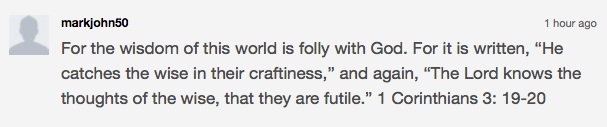
markjohn

roccopan

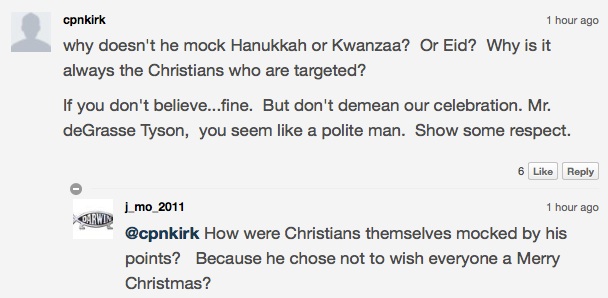
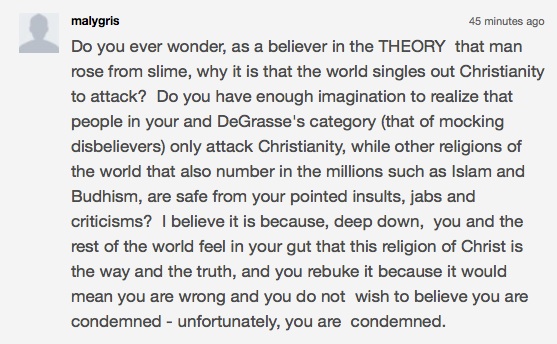
Some were anti-anti-hypocritical.

cpnkirk

malygrls

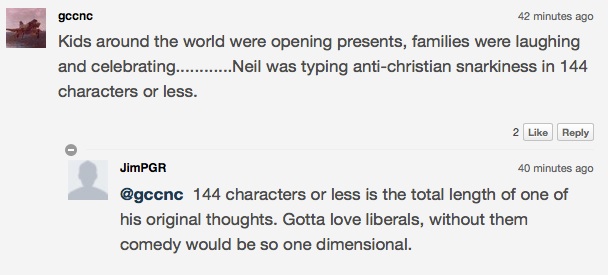
Some used ad hominems.

gccnc

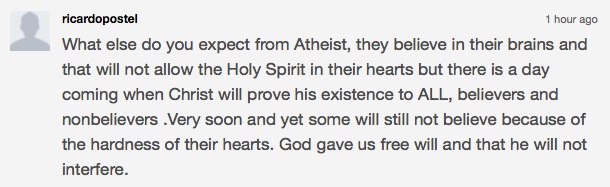
ricardo

Um. Yes, I believe in my brain. I know I have one. I’ve had it scanned by MRI and CT machines.

jnhks

This is the dumbest comment in the lot. I considered omitting it from this post due to possibly being Poe, but I decided to let you decide.

sith lord

Neil is married to a woman and has two children. I’m pretty sure he’s not gay. I think you’re confusing him with Neil Patrick Harris.

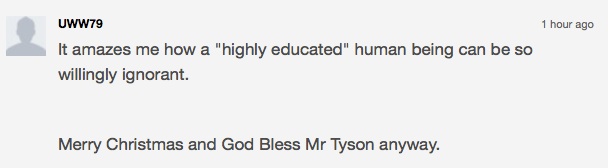
uww

Why the quotation marks? Tyson holds a Ph.D in astrophysics from Columbia University. That is literally highly educated.

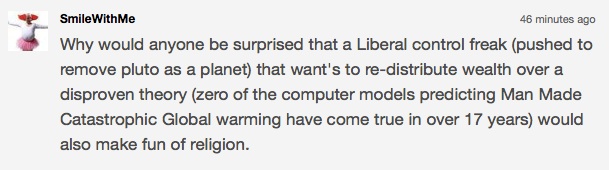
Some clearly didn’t peruse the scientific literature prior to posting.

smilewithme

Some were just idiotic.

jnhks2

So what if Newton believed in god? That has nothing to do with his contributions to science or Tyson’s admiration of him.

good2know

Some were actually funny.

panamaexpat

Funny, yes. Then again this assumes Tyson is a “progressive,” whatever he means by that.

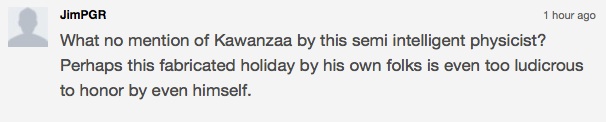
Unfortunately, many turned racist.

jimpgr

john

Something tells me Tyson and Sharpton are at opposite ends of the theological spectrum.

And probably the most racist one of all:

mikerotch

Essentially this poster is saying he has no idea who Neil deGrasse Tyson is, “but look! He’s black! He’s a “hood rat savage!” Don’t believe anything he says!”

I wish I could say that these comments were extreme outliers in a forum of mostly reasonable responses to an article on Fox News about Tyson, but unfortunately they weren’t. I’m very aware that Fox News is where some of the right-of-center folks end up getting their news, so I was not surprised at the level of vitriolic words aimed at one of our most highly esteemed thinkers. I just wish they didn’t take his humor as personal attacks against them.

And finally:

racercb

No. No he wouldn’t.

Posted in Uncategorized | Tagged , , , , , , , | 3 Comments

An alternative to secular Christmas music: That Detroit Soul!

It’s that time of year again when ex-Christian non-believers must accept the shackles of their former religious upbringings. While December 25 — to us — is just another day on the calendar, no more worthy of special treatment than December 26, the social contract written by religion but enforced by family compels us to spend our hard-earned cash on trivial gifts for family members who may or may not deserve them, invest in gaudy wrapping paper, make our travel (and timely escape) plans, and come up with polite ways to avoid the topic of baby Jesus. But it’s not all bad. There’s a secret many of us keep. I want to shed some light on that secret. Personally, I’m always up front about it, and when I am, others will, too, confess their guilty pleasure.

I enjoy Christmas music.

The majority of popular Christmas songs out there are classics. They’ve become a traditional part of the Christmas experience, especially in the US. They were recorded during a time when music was pure, unadulterated by overpaid record producers and engineers. They were recorded when arrangement took priority over production or volume. In other words, these recordings mimic the time in which they were recorded. Bing Crosby, for example, is still Bing Crosby when he sings “White Christmas.” And Bing Crosby recordings are immaculate.

Perhaps that’s the reason Bing Crosby is a staple, while Josh Groban’s Christmas album will most likely be completely forgotten in ten years.

My original plan for this post was to offer non-believers a list of secular Christmas songs, but to be honest, I even enjoy the religious tracks. While Googling around for secular Christmas songs I came across scores of bloggers who’d beaten me to the punch. If you’re looking for secular songs to play on Christmas, Google will not disappoint you. But why do they need to be secular? Who cares what the lyrics are about? In my humble opinion melody, rhythm, vocal cadence, and instrumentation far exceed the importance of lyrical content. So I did a different Google search and found something incredible: Detroit Soul.

motown christmas

The above album is just one of many Motown Christmas records put out over the years, and they’re all available on iTunes and Spotify (albums in links), etc. I clicked through several of the songs and, just as I indicated above, these recordings more accurately reflect the mood of Motown than the mood of Christmas. Unfortunately, just as I predict with Josh Groban, these recordings have largely been lost in Crosby’s shadow. So why not pull them out this Christmas and surprise your family with the tradition of “Joy to the World” with all the soul of the Supremes!

Happy holidays, everyone. I’ll be back after I do this family thing. Until then, alcohol. Lots and lots of alcohol.

Posted in Music | Tagged , , , , , | Leave a comment

Should Christians bring back the beard?

The short answer to the question I pose in the title is, unfortunately, no. They have no reason to. Christianity is more about grace than it is about grooming practices. Contrary to a few other religions, Christianity does not teach that salvation comes through growing a beard. This is a little frustrating to me. Having previously lived in a Middle Eastern country where beards are as common as Nike tennis shoes, the professional social stigma against beards in the United States stings even more. But the stigma is changing. It always does. Beards go in and out of vogue on a regular basis here. So what if there is some way to reconcile the beard with the largest religion in the US, Christianity?

First, I will examine popular depictions of popular religious figures. Second, I will contrast that against what the bible actually says about beards. Lastly, I’ll make my argument.

One of the most interesting aspects of Christianity is its ability to confine the power of its god through human-defined and created contours on a canvas or relief or free-standing chiseled stone, despite the Exodus prohibition against making graven images. These biblically-inspired works of art are wonderful, and many of them depict god or his followers sporting quite remarkable beards. Here’s a painting of literal god offering Jesus a spot at the throne of heaven.

GodInvitingChristDetail

God has an awesome beard (according to the painter). But what about men? Here’s a well-known image of Abraham doing that thing Abraham did (you know what I’m talking about).

Sacrifice-of-Isaac-965x543

Wow! That’s one hell of a beard! And what about Jesus? Here’s a composite of the historical Jesus through the lens of several societies.

CompositeJesus

Eh. He still rocks a good beard (even Oriental Jesus), but let’s be honest; he’s got nothing on Abraham’s incredible, divine locks (to be fair, however, god’s beard does come close).

What I’m trying to say here is Christianity, as conceptualized through artists’ renditions, and often commissioned by Papal funds or other church coffers, depicts a holy land replete with god-fearing, bearded men. And heaven itself is ruled by a bearded man and his bearded son. It was almost as if the bible itself commanded every man to grow a beard. And that brings us to part two of this post.

What does the bible say about beards? Well, it says a lot in the Old Testament. For example, when Kind David pretended to be insane, he drooled down his beardAaron had a beard.  Samson had a beard (he took a Nazarite vow, which meant he didn’t cut any hair). And one of Saul’s sons grew a beard (albeit while in mourning). There are many, many other awesome beards mentioned in the Old Testament, but not so much in the New. Then again, the OT does mention that Jesus will sport a beard.

Yes, in Isaiah 50:6 (NRSVCE), Jesus explicitly mentions his beard:

I gave my back to those who struck me,
    and my cheeks to those who pulled out the beard;
I did not hide my face
    from insult and spitting.

Note that the Isaiah verse is a prophesy.

The OT also very clearly prohibits trimming beards (Leviticus 19:27).

You shall not round off the hair on your temples or mar the edges of your beard.

Of course, this is all meaningless because, as almost any Christian will point out, Christianity is not about adhering to the arcane and arbitrary laws of the Old Testament. Christianity eschews many of those rules in favor of grace through honoring the sacrifice their god made to save their souls from sin. Then again, what better way to honor your god than to embrace his creation?

My argument is that both artists’ renditions of biblical figures and the bible itself show men with full and luxurious beards. Even Jesus himself wore a beard. If this is true then it might be that these men grew their beards because it was part of their god’s creation. God created men with an ability to grow facial hair, and instead of shunning that ability, these men exalted the gift upon which god had bestowed them.

If Christian men in the United States stopped shamefully shaving their god-given facial hair, the social professional stigma against beards would evaporate overnight. If there were a Christian-led beard revolution, wherein Christian men assumed their god-given gifts, there would be no stopping the beard anywhere. There would be no more beard policies at the workplace. (And don’t even try to tell me the bans could still be in effect in the food industry. Hair is not a health hazard. It’s just gross to find in your food). We would have a bearded president. Our military might lax their prohibition against facial hair. And even better, I can grow my beard long without being called “hippy” or “Gandalf” or being mistaken for an Islamic radical (that happened in Lebanon once).

Although I’m atheist, it’s my position that if you believe in the Christian god, if you believe in Christianity and Christ, and if you believe that god is the author of creation (even if you’re not a creationist), then you must believe that god created the beard. I think it is your duty as a Christian to either grow a beard or refrain from judging anyone who wishes to embrace god’s gift of beard.

When David was told, he sent to meet them, for the men were greatly ashamed. The king said, “Remain at Jericho until your beards have grown, and then return.” – 2 Samuel 10:5

Posted in Uncategorized | Tagged , , , , | Leave a comment

Want to test your cognitive dissonance?

I don’t have much for you today. Lately I’ve been much more interested in reading than writing, but I came across an article from the BBC today titled “Will religion ever disappear?” It’s a wonderfully written piece by Rachel Nuwer. Honestly, I was very impressed by the scholarly quality of this article, which, upon Googling her name, makes sense. She holds two master’s degrees, one in a science field and one in scientific writing. Furthermore, according her her bio page on her personal website, she’s a published scholar in a peer-reviewed journal.

Her approach to the question raised in the title of her piece is a combination literature review and critical analysis (basically the exact thing graduate students are taught to do in pursuing a master’s degree). The answers she gives should be uncomfortable to both believers and non-believers alike, which brings me to the main thrust of this post: Reading her article is a perfect exercise in cognitive dissonance discomfort mitigation. Refer to my most recent post for more info on that. How you respond to this article should reveal something about you. For example, Richard Dawkins’ assertion that no child is born religious is directly contradicted in Nuwer’s article with a linked peer-reviewed study. Atheists might have a difficult time accepting this. Religious people, too, might suffer cognitive discomfort by reading this article, even the bits that seem to lend credit to religions.

What I will find most interesting is, regardless of your religious beliefs or lack thereof, how you mitigate the cognitive discomfort. Will you seek to verify her arguments and, with strong evidence, modify your current beliefs about certain phenomena? Will you seek to justify her contradictory arguments by incorporating them into your pre-existing beliefs? Or will you completely ignore her arguments, even in the face of strong evidence, and stick to your original beliefs, unaltered?

Enough of my babble. Go read the article!

Posted in Atheism | Tagged , , , , , , | 1 Comment

We’re the reason creationists are crazy

I’ve mentioned cognitive dissonance a lot in my blogs. It’s a problem that plagues practically every thought we ever have. Everything from politics to philosophy, from medicine to physics, from music to television, cognitive dissonance is a bitch. If you’re unfamiliar with the concept, I’ll let the man who coined the term sum it up for you:

This theory centers around the idea that if a person knows various things that are not psychologically con­sistent with one another, he will, in a variety of ways, try to make them more consistent. Two items of information that psychologically do not fit together are said to be in a dissonant relation to each other. The items of information may be about behavior, feelings, opin­ions, things in the environment and so on. The word “cognitive” simply em­phasizes that the theory deals with relations among items of information.

This comes from Leon Festinger’s 1962 article “Cognitive dissonance” from Scientific American 207 (4), page 93. To illustrate this phenomenon, Festinger likes to use a smoker. Imagine a man smoking a cigarette. Ask him if cigarettes can kill. He’ll acknowledge they can while taking another puff. On the one hand he believes smoking is enjoyable. On the other hand he believes smoking is life threatening. This is a rather insignificant example of cognitive dissonance at work, but I think it’s a good example.

We can find a very remarkable example by looking at creationists. In this post my aim is to argue that it’s our (non-creationists) fault that creationists believe what they believe. We are not the only reason. Surely, their religions play some role, but there’s no denying that we push creationists to hold onto those beliefs after they’ve experienced severe cognitive dissonance.

On the one hand many creationists, particularly young earth creationists, believe the earth was created by god in six literal days around 6,000 years ago. On the other hand, they know there is undeniable evidence to support a much, much, much older earth created by natural processes. This undeniable evidence is rather uncomfortable, so they seek to mitigate this discomfort by surrounding themselves with like-minded individuals to reinforce their original, young earth beliefs.

When dealing with the discomfort of cognitive dissonance, we are faced with three choices: 1) We can accept the new, undeniable evidence and drop our previous untenable beliefs, believing instead in the thing we can support with evidence. This is very difficult to do because one must admit they were wrong. Even admitting that to yourself is often difficult. Imagine admitting it to the world. But it’s possible, and it completely alleviates the discomfort caused by cognitive dissonance. 2) We can try to keep our original untenable beliefs by justifying the new evidence with our old beliefs. For example, the smoker might say to himself, “Yes, smoking is dangerous, but my grandfather smoked two packs a day and lived to be 98. I’m not worried.” The creationist might say the new contradictory evidence is supported by the bible (even when it’s not). Finally, 3) We can completely ignore the new, undeniable evidence and hold steadfast to our original untenable beliefs. Both 2 and 3 make it impossible to completely alleviate your cognitive discomfort, but it’s possible to lessen the discomfort with them. Young earth creationists tend to do a combination of 2 and 3. Surrounding themselves with like-minded individuals only serves to strengthen their adoptions of 2 and 3.

Meanwhile, creationists tend to do a lot of proselytizing, which puts their beliefs within mockable reach. The more public they become — such as Ken Ham and Eric Hovind — the more their beliefs will be challenged by undeniable evidence and probably mocked by people who have presented this evidence, particularly when they choose to have a public debate with a scientist. While the cognitive dissonance creates extreme discomfort, often causing them to lash out, a cognitive paradox occurs: Should I deny the new evidence and hold onto my beliefs or accept it and confess to the whole world that they were right? The answer isn’t pretty. Again, I’ll let Festinger explain this phenomenon:

[T]he jeering of non-believers simply makes it more difficult for the adherents to withdraw from the movement and admit they were wrong…

This quote comes from Festinger’s 1956 book, When Prophesy Fails: A social and psychological study of a modern group that predicted the destruction of the world (University of Minnesota Press), page 5. Although creationism at face value has nothing to do with a UFO doomsday religion, this was the seminal work that later led to Festinger’s research into cognitive dissonance theory. We can take those elements from the quote and apply them to creationists: “The jeering of non-creationists simply makes it more difficult for the adherents of creationism to admit they were wrong.”

In other words, our mocks compel creationists to stand their ground, even when we present them with undeniable evidence that completely contradicts creationism. They would rather live a life of maddening discomfort than to admit that the discomfort was in vain. To them it’s about honor over truth.

What is most remarkable, then, is when a creationist accepts the undeniable contradictory evidence, despite their honor. Indeed, considering the amount of cognitive discomfort and mental gymnastics one must go through in order to drop creationist beliefs, it’s extraordinarily honorable to do so. Imagine spending your life believing something so ridiculous as creationism and fighting tooth and nail to prove it, suffering years or torment and mockery because of those beliefs, but also receiving reinforcement from your creationist social support structure, which is extremely difficult to abandon… and then one day you realize it was all a lie. And you publicly confess your failures. That takes guts, and it deserves the utmost social esteem.

This post is not to say we should stop mocking bad beliefs, particularly creationism; it’s merely pointing the finger where the finger deserves to be pointed. We may play a big role in the perpetuation of untenable beliefs, but that’s not our fault; it’s due to natural cognitive failures.

Posted in Atheism | Tagged , , , , , , , , , | 4 Comments

This is how religious people and everyone else should approach morality

I sat for a seminar today (I know, how fun), and the woman proctoring the seminar was a case worker for a neighboring city’s juvenile and domestic relations court. When she gave examples to explain the concepts she was presenting, she often spoke about the children she supervises. Mostly every example she gave used actual court cases involving juveniles or juveniles who had been sentenced and gotten into more trouble. This is rather important to the central point of this post, which I will get to momentarily.

After she introduced herself, the first thing she said was, “I believe in a higher power. I believe in a god.” Which god? I don’t know, but she’s a latin woman, so the odds are she’s Catholic.

This made me roll my eyes because this seminar had absolutely nothing to do with supernatural agencies or even religious beliefs. It was almost like she was telling us she believed in god strictly for her own benefit. But then towards the end of the seminar the issue of morality came up. Before we go on, I’d just like to reiterate that I’m a firm supporter of the idea that what many call morals are socially constructed. Objective morality is a myth. Of course, I’m sure you can see where this is going.

The first thing she said about morality was, “I believe in a higher power. We might not get in trouble for our actions on this earth, but god up there will one day hold us accountable.” … and there it is.

A man a few seats away from me turned to his neighbor and said, “I don’t believe any of that nonsense. Why is she even bringing it up?” She must have heard the man because she quickly put him in his place.

She said, “If you don’t believe in a higher power, if you don’t believe in god, if you don’t believe in karma, you better believe in a judge!”

Bam!! She nailed it! People hold us accountable for our actions all the time. Be it the police, a judge, our boss, our family members, our friends, or some other social force, someone is going to punish us if they catch us doing something wrong.

I wish everyone, especially religious people, especially especially apologists, would shut up about objective morality. We can all agree that judges exist and are ready, willing, and able to mete out justice. That’s as close to objective morality as we’re going to get.

On a side note, I was especially appreciative of how she handled the atheism issue. She acknowledged our presence in the room. She validated our position (instead of condemning it). And she offered us a secular alternative to her beliefs (instead of forcing her beliefs on us). Good for her. I hope all religious people will take a page from her book.

Posted in Atheism | Tagged , , , , , , | 1 Comment

It’s time to take the “X” out of Xmas

Warning: Satire. It’s been a long, unproductive day. I figured I’d continue in my unproductiveness and make this post.

For what feels like centuries Christians have been trying to put “Christ” back into Christmas, whatever the hell that even means. Although the “war” on Christmas has been grossly one-sided, somehow Christians have missed out on the fact that, while they’re fighting to keep manger scenes on state property, Christ was abandoned from the holiday long ago. What’s left is essentially a secular holiday where people from all religious backgrounds come together to eat food, exchange gifts, and keep each other company. Christmas is also a holiday when Chinese Americans cook exclusively for Jewish people.

What’s left of the holiday is “X”-mas (even though the X in Xmas literally means Christ, but let’s pretend it doesn’t since Christians often forget that it does).

Some have predicted in 1,000 years the word “Christmas” will no longer exist, having long been replaced with “Xmas.” But what if we can change the future? What if we can take the “X” out of Xmas, replacing the letter with its complementary counterpart, its perpendicular friend, “Y.”

Yes, let’s start calling it “Ymas.”

ymas

It’s best to be at 0 on the X-axis. High on the Y-axis is where it’s at. In other words, it’s best to be at 0 on the Xmas. Ymas is where it’s at!


For Ymas you can buy your friends and families gifts like this:

stats for dummies

Posted in Satire | Tagged , , , , , , , | Leave a comment