A Christian blues lover: Satan is the author of the blues

I’m a huge fan of the blues. I play drums and sing in a blues band. And when I’m not onstage, one can often find me attending all-Saturday night juke joint-esque live blues clubs. These events are like no other after-dark celebration. Blues lovers ranging from barely 21 to cusp-of-death 94 pack small, cramped, lowly lit restaurants for one purpose: to spend all night with a single band playing everything from Robert Johnson to Led Zeppelin. The party lasts all night, or at least until the liquor runs out. And in a drunken stupor the atmosphere hits a sexual frenzy, complete with (sometimes) jealous fist fights. It’s an ancient ceremony, and legends about the devil abound.

Last weekend I went to one of these events. In between sets I had a chance encounter with a “non-denominational Christian who lives by and preaches the ‘true’ word of Christ,” whatever that means. The conversation didn’t begin with religion; it actually began by talking about the roots of early bluesmen, which inevitably led to talk about gospel music (another genre I enjoy). The man had some strong feelings about gospel music. I’m going to attempt to recreate the conversation as best as I can (remember, I was drinking that night…heavily). The end offers an interesting revelation about this man’s feelings about the blues.

Me: “I love gospel music. I get an incredible feeling when listening to gospel music or seeing gospel bands.”

Him: “That’s god talking through the music. It’s Jesus Christ personally talking to you. That’s why you get that feeling.”

Me: “Well, I’m atheist, so I don’t know about that.”

Him: “Oh come on! You can’t tell me that feeling is something else. I know it’s Jesus reaching out to you.”

Me: “But I get the same feeling when I listen to the Muslim call to prayer. Is that god too?”

Him: “No that’s the devil [laughing]. Satan is trying to trick you into joining a false religion.”

Me: “But I also get the same feeling when I listen to the blues. Is that Jesus? Or is Satan trying to trick me?”

Him: “That’s Satan too. The blues is a godless music. Satan invented the blues to stray us. It promotes wickedness and sexual perversions. Fornication. Adultery. Loose women. This is all the work of the devil, I tell you.”

Me: “Don’t you like the blues?”

Him: “I love the blues! Satan has got a hold of me tonight, but tomorrow I’ll go back to god. God doesn’t care what happens in these joints as long as we ask forgiveness Sunday morning.”

The rest of the conversation was an ill-fated attempt on his part to convert this godless heathen. But the next day, after I cured my hangover with a meal fit for a king, I started to think about what the man said about the blues. His general idea was this: He can “sin” all he wants to Saturday night, even taking home a “loose” woman (his words), even if it means he’s literally (in his mind) doing Satan’s work, as long as he turns himself back to Jesus by time the sun comes up.

I wonder what other “sins” he can justify as long as he repents afterwards.

NOTE: The blues is not only an incredible genre of music, but its history is probably the bloodiest in music, and, even though it was created by a highly religious American demographic, the blues is surprisingly almost entirely devoid of reference to god. It’s quite a secular genre.
Posted in Atheism | Tagged , , , , , , , , , | 1 Comment

The most annoying thing about being a skeptic

Note: This post is not about atheism or religion. It’s not even about skepticism in general. It’s about me. But I’m sure other skeptics out there feel the same way I do.

I’m not a huge fan of the science fiction genre, per se, but I do enjoy several series and movies that fall under that classification. For example, I very much enjoyed BSG (both incarnations), and I watched The 4400 almost religiously and felt betrayed when it was cancelled during a cliffhanger. But generally I have a difficult time watching science fiction films and television series because I have a natural tendency to suspend my suspension of disbelief. And this, at times, annoys the hell out of me.

This can make watching a 22 minute episode on Netflix very tedious — as I pause the player every 45 seconds to either check a claim or, even worse, type a query into EBSCOhost to read about what the latest scientific literature says about a topic discussed in the episode. I’ve — quite a few times — turned a single episode of something like Jericho into a five hour review-of-the-literature on nuclear weapons. (By the way, it’s my professional opinion that Jericho accurately depicts what would happen if the United States suffered several nuclear detonations).

Sometimes, of course, a movie or episode makes a claim or sets a stage that piques my curiosity, but I’m unable to find what the scientific literature says about that topic. This can make my head explode. So what do I do in this circumstance? I mean, my suspension of disbelief is still suspended, so I have to do something.

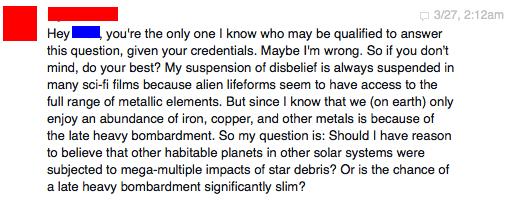
I write to my friends in academia or professional research who study those particular fields and ask for their input. Here’s a discussion I had earlier this year with a friend of mine who is a physicist working at LASP.

bombardment1

Of course, my friend gave the classic non-answer we expect from people with intellectual integrity.

bombardment2

His answer is basically this: We have no reason to reject X, but we don’t yet have the capability to support X. In other words, “I don’t know, but I’m leaning towards yes.” This non-answer, while honest and all I could expect from someone who actually studies this, does absolutely nothing to satisfy my intellectual curiosity. And thus, I’m left thinking about this question throughout the remainder of the movie or series. I’m able to somewhat still enjoy it, but I can’t shake that skepticism.

So am I alone? Do others out there suffer through the same intellectual curiosity that I suffer? So much that it prevents you from fully enjoying science fiction, documentaries, or other mediums of entertainment? Interestingly, I don’t have this problem when watching fantasy. I can easily suspend my disbelief when I know what I’m watching is impossible (probably because “impossibility” is a satisfying answer).

Posted in Atheism | Tagged , , , , , | 3 Comments

Cancer doesn’t care about Jesus

I found the following image floating around the Internet yesterday, and I had to shake my head in disapproval.

cancer jesus

Cancer doesn’t fear Jesus. Cancer doesn’t have a central nervous system capable of forming any emotions, not even fear of 2,000-year-old zombie gods. Furthermore, the image shows a patient who obviously put trust in medical professionals who prescribed chemotherapy or radiation (it’s unlikely her hair loss was caused by intercessory prayer). Why wouldn’t the author of this image use a healthy looking person to get their point across?

This image is rather harmless and innocent, but it’s incredibly annoying. If you believe praying to Jesus can help cure cancer or other ailments (by the way, the opposite is true) then that’s the way you feel, but don’t get your hopes up. So far Jesus has contributed precisely nothing to the medical field.

Don’t share this image to inspire people. Mock it.

Posted in Atheism | Tagged , , , , , , | 2 Comments

The worst argument in politics: God

Remember when we were small children, completely ignorant to domestic politics, completely unaware that foreign policy and global politics existed? When we were mere lads and lasses we couldn’t care less about what those men in suits said who kept our fathers’ faces flush to the television screens. Our ignorance to everything political didn’t stop father from loudly taking his position, shouting it at the screen, grumbling it to himself as he sipped his beer. And for those few short years, everything we learned about politics we learned from a single, angry source: Dad.

A devout conservative, my father, it’s surprising that during my first grade mock presidential elections I voted for Dukakis. The rest of the class of six and seven-year-olds voted for Bush (41). Why did they vote for Bush? Did these children know something about Bush’s platform that I didn’t know? Were they fully aware of the issues at stake? No. Quite literally they voted for Bush because “My dad says Doodiekochyhead is an idiot.” Ok, fair enough. Daddy’s always right. Me? I didn’t fare any better. I voted for Dukakis strictly because I was the only person in my class who could accurately pronounce his name. I had a prepubescent superiority complex.

Most of us (the reasonable people) outgrow this tendency to defer back to father when talking about political issues. We form opinions of our own after years of being exposed to generalized issues such as social policy, economics, foreign policy, etc. We begin to align ourselves somewhere on or within the political spectrum. But then again, there are some (many) of us who still defer back to daddy, even if it’s not biological daddy. Behold:

di finch

SOURCE: Comments from this article

I could’ve used almost any political news article from the last two weeks to illustrate this point, but that would’ve been too easy. Just swap out some of the words and the above comment now reads: “As an American I am angry at this socialist crap. Whatever judges decide marriage belongs to straight couples. God said that so that decides it as far as I am concerned.” My point is that this comment could’ve been left anywhere, and it would still be just as intellectually lazy.

Saying “Because god said so” is not an actual answer to anything. It’s no more informed than a child saying “Obama’s a stupid head because my dad says so!” Unfortunately these comments are everywhere, on everything from same-sex marriage to ISIS. There are still people who take positions on political matters based on what their scripture says. They don’t take the time to understand the issue, instead deferring to their religious beliefs. Or even worse, they do understand the issue, but instead do the opposite of what logic tells them to do because their sky daddy says so. “Obama’s a stupid head because god says so.” See how idiotic that sounds?

If you’re going to take a position on something, be informed. If your position is “god says so” then you’ve taken a stupid position. If you actually invest oneself in the issue, you’ll find the issues are far more complicated than a black-and-white deferral to god. Have your own voice because these are issues that affect us all and have nothing to do with your particular brand of theism. Referring back to the comment illustrated in this post, Palestine is incredibly more complicated than what the Abrahamic religious texts say. Saying “God gave the land to the Jews” completely ignores the complexity of this issue.

Posted in Atheism | Tagged , , , , , , , | 6 Comments

Do Americans have freedom FROM religion? Actually, yes (two SCOTUS cases)

Americans indeed have a right to not be forced to practice a religion, any religion. We have rights to not be subjected to a state endorsement of one religion over another, or over irreligion. These are inalienable rights; however, some have resisted the implementation of these rights with a rather strange assertion: “It’s freedom of religion, not freedom from religion.” Well, yes, that’s how it’s traditionally worded, but I don’t think they understand what freedom of religion actually is.

Yesterday I examined how — in my opinion — religious exemptions to certain rules (in my example, beards) have the unfortunate effect of harming the rest of us. Today I’ll pore over two court cases that explicitly lay out how Americans indeed have freedom from religion. Yesterday’s post highlighted rather inconsequential issues, so I figured I should examine issues of literal life and death: War.

In these cases SCOTUS sidestepped defining religion, and instead essentially stated that “It’s up to you — the individual — to define what a religion is.” Their finding: Secular ethics and religious ethics occupy the same places in our hearts.

Case #1: United States v. Seeger, 380 US 163, 85 S. Ct. 850 (1965)

The issue before the Court in Seeger was whether or not people who do not follow orthodox religions can be exempted from forced military service. The Court found that following unorthodox religions meets the criteria for religious exemption from military service. Specifically,

A sincere and meaningful belief which occupies in the life of its possessor a place parallel to that filled by the God of those admittedly qualifying for the exemption comes within the statutory definition. This construction avoids imputing to Congress an intent to classify different religious beliefs, exempting some and excluding others, and is in accord with the well-established congressional policy of equal treatment for those whose opposition to service is grounded in their religious tenets.

This quote is hugely important. The Court not only exempted unorthodox religious adherents from military service; it also equated strongly held ethical stances with religious beliefs. In this sense, the Court also exempted atheists from service, so long as said atheists express “A sincere and meaningful belief [against war] which occupies in the life of its possessor a place parallel to that filled by the God.” But some might contest my assertion, so I’ll move on to the next case.

Case #2: Welsh v. US, 398 US 333 (1970)

The issue before the Court in Welsh was whether or not a person can be exempted from military service if their objections to service do not stem from any religious background. The Court found that, yes, one doesn’t need to be religious to have ethical beliefs that are identical to religious ethics. Specifically (quoting Seeger),

If an individual deeply and sincerely holds beliefs that are purely ethical or moral in source and content but that nevertheless impose upon him a duty of conscience to refrain from participating in any war at any time, those beliefs certainly occupy in the life of that individual “a place parallel to that filled by . . . God” in traditionally religious persons. Because his beliefs function as a religion in his life, such an individual is as much entitled to a “religious” conscientious objector exemption under § 6(j) as is someone who derives his conscientious opposition to war from traditional religious convictions.

Here the Court explicitly equates deep ethical stances with the same level of authority over the self as religion. In other words, atheists can file religious exemptions from military service even if their stance about war came merely from within instead of from a pulpit.

So What?

These cases are extremely important because, as I stated above, SCOTUS expanded religious exemptions to include anyone, even atheists, so long as their ethics resemble those of the religious. But furthermore, the Court separated itself completely from religion. Not only do ethics occupy the same place in atheists’ hearts as religion occupies in the faithful, religion occupies in the hearts of the faithful the same place ethics occupies in the atheists. In other words we not only have freedom of religion, the Court’s decisions in Seeger and Welsh exemplify that we indeed have freedom from religion. We need not pass a religious litmus test to enjoy a religious exemption from military service. Secular ethics are just as valuable as religious ethics.

Posted in Atheism | Tagged , , , , , , , , | 1 Comment

The beard is not just a right for Muslims: How religious exemptions hurt everyone

I love beards. You can often find me sporting a beard of any variety — from the porn ‘stache (some call it a pedo ‘stache, but let’s not change the subject) to a full length mountain man beard that rivals the folks at Duck Dynasty. I once heard a Sikh man say, “The beard is a gift from god, so I will not cut mine.” While I’m not a believer in god, the man makes sense. That is, there’s absolutely nothing wrong with growing and maintaining a beard of any fashion. I mean, we can, so why not?! (This applies to some of you ladies out there as well).

I’m sure many of you are familiar with the case of the Muslim inmate’s lawsuit against Arkansas’ prison policy against beards. While I wholeheartedly agree that the prisoner should be offered a religious exemption from the rule based on the teachings of Islam, I also feel that such an exemption is precisely why the rule should be abandoned. Namely, it discriminates against non-Muslims, including — gasp — Christians!

Now don’t misread that; I’m not saying this is evidence of Christian persecution. I’m merely saying it’s an example of a policy that makes exceptions for Muslims but not Christians (or any non-Muslim, including atheists) strictly because their religious teachings don’t include instructions for beards.

Because most sects of Christianity don’t require men to grow beards, those believers — if caught up in the justice system — could be stripped of a “god-given” right to grow beards. Giving special accommodations to people of certain beliefs strips others of the right to those accommodations. I’ve even heard of prison rules that require all people asking for vegetarian meals to prove they are either Jain, Buddhist, or Hindu. Christian vegetarians — in some prison systems — are forced to abandon their moral-based diets. Atheists have it worse; there are precisely zero religious exemptions an atheist could expect in prison, or anywhere really.

If a rule exists — anywhere inside or outside prison — that is malleable enough to offer religious exemptions, we should dismantle that rule completely. If a Christian, or any non-Muslim, finds oneself in prison and wants to grow a beard, they should not have to choose between converting to Islam or Sikhism and growing those incredible whiskers. It’s obvious that such policies are not important enough that they can’t be broken now and then. So instead there should be no religious exemptions; there should be equitable rights across the board, regardless of religion. Besides, prison officials should not be in the business of interfering with prisoners’ religions or lack thereof.

Of course, this is merely my opinion, and it’s not immune from criticism.

Posted in Atheism | Tagged , , , , , , , , | 4 Comments

Church of “Spirits”: An alternative to sacramental wine

Holy communion is a method of contracting obligating promising oneself to follow some guy from 2,000 years ago. But the sharing of the chalice is potentially dangerous, especially for people who may or may not know their immune system is suppressed. Furthermore, it’s not an efficient way to get drunk, which, as an atheist, I can only assume is the real reason people go to church on Sunday. I have a solution to this that a) mitigates the risks associated with sharing sacramental wine, and b) meets worshippers’ needs to get wasted.

There’s a turn-of-the-(last)-century church about two miles from my house, and it’s for sale. I don’t know the story behind its closing, but the building is in quite good shape, and it would be a shame to see it return to its former abysmally boring and atonal church services. There are many, many other buildings around town that serve that purpose. So I’ve decided to buy it.

A friend of mine mentioned that I can take advantage of the transaction by qualifying it as an actual non-denominational church to receive tax exemption. Without a second’s hesitation, I immediately blurted out, “I shall name it the Church of Spirits.”

The Church of Spirits is a combination place of worship for those who wish to pray to their invisible sky lords (in a room sealed off from the rest of the pub church), a place of religious and political debate for those who wish to discuss such matters, a soapbox for washed-up academics who can’t publish their research (possibly due to falling to the pseudoscientific dark side, to which it is our duty to mock him publicly), and a fully-stocked bar, complete with every conceivable spirit, wine, and beer.

It will be open twenty-four, seven, and will accept mandatory market-based tithes to receive individualized sacramental beverages in clean, sanitary glasses, flutes, steins, or whatever, or personal-sized bottles (generally 330-750ml). Blessings will be performed on-site immediately before consumption, usually by a priest of the Church of Satan or a teenager experimenting with Wicca (we have to outsource the communion because the management is not ordained, due to aforementioned atheism). For the consecration of the host, an onsite kitchen will provide a full-service menu, including sandwiches toasted with Jesus’ image (or any other mythical figure). Night attendance will be accompanied by local death metal and punk concerts, that guy Phil who peddles pills and caps outside of Yummy China Buffet, and a midnight review featuring men in costume as god created them (fully nude).

Membership in this church is open to everyone. Come join us in fellowship every night of the week. Invite your friends and family. I want to get fucking rich!

Posted in Atheism | Tagged , , , , , , , , | Leave a comment

The Straw Man in Theology: Everyone gets religion wrong

As social constructs, religions epitomize the old adage, “There’s nothing natural about [fill in the blank].” This is a statement used to challenge systemic approaches to explain social phenomena. In my field it’s a great quip to mitigate anarchy. Or at least to explain it in a social sense. There’s nothing natural about anarchy. “Anarchy is what states make of it.”

There’s nothing natural about religions. They are what we make of them.

Religious ideas as universal, systemic structures over all people are not inevitable consequences of human nature. If they were, we should see uniformity across the social and geographic spectrum. Instead we see a multitude of religious explanations competing over a multitude of matters. Sin, the afterlife, miracles, god — these vary greatly depending on geographic location. Geographic location sets the parameter of the social setting: access to limited resources. Depending on the quantity, quality, and kind of resources available to a specific population, social ideas fall into various hierarchical structures, defined by the society exploiting — or attempting to exploit — those resources.

In other words, whatever the method used for constructing gods, the purpose is infinitely different between populations. Scarcity of one resource might create a different god than a population with an abundance of that resource. This sets the basic principle of the main idea of this post: These two religions are contradictory explanations of the world. No matter how much we temper our differences — even if we all adopted the same exact religion — we will never have the same religion, even if we already do have the same religion. Here’s why.

It comes down to a very basic fact: We cannot read each other’s minds, though try as we may.

We cannot understand what others believe. We can only allow them to explain it, but we will invariably view their beliefs according to our own interpretations. In this sense, we could take two identical twins of a specific Christian faith — all other things equal — and we would have two infinitely disparate interpretations of that faith.

This is a well-understood — yet solutionless — problem in communication: No matter how certain we are that we’ve perfectly explained something to another person, they will understand it in an infinitely divorced fashion, even if they understand it fairly well. (You right now are interpreting this differently than I’ve explained it).

This inevitably means that all religious arguments and all counter arguments are wrong. Because we learned them in the social context, we can only repeat them in a manner sufficient that we — ourselves — understand them. No two explanations are identical, even if the words we use are.

This might sound like a fairly abstract idea, and it’s easily challengable on that basis, but it’s quite simple: Until atheists and religious people can read their preachers’ minds, they will never perfectly understand the religious explanation. This goes for any and every social phenomenon.

Posted in Atheism | Tagged , , , , | 7 Comments

Mohammad’s true quest in America

The Prophet Muhammad was certainly a globetrotting pedophile.

Happy Blasphemy Day!!

muhammad humbert

Posted in Atheism | Tagged , , , , , , | Leave a comment

Capitalizing “He” makes a mockery of the english language (or Two can play At that game)

When reading through blogs or Internet article comments, I must admit that I cringe every time I see religious people capitalize “He,” “Him,” or “His,” etc. to refer to god. It’s one thing to capitalize the “G” in god, even though that’s quite absurd because the word “god” is not a proper noun. But to capitalize pronouns and determiners is an attempt to use them as if they are proper nouns, and that makes a mockery of the english language. I can sort of understand wanting to promote nouns to proper nouns, but a determiner?! Come on!! So if that’s the game we are going to play, I suggest we nonbelievers write some satirical posts where we capitalize prepositions (we can also include infinitive markers and adverbs too for added flavor).

Here’s a list of english prepositions for you.

It might seem absurd, but it’s not more absurd than capitalizing a determiner (which robs the determiner of its determination). Here’s how it might look:

“Religious people annoy the fuck Out Of me With their attempts To bastardize english grammar In order To suit their stylistic wants.”

Note: This only applies in english. In some languages, such as German, all nouns are capitalized, which actually makes a lot more sense than the english lower case method.

Posted in Atheism, Satire | Tagged , , , | 14 Comments