Everything you ever wanted to know about menstrual cycles (according to Islam)

I’m going to make a short post today because I have a meeting in an hour. Yesterday I was doing some reading in the hadith, and I came across an entire section devoted to the menstrual cycle. Many of these are narrated by Aisha (or are about her). Note that the sexuality between Aisha and Muhammad doesn’t necessarily imply that the “prophet” was engaged in pedophilia. She very well could’ve been referencing a time when she was a fully grown adult. But still, these are pretty hilarious. Case in point:

Narrated ‘Aisha:

While in menses, I used to comb the hair of Allah’s Apostle .

Another one:

Narrated ‘Aisha:

Whenever anyone of us got her menses, she, on becoming clean, used to take hold of the blood spot and rub the blood off her garment, and pour water over it and wash that portion thoroughly and sprinkle water over the rest of the garment. After that she would pray in (with) it.

Read at your leisure.

Menstrual Periods


Posted in Atheism | Tagged , , , , , , , | Leave a comment

The dumbest thing ever done in the name of religion

Remember Jim Jones? Marshall Applewhite? David Koresh? What about Li Hongzhi? These are all bat shit insane cult leaders who compelled their followers to commit mass suicide (or maybe it was murder??) (ok, so Waco’s debatable). The point is that every once in a while some nut job who thinks he’s the Christ risen or some other divinely powerful earthly creature gets it in his head that the best way to prove your devotion to the LORD is to drink some arsenic-laced Flavor Aid or set yourself on fire. And when this happens most of the world is in shock, pointing their fingers at those religious idiots for not religioning right. You bastards!! What, giving all us decent god-fearing normal people a bad name! Me? I’m always over here scratching my head, my interest piqued, a new problem to solve, because suicide missions are kind of my specialty.

These mass suicides are always rather idiotic. The members are compelled to kill themselves with the promise of eternal salvation for following this insane suicidal order. These are people who — while perhaps threatened by their religious leaders — feel that the afterlife is so fucking incredible that violently shedding one’s earthly body is a rational choice. But sometimes it isn’t about the afterlife at all; it’s about some crazy ass mother fucker who thinks he can perform miracles.

Ugh… I should just get to the point. That’s why you’re reading this anyway.

Last week a popular Sufi Pakistani spiritual leader, Muhammad Sabir, claiming a divine ability to raise the dead sought out a volunteer to have his throat cut in order to prove his divine gift. In other words, the religious nut didn’t compel anyone to kill themselves; he patiently waited for someone to raise their hand and say, “Me! Me! Me! Oooh kill me, please!!” And sure enough, he found someone stupid enough to go through with it. Do I have to tell you how it ended.

(Spoiler alert: It ended badly)

Muhammad Niaz, a 40-year-old provider for six children believed Sabir so wholeheartedly that he rose to the challenge. Sabir tied Niaz to a table and cut his throat in front of a large group of believers. Niaz, of course, died, and Sabir frantically tried to chant Niaz back to life, with no luck (what a shocker). Meanwhile, the only rational onlooker called the police, and Sabir tried to make his escape but was soon caught and arrested.

What makes this even stupider is that Niaz’s sister believes he went to heaven for his sacrifice, completely ignoring the fact that his six children are now fatherless… and that, you know, this technically counts as suicide, which is forbidden.

To recap: This is more idiotic than people killing themselves to be taken to heaven on a magical spaceship trailing the Hale Bopp comet. My reason: He wasn’t promised an afterlife. He was promised merely a short break in actual life, no more than a few seconds. Furthermore, he should’ve known better! No human being has ever returned from the dead! But most of all, he didn’t have to do it!! Sabir wasn’t compelling him at all. The choice was totally within Niaz’s control!

I’m very sorry that a person had to die, but he should’ve fucking known better.

Posted in Atheism | Tagged , , , , , , , , , | Leave a comment

Don’t violate the 9th commandment because you’re too lazy to read

I’m a serial non-commenter. It doesn’t mean I don’t read other people’s blogs — I do. I just don’t always have something to say. Often when I do comment it’s because someone — usually a theist — has violated the 9th commandment. If they make a false scientific claim I can verify that claim with a short series of clicks on my computer. Even without my access to a university credential to hundreds of scientific databases and scholarly journals, google is still a magical tool for fact checking. This post is to underscore the importance of being intellectually honest about your own weakness areas and how to talk about them.

I’m no polymath. I lack any discernible knowledge in Nanoengineering. I’m weak in Herpetology. I don’t know the first thing about Industrial-Organizational Psychology. Therefore, when discussing these fields with someone, I go to great lengths to avoid misrepresenting what these fields say about their respective topics. Prior to discussing, for example, non-linear electrodynamic coupling, I will review the literature to get at least a basic understanding of this phenomenon. In this specific example, I actually have a friend who wrote his Ph.D dissertation on this topic, so I might also call him up to discuss the field and ask for direction towards books or academic articles that will help me explain this phenomenon. I will not merely try to fill in the gaps of my understanding with guesswork and pass it off as fact.

But this is where some people — again, usually theists — encounter problems. I’ve read possibly hundreds of blog posts by theists who make scientific claims (often that “prove” god exists or something along those lines). But when I fact check them by reading about what science actually says about a topic, it becomes apparent that they don’t know the first thing about the field of science they are referencing.

Often I’ll google their claim directly and find a link to a creationist’s website. The source might have a shiny pseudoscientific veneer, but it lacks any credibility in actual science. In other words, it becomes evident that the theist blogger making these claims is just regurgitating intellectually dishonest work and passing it off as scientific research.

Listen, you don’t have to have an education to be able to explain scientific topics. You don’t have to have a Ph.D or even a B.A. to take part in the discussion. But you do need at least a basic understanding of a topic in order to have something to say. Don’t make a Not even wrong argument. If you don’t understand a topic well enough to be able to accurately explain it, stay out of the discussion until you have a better understanding. Although I am focussing mainly on theists making claims about god or cosmology or biology, this applies equally to atheists and, well, every human being alive.

And finally, we atheists often tell theists it’s up to them to provide evidence, but I think we also have an ethical responsibility to do some fact checking and lead them to what science actually says about their chosen topic. It’s rather simple to do. A couple minutes of clicking and typing, and you’ll find a wealth of knowledge about that topic, and I doubt god is ever the answer. Do what I do: Be relentless, even if it makes them feel ashamed. Don’t sit back and allow them to violate their own 9th commandment in such a way that it bastardizes and misrepresents science. Also, by doing so you’ll be exposed to more of that beautiful little thing called knowledge.

Posted in Atheism | Tagged , , , , , , , , | 4 Comments

Dear ISIS: Without math there is no future in science

A few days ago I stumbled across this article from Inquisitr: “ISIS Bans Children From Learning Math And Social Studies.” Essentially, the Islamic State is saying that they are willing to sacrifice their children’s future in order to live up to their interpretation of Islam. This is not merely saying they wish to teach intelligent design in addition to biology or something along those lines. The Islamic State is cutting mathematics — a fundamental necessity to understanding practically every branch of science — because it offends Allah.

If this is the way the Islamic State wants to play it, they will discover an entire generation of children in the Levant who are wholly unequipped to enter into the dialog of science. These intellectually unprepared children will continue to pull their societies down as more educated societies prosper. Let me put it this way: You will find fewer and fewer Iraqi and Syrian children applying for and getting accepted to medical schools. The engineers will dwindle. Technological innovation will be a thing of the past. Their idea of an Islamic paradise sounds like hell to me.

I can’t stress this enough; they aren’t cutting art or extracurricular activities to balance the school’s budget. They are banning math — MATH — because they’ve twisted their religion so much that mathematics is essentially satan. This is quite a contradiction of Islam’s previous contributions to mathematics. How has Islam fallen so far that it could even allow for this backward-thinking group to come to power? This is another reason why moderate Muslims should condemn ISIS to the maximum extent possible. We need mathematically literate children. Without them there is no future in science and no future for children under ISIS control.

Posted in Atheism | Tagged , , , , , , , , | 6 Comments

Everyone’s a skeptic (and the problem with atheist faith)

“Atheists have blind faith.” This non starter persists in the world of pseudo intellectual (and hypo intellectual) thought. Its position assumes it begins the race at the finish line and allows for no reasonable or rational discussion. “Atheists have faith, therefore any counterarguments are merely evidence of their blind faith.” This idea doesn’t make any sense, but furthermore, this statement completely belittles actual religious faith.

The reality is this: even religious people are skeptics.

Atheism and blind faith

I’m not going to get into how skepticism is the complete absence of faith. That should be self-evident. But let’s take the position of the devil’s advocate for a moment and — for the sake of this discussion — assume that atheists indeed have blind faith. What they have faith in is uncertain, but let’s assume it’s something. It might be science (that’s a trendy accusation amongst some believers). This has the unfortunate effect of undermining religious faith because it places them both on a plane of mediocracy.

Atheists are generally skeptical by nature (but by no means all of us). We look to science for guidance towards knowledge, but we are equally as skeptical about the findings of science as we are the findings of religion. We need to peruse the methodology and perhaps recreate experiments before we are satisfied that an experiment has provided us with an adequate correlation. Even then we are open to considering contradictory findings in the future.

If this is faith in science, then faith in god must resemble the same. But it doesn’t. We can stop playing devil’s advocate for a moment and consider how if this were faith, then atheists also have faith in their hairdressers because they have a demonstrated track record of providing decent hair cuts. Our assumption that they will continue to do so meets this religious threshold for faith. Religious people who make this claim belittle faith so much that they necessarily have faith in practically everything. What does faith even mean anymore? It means absolutely nothing if this is the way they wish to look at faith.

I’d assume “faith” is an important word to religious people. It encapsulates the very essence of religion. I’d also assume they’d like to keep this word sacrosanct. If this is true, I might advise against lobbing it at people who, by definition, have the complete opposite of faith. To use it so liberally makes “faith” lose all meaning.

Skepticism in practice is not always a good idea

In the real (read: non academic) world essentially all people are more pragmatic about issues of utter importance. Without doing this we might face severe consequences. I’d like to use the example of landing oneself in triage with an illness.

Imagine that you have a severe and mysterious disease. The symptoms are very telling: Without immediate medical treatment, you’ll probably die. (Pretend you’re a patient on House, M.D.). At this point in time, it’s not a good idea to put on your skeptic hat and start demanding evidence to support the doctor’s claims (his or her diagnosis). Instead you accept that this doctor has been sufficiently educated and knows what he or she is doing when they send you for surgery or inject you with medicine. You also accept that you might be wrong, or even worse, the doctor might be wrong and you’ll die. But it’s better to trust the doctor than to refuse treatment on the off chance that the treatment will kill you. It’s not faith; it’s pragmatism. In other words no one has faith in their doctors; we accept that they can probably treat us better than we can treat ourselves.

Religious people are skeptics too

But this uncertainty we feel during matters of life and death is called skepticism. Even if the odds are in our favor, that 1% uncertainty is enough to give us anxiety. Even religious people understand that going to the hospital with a medical emergency is no guarantee that they’ll survive. The major divide, however, between this kind of skepticism and religious skepticism is as follows: being pragmatic about medical issues — even in the face of our skepticism — is necessary to mitigate the threat to our existential security. Being skeptical about religious ideas in no way diminishes our existential security.

In non-life threatening areas everyone — including religious people — employs skepticism when watching the pundits on television. We use it in the jury box. We use it when a friend brings a smelly dish to work, claiming it tastes like heaven and offers us a sample. We use it when shopping for a used car or even a new car. Religious people reading this might be skeptical about their skepticism.

Furthermore — and I don’t really have to state this — religious people are probably skeptical about other religions.

So what?

While this argument may on the outside resemble the same fallacious argument made above about atheists having faith, I would counter that it’s quite the opposite. Skepticism is a tool, not a belief. We use this tool in many places, and we attempt to leave it aside when our lives are at stake. We use it when a new movie comes out to rave reviews or when a trendy new restaurant opens downtown. We use it to help verify whether or not the movie is any good or if the food is as good as they say it is. Everyone does this, not just atheists. Atheists and agnostics, however, use this tool in a more universal sense. We don’t accept religious claims just because a religious person makes them. That’s where faith comes in, something we lack. To bring this all together: Skepticism is the foundational tool that leads us to the most powerful tool we have — the scientific method, a tool enjoyed by many an atheist and believer alike.

Posted in Atheism | Tagged , , , , | 3 Comments

Eternal life is completely meaningless

I woke up early today with a long list of problems to solve and chores to finish. I started the day off by breaking one of the 10 Commandments (I chose to work on the sabbath). I finished my list of chores and solved many of the problems I set out to solve, and then I came home and worked up an entire new set of chores and problems to solve. Indeed, writing this post is both a chore and a solvable problem (how do I word this correctly?). By reading this you are completing a chore and solving a problem (do I understand what he’s trying to say?). By completing chores (both good and bad) and solving problems, we enable ourselves to form memories of the experiences. These memories form the basis of our experience of time. They also serve as a list of our accomplishments and failures, both of which exist in our perception of time.

This reality creates a paradox when thinking about eternal life. Generally speaking in the religious context, eternal life is characterized by the conceptions of eternal bliss (heaven) and eternal suffering (hell). With a few exceptions (some branches of Buddhism and Hinduism, for example), there is no in between. In many religions we die and experience the totality of one extreme and a null of the other. Both concepts of eternal life are completely meaningless.

Heaven

Within the concept of eternal bliss, by definition we can have no pains and no concerns. There are no lists of chores to accomplish and no lists of problems to solve. Everything is perfect, painless, and certain. We can develop no meaningful memories if everything is always the same and we are forever stationed on the premise of bliss. If everything is eternally blissful then when do we sit back and take stock of our accomplishments? When do we feel relieved that a chore or problem didn’t end in failure? Furthermore, if we are under the system of eternal bliss, at least one of two non-mutally exclusive realities is necessary: 1) Eternal bliss is quite boring, or 2) Because we have no basis on which to form meaningful memories, eternity will inhabit a period of time smaller than the smallest measurement of time. Time without end will inhabit the same “space” (for lack of a better word) as a fraction of a fraction of a fraction of a nanosecond.

Eternity in a mind-numbing paradise might be better understood as a mind-numbing torture. Either way, the concept of eternal bliss is meaningless, and we might be better off not existing at all.

Hell

In some Christian canons, hell is either a place where the Israelites burn garbage or a place where human sinners go to die a second death. Other religious (including many Christian) canons view hell as a place of eternal punishment. (The correct answer, according to the bible, is hell is a place where people go to die a second death, not eternal punishment).

Either way, if our existence is an eternity of suffering, then it should be safe to assume we experience no success, but instead eternal failure. If every act we take represents a totality of pain and a totality of failure, then it’s completely meaningless. Objective pain needs to be subjective to our other experiences. So what’s the base line? Infinity again would inhabit a tiny speck of time.

Confutation?

No. I don’t think there’s one to offer. Believers should have a difficult time with this one outside of complete conjecture. To illustrate this point, there is not a single verse in the Christian holy book that describes life beyond this one. Not one. Some verses call heaven “a city,” which doesn’t tell us anything. Others refer to it as a place where god sits on a throne and makes “all things new.” And some refer to heaven as a giant mansion. But there is no verse that says anything about eternal bliss. The best the bible says is that do-gooders will receive everlasting life, which we can only conceptualize as a life filled with the same problems we already have — not a life of eternal bliss.

But that too would be rather tedious. If we have an eternity to complete our chores and solve our problems, there’s no problem too big to solve and no chore too complicated to finish. We would either have no incentive to complete chores and solve problems, or we would get no satisfaction from doing so because, even with minimum effort, it would be a given that we wouldn’t fail.

Instead death is the reality that makes our memories and accomplishments meaningful. Death is a compelling motivator.

Finitude, not infinity, gives us meaning.

Posted in Atheism | Tagged , , , , , , , , , , , , , | 12 Comments

An open letter to atheists, Christians, and Muslims about working together to condemn ISIS

My criticism of religion must take a back seat for a moment. Lately I’ve been writing a lot more about ISIS — and with good cause. The Islamic State is the perfect example of what happens when religion goes horribly wrong. And for that reason I find it difficult to convince myself to write about bible contradictions.

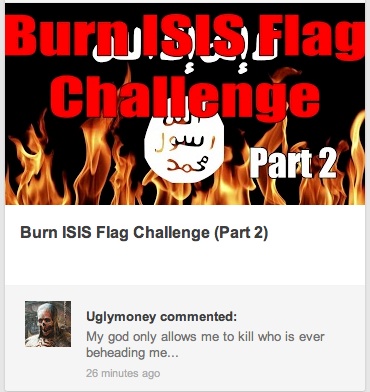
My challenge to burn ISIS flags has been mostly met with approval (sometimes with an asterisk). Even followers of Christ agree with me that burning the ISIS flag is a satisfying response to the murder and terror carried out by members of the Islamic State party. Muslims too have offered their support; however, some have also criticized me for burning the ISIS flag because it contains the Shahada. This post stands as a call to temporarily reconcile the contradictions between our religious beliefs (or lack thereof) in order to stand in solidarity against the Islamic State.

(I highly recommend this collection of images showing what ISIS does. These are relatively not graphic. One picture contains a nail in a man’s hand).

To Christians

IS is a terrifying organization. For those of you in the US or some other non-Levantine country, they may seem a far away nuisance with little threat to non-Muslim countries. While IS might be of little concern to the general state of US security, you should wholeheartedly condemn them for torturing and murdering Christians. This is a group that is willing to slaughter everyone who stands in the way of their goal to restore the caliphate, and Christians are no exception.

I’m usually against war, but I hope that — no matter what side of the political spectrum you lean — you will support any policy aimed at crushing ISIS. I hope we can do this while mitigating civilian casualties. I’m willing to cross the isle here and team up with Democrats, Republicans, and everyone else who condemns IS. I hope you will see anti-IS atheists (I would assume all atheists detest IS) and anti-IS Muslims as your friends and vocalize your resistance to IS tactics.

To Muslims

IS has stolen your flag. Once a symbol of Islamic faith containing the Seal of Muhammad, IS now uses this flag in their terror campaigns. For those of you who criticized me for burning the Shahada: I would’ve burned any flag IS used, even if it had a picture of Christopher Hitchens on it. By standing against IS and vocally supporting direct action against them, you will have the opportunity to cleanse the blood from the Seal of Muhammad.

Don’t be fooled into thinking IS doesn’t give Islam a bad name. Remember how al-Qaeda gave Islam a bad name following the 2001 terror attacks in the US? The same thing is happening right now. If you’re angry at me for burning the Shahada, I hope you are a thousandfold angrier at IS for murdering innocent people and terrorizing thousands. IS is precisely why some people find it difficult to believe there are moderate Muslims. Prove them wrong.

Please see anti-IS Christians and anti-IS atheists as your friends. We all want the same thing here: the defeat of arguably the most dangerous Islamist organization ever.

To atheists

If you haven’t already condemned IS using the strongest words possible, shame on you. This is precisely what we’ve been upset about. We can bitch and moan all we want about people putting up the 10 Commandments in courthouses, but we better not do that before we’ve condemned IS.

Many of you are against military action because it tramples sovereignty and catches innocent lives in the crossfire. But I think there are times when we should make an exception. And this is one of those times.

And I think it is our ethical duty to spend a little less time criticizing Christianity and a little more time supporting the complete annihilation of the Islamic State. Remember, even Christopher Hitchens supported the wars against Saddam Hussein and the Taliban.

Conclusion

Atheists, Christians, and Muslims rarely see eye-to-eye on issues. But this is one where we can all work together in hopes of returning stability to the Levant. We all want the same thing, and I hope we can all work together to unequivocally and multilaterally condemn ISIS to the furthest extent possible.

Posted in Atheism | Tagged , , , , , , , , , , , , , | 11 Comments

Moralism Islamic terrorists can learn from the Westboro Baptist Church (More death threats)

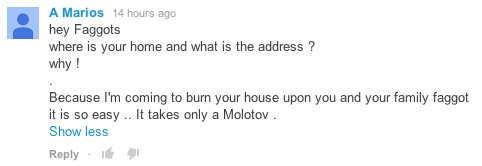
One of the things I find rather striking about Islam is how quick its members are to lobbing threats of violence and death. As I wrote about before, I received death threats from Muslims and alleged members of ISIS after I posted two videos (Part 1 and Part 2) where I burned the ISIS flag. Why have I not reported these threats to the FBI? Because I don’t consider them to be very convincing. These are Youtube users. As far as I know, there is no “Death to Rayan Zehn” Facebook page where supporter lists are relatively public. The NY Post even outed my current city of residence in their article about burning the ISIS flag, but I still don’t fear for my life. Besides, radical Islamists can’t get to Salman Rushdie, and he’s a public figure. What makes anyone think they can get to me, a pseudonymous figure with no discernible itinerary?

So far this is my favorite threat. And no, this guy doesn't appear to be joking. He actually wants my address and hopes I'll give it to him.

So far this is my favorite threat. And no, this guy doesn’t appear to be joking. He actually wants my address and hopes I’ll give it to him.

ALEX SLAVE AK 1

But still, there is cause for alarm. When even a small percentage of Muslims throw around death threats against people who offend their religion, as if death threats were nothing more than candy, we should be concerned. Contrast this with the list of death threats I’ve received from Christians. The vast majority of my posts specifically target Christianity. If the rate of death threats from Muslims is any indication, we would assume Christians would be threatening my life on a daily basis. But to be honest, the list of death threats I’ve received from Christians for insulting Christianity caps out at zero. That’s right; not a single Christian has ever threatened my life for my atheist-themed social activities. This is why I wrote last year that we should criticize Islam more than Christianity.

This is not to say that Christians are not sometimes compelled towards threats of religious terrorism. The. Opposite. Is. True. Instead, this is to say that Christians tend to — at least in the United States and the West — take the moral high ground compared to Islamists when their religious beliefs are offended. Christians might resort to evil — passing anti LGBT legislation or, in extreme cases, trying to pass off creationism as science — but this is relatively benign compared to what radical Islamists do.

I have been lectured ad nauseam by Muslims who wish to distance themselves from the Islamic State. They tell me ISIS doesn’t reflect Islam (a No True Scotsman approach). To be honest, I don’t give a fuck. I’ll be nicer to Islam the day radical Islam more resembles the Westboro Baptist Church than it does, well, radical Islam.

The Westboro Baptist Church might be filled with assholes, but at least those assholes don’t conduct suicide terror missions.

A god we can all understand.

Not a death threat: A god we can all understand.

Posted in Atheism | Tagged , , , , , , , , , , , , , , , , , , , | 1 Comment

Animal rights despite the bible: Morals vs. religious ethics

Yesterday I read a very entertaining anecdotal post on Constant Consciousness titled “Why I Don’t Kill Bugs.” Go ahead and read it. I think many of us can relate to it. I myself constantly go out of my way to do no harm to bugs, even — as did the author of the linked post — catching spiders and releasing them outside instead of swatting them with a shoe. As I was reading it, I started to think about my own morality.

I’m vegan. This post is not about veganism or animal rights. It’s merely to highlight a contrast between Christian (and other religions) “morality” and human morality. For the purpose of this post, I will be highlighting animal rights to make my point (don’t worry; I’m not here to proselytize animal rights).

As I’ve written before, by definition Christianity literally has no morality. Morality is an innate feeling of what is right and wrong. Rather, religions construct ethics, which are similar to morals but based on teaching and social views rather than innate feelings of right and wrong. In other words we learn ethics; we know morals.

I don’t kill bugs because I have an innate feeling that killing bugs is wrong. I’m vegan for the same reason. I was never taught this (my father is a de facto carnivore). I just felt it, and that’s how I live my life, doing the least amount of harm as possible.

In this case I have a higher standard for morality than Christianity (or many other religions). If we look to Christian ethics, my morality is still at a higher standard because Christianity says almost nothing about animal rights.

Animal rights are tenuously mentioned three times in the bible. In Genesis 1:28 Adam and Eve are commanded to have dominion over the animals. What does that even mean? No further instruction is given. It must be stated, however, that in order to conceptualize death to Adam and Eve after “the fall,” god personally slaughtered an animal in Genesis 3:21 to make clothing. This is literally the first death in the bible. The very first death in the Judeo-Christian universe is god killing an animal for its skin. In Genesis 9:1-2 god tells Noah that he is personally responsible for the well being of the animals that were under his care (this comes, paradoxically, immediately after god made all animals afraid of Noah). Finally, in Proverbs 12:10 we are told that righteous people understand animals’ needs. These verses all come from the Old Testament. What does Jesus say about animal rights? Nothing. The closest thing he says about animal rights is when the zombie Jesus commands Simon to feed his lambs to prove his love for Jesus. But that’s not really animal rights; that’s a chore.

Christian doctrine says little-to-nothing about taking care of animals. But many Christians worldwide have an innate compulsion to care for animals. Many live with cats or dogs or parrots or other animals, and those animals are granted family-member status. Some Christians are vegetarian or vegan. Most will stop their car if a mother duck and her ducklings are crossing the street. Indeed, most human beings have an innate moral responsibility to mitigate animal suffering. This is not to say killing animals for food is immoral. Most hunters, for example, strive for clean kills. You will very rarely find a hunter torturing a deer to death. They know prolonging animal suffering for fun is wrong.

In the case of animal rights — from hunters going for quick kills all the way through vegans and non-bug killers — we can see that our morality comes not from religious instruction or Christian ethics; rather, it comes from our innate nature. Christians who care for the emotional and physical happiness of their animals do so not because Jesus told them to, but because they know it is the right thing to do. Morals are ingrained; they don’t come from religious ethics.

Posted in Atheism | Tagged , , , , , , , , , , , , , | 3 Comments

On ISIS, death threats, and free speech

ALEX SLAVE AK 1

The above image is one example of the many death threats I’ve received from radical Islamists after I posted two videos to Youtube where I burned the Islamic State’s flag (Part 1 and Part 2). I’m not worried about these death threats; I actually find it quite humorous that there are people that insecure that they need to resort to threats of violence. Even if I were worried, I would not take these videos down. I’m a huge supporter of free speech and expression. These are of the most sacrosanct rights of all. If I were to self-censor myself I would be abandoning my right to free speech. If we sacrifice free speech for security we have only the illusion of security.

But not everyone agrees with me. I’ve had some beg for my self-censorship. Today I received the following text message from a friend. I’ve edited out some parts that are personal and might identify the sender. But the main gist is intact.

Hey I saw your post from last night. Honestly, i think encouraging this obvious terrorist who is “researching” you and knows about your sister is fine for your entertainment but reckless for [redacted]. Not cool.

Later I received another message from her, this time over Facebook.

Also- with all this international unrest I think it’s reckless and dangerous to joke around with any potential terrorist of any kind … Again- seriously not cool.

It’s obvious that this friend is concerned. But this concern is misplaced. The man in the image above knows about my sister because I made a Youtube video about her death. That is the extent of his ability to “research.” Furthermore, she appears to believe terrorists would conduct a costly mission to track me down and go after people I know. Islamic terrorists don’t generally work that way. But even if ISIS cared about me so much that they’d spend a shit ton of resources to find me, so what?!

I must reiterate: The only benefit from sacrificing our free speech is the illusion of security.

If we don’t openly criticize ISIS and other Islamic radicals, then we are — by our omission — condoning their message and their methods. If we self-censor ourselves because we are afraid that they will harm us, then we are essentially giving them a green light to actually harm us (and thousands of men, women, children, and elderly people in the Levant). Who cares if they send rather meaningless — or even actual — death threats? They need to know the extent of our disdain for their behavior. We cannot let them bully us into silence. And we must ignore all requests from our loved ones to be silent.

While our friends and family might have genuine fear about ISIS seeking us out in retaliation for criticizing them, our freedom of speech is too invaluable a right to sacrifice for appeasement. And self-censorship doesn’t stop ISIS or any other terror group from carrying out terror missions. And ISIS needs to know unequivocally how much we disagree with them. Don’t be silent. Be loud.

Posted in Atheism | Tagged , , , , , , , , , , , , , , , , , | 4 Comments