The Atheist and the Retired Minister: Strange conversation about knowledge

I spent much of Thanksgiving behind the wheel, driving along a two lane highway through what can only be described as the rural farmland hills of the Bible Belt. We were far from the Interstate. Along the way I passed an occult shop with a giant sign of a crystal ball, promising your fortunes told. I thought it a peculiar place to nestle between churches. When I finally arrived to my destination, I largely ignored the other people as I set up my vegan food on the hot plates provided. I managed to find the only other atheist, and I ate my food with him, discussing nuclear weapons and Bangkok, mostly. But then I realized we had a newly retired Baptist minister in our ranks, and I made my way to his table and said hello.

This post is an anecdote describing a single event, and it is not meant to generalize anyone or build any straw men out of Christians. The conversation I had with this retired minister and his wife was surprising and provides us with much to mock.

After introducing myself I asked the minister about his church. I often give lectures at churches depending on their position on capital punishment, and I’m always looking for an audience willing to hear me out. He surprised me by informing me his church was in the city next to mine. We were somehow neighbors who had found each other hundreds of miles away. He refused to tell me his church’s position on capital punishment, and he quickly turned the conversation by explaining how his church is only concerned with educating people about Christ’s sacrifice so that we can live forever.

“I don’t know,” I said. “I’m not a religious person. I’d rather discuss the things we can know rather than the things we can’t know. I’d rather talk about what your church does instead of what it believes.”

“Are you an atheist?” he asked.

“I would call myself an atheist, yes.” I hadn’t planned on telling him I’m atheist, but when asked I refuse to lie about it.

At this point his wife left for the coat room and returned with her purse. She was a very sweet old woman, the kind of woman everyone would want for a grandmother.

The minister and I kept talking through it. “Most atheists I meet ask for evidence. Are you the kind of atheist who needs proof, or will no proof convince you?” he asked.

“It would take very compelling evidence to convince me of anything, especially religious claims.”

“I’m surprised people like you can call yourself atheists. The only evidence you need is all around you.” He pointed outside. The clouds had cleared, and we had a particularly beautiful view of a stream nestled between two hills in the woods.

“That’s not really evidence,” I said.

“I just said I’m surprised. I know you need more evidence than that. I know for a fact that Christ is the lord because I know for a fact what he has done in my life and what he has done for me. I’ve spoken to Christ and he’s spoken to me. He’s helped me through some difficult times, and he has shown me exactly how he’s helped me.”

“So you’re saying you have perfect evidence that Jesus is god, but it’s in your head and you can’t show it to me?”

“Well, yes,” he admitted. “But if you ask for evidence of Christ he will gladly show you the evidence, and it will be undeniable evidence. This is what I want you to do. Ask Christ five times a day to show you a sign. If you are sincerely seeking knowledge, Christ will show you a sign. He’ll do something amazing for you that you won’t be able to explain.”

“There’s a problem with that,” I said. “I can’t sincerely ask someone for something if I don’t believe they exist.”

“You can’t sincerely ask Santa to bring you presents on Christmas…”

“Precisely. It’s the same way for Jesus.”

“I can tell you’re sincere about knowledge. You seek truth, right?”

“Yes.”

“Truth is through Christ. If you seek truth, you’ll find Christ. Sincerely seek truth and Christ will show it to you.”

The conversation continued for a while, but I had places to go. I said farewell to the old man, but not before his wife reached into her purse and unloaded a torrent of tracts, which they made me promise to read. They also invited me to their church, but to “learn,” not to speak. I’ll read the tracts (and probably write a post about them), but I’ve no interest in being evangelized to, so I’ll probably not take them up on that offer.

But it got me thinking. If all I have to do is talk to myself, asking for truth, and suddenly Jesus will appear and give me a present, then why shouldn’t I try this experiment with others? There are thousands of gods to choose from. Facebook God and Facebook Satan too! Actually I already know those two are real. If by his logic it will work with Jesus, it should also work with Thor.

But seriously, the man is essentially saying that if I ask for something enough times, I should take any unforeseen thing as a sign of Jesus. If I ask for knowledge five times a day and win a small lottery on a scratch game, that would be a sign from above. It would literally be Jesus magically ensuring that whatever scratch game I played would be a winner.

I’ll try it, but like I said, I think I’ll ask for knowledge from Satan first.

There are many things I could mock about this man’s ideas, but I’ll save that job for you, dear readers.

Posted in Atheism | Tagged , , , , , , | 1 Comment

Reasons why both believers and non-believers should do volunteer work

Charity is not solely the domain of the devout. While religious organizations indeed greatly contribute to the social well-being of their communities through encouraging people to volunteer their services (see chapter six, page 87), non-religious people share and fulfill a great deal of the burden to offer charity. Indeed, while non-religious people tend not to offer charity as often as believers, when they do they give more (see page 4). This post is not to discuss the contributions of believers and non-believers; it is to discuss the benefit for everyone to volunteer their time or their money. This post serves to encourage charity from both believers and non-believers.

I have an impressive (I’m so humble, aren’t I?) history of volunteer work. I’ve donated over 400 hours to PETA, doing everything from research to stuffing envelopes. I dedicated a year to Operation Smile, primarily helping to organize high school and college sports events that raise money for the organization. I served on a board of directors for a state-level non-profit organization to end capital punishment, mostly in major and planned giving. And currently I volunteer at an organization that raises money for ForKids. My contribution to this group is less impressive; I mostly sort through and organize donations of clothing. I’ve actually run out of space on my resume to adequately discuss my professional experiences with these groups.

Why am I bragging about my volunteer achievements? Two reasons, first because I earned them. And second, to convince you to earn the right to brag about your own volunteer work.

Besides the inner fulfillment volunteering brings, volunteering also has many great benefits to the individual donating their time. For example, it’s a great way to pad your resume with relevant experience. Just out of college and have no work experience to report to future employers? Volunteer two to ten hours a week and your resume will build itself without much effort. In many cases, one need not even apply to volunteer; just show up!!

Another benefit comes to those who’ve either been fired from their job or are on layoff status. Potential employers want to know how you’ve kept busy during your unemployment period. Volunteering is a great way to tell the hiring manager that you didn’t sit at home sulking, feeling sorry for yourself for losing your job. It tells them you’ve been active and used your unemployment as an opportunity to give back to the community.

Finally, volunteering can earn you a medal from the President of the US (if you live in the US). Just volunteer at least 100 hours during a 12 month period, and the White House will send you a freakin’ medal!!

Presidents-Volunteer-Service-Award

SOURCE

That’s something impressive you can show off to your buddies (and inspire them to volunteer too)! Plus, it looks really good on your resume.

If that’s not enough to convince you to volunteer your time (or money) to help your community, then I hope that your communities’ needs for volunteers is compelling enough to convince you to sign up. And if you’re an atheist, volunteering is a great way to remind your religious counterparts that morality and ethics don’t belong strictly to the teachings of the church. Atheists are not heartless bastards. We actually care about our communities, and we’re willing to get our hands dirty to prove it.

Posted in Atheism | Tagged , , , , , , | 2 Comments

Addressing the weakness of our data and arguments: A responsibility for all

Knowledge is very difficult to come by. While knowledge might not require certainty, certainty is the utopia for which all science and philosophy strives. In the mean time — while we wind our way through the maze of knowledge to, at some distant point in time, arrive at certainty[1] — we gather all the data we can and attempt to analyze it in the best way possible. During this process we weed out the obviously useless data, but we are still left with imperfect data. If the data were perfect, we would have already arrived at certainty. So what do we do about the imperfect data we have? Obviously our arguments are weakened by imperfect data, so we cannot say for certain that our arguments are valid. What to do?

We address the weaknesses of our data and the weaknesses of our arguments.

This is an immensely important step in the soft sciences. Without taking this step our papers will be held to higher, impossible to clear scrutiny. Claiming to have absolute knowledge (certainty) in the social field (and probably in other hard science fields) is a death trap for academic papers.

In my research into the practice of self-immolation as a tool for political contention, I went out of my way to address the weaknesses of my data, devoting about five pages of text to uncover and discuss the various problems associated with it. In my analysis chapter I addressed how these weaknesses impact my findings and how we may overcome these weaknesses in the future. I went above and beyond the call to address the weaknesses, but this actually strengthened my overall argument. (Essentially I was saying, “This is what the preponderance of the evidence suggests, but until better evidence can be collected, I cede that I may be wrong.”)

This is not the only way to address the weaknesses of you data. You might not even use the word “weakness” when addressing the deficiencies of available evidence or the weaknesses of your argument. Instead one might utilize the tried and tested counterargument and rebuttal chapters. Either way, it is important to acknowledge the potential for being wrong. Everyone in academia does this: from freshmen working on their first research paper all the way through professors emeritus.

This action should not be solely the domain of academics. I suggest that we bring this into everyday discussion, particularly when one attempts to make an argument on a social forum. This might appear risky to religious people, as addressing the weaknesses of religious claims has the unfortunate side effect of undermining religion (hey, it works both ways, buddy!), but I feel religious arguments would get more respect if the people making them publicly acknowledged that evidence may render them wrong.

Religious arguments that cede this undeniable point benefit greatly from acknowledging their weaknesses. Most important among these: they can be brought into the public discussion without fear of being wrong. Let me reword that. It is impossible one will be wrong about saying they might be wrong. It also allows for religious claims to be altered by available data, leading to a more coherent tool to explain observable phenomena. Religions cannot survive if they do not adapt to the evidence before them. Then again, like I already stated, it’s a double-edged sword because religious claims, even those that adapt to evidence, are less relevant than claims at which we arrive using the scientific method.

In summary, knowledge is imperfect, even though we strive for perfection. Because of this, it is our duty to admit to where and how we may be wrong. It is our ethical responsibility if we are to use our findings to explain the universe (both physical and social). Religions should adopt this practice, despite the implications of doing so.

[1] Using the trope of international security, Ken Booth lays out how we may be inching towards utopia (certainty, in this case). This has little to do with knowledge as a concept, but if we apply his work to knowledge, we might better understand this phenomenon.

Posted in Atheism | Tagged , , , , | Leave a comment

Why this blog doesn’t matter

In writing and administering The Atheist Papers, I try to be as intellectually honest as possible. Some things may fall through the cracks (such as not addressing the weakness of one of my bible contradictions) because — let me be obvious — this website is a hobby, and it’s not very important to me. In academic and professional research I would never allow myself to make an error in logic, and if I still did I would correct my mistake publicly. But even if I control for the mistakes I make while throwing together a post about a bible contradiction in five minutes, this blog still shouldn’t matter. It shouldn’t matter because it’s philosophy with precisely zero more authority than religious philosophies.

Religious philosophies don’t explain anything, and neither does a blog making fun of them. And I grow quite frustrated when people take what I say about religion seriously enough to throw temper tantrums when they disagree with it. If one disagrees with my personal take on something religious, it should be taken no more seriously than if one disagrees with my personal favorite song by Pink Floyd. It’s really not that important.

But that doesn’t mean that everything I say is unimportant. Where philosophy matters is in the realm of harm. “Do no harm” should be the first priority in philosophy, religions included.* If I criticize a religious teaching that does or promotes harm, and if you jump on my back because you think your religion allows you to harm others, then you’re the asshole, not I.

*Then again, this falls under the purview of the is-ought problem. The is-ought problem proclaims that we can’t know how the world ought to be because we can’t agree on how it ought to be, and furthermore we can’t even agree on how it is. We can fix this by gutting the idea of objective morality, but I doubt religious people would be willing to give it up. I might imagine, therefore, that many non-religious people would enjoy this post for being an honest critique of the self and its religious counterparts, while many religious people would scoff at an imaginary straw man, attributing all of the weaknesses to non-religion and proclaiming “My religion is better than your philosophy.” I hope this isn’t the case.

Posted in Atheism | Tagged , , , , | 3 Comments

Religions in Battlestar Galactica: Which one is right?

I once mentioned on this blog that I’m a fan of Battlestar Galactica. The series is filled to the brim with religious overtones. The only atheist on the show is a brilliant but bumbling buffoon who spends the entire series narrowly escaping certain death by going full sociopath (not a very flattering portrayal of atheists, if you ask me). When I watch the show I’m often left intrigued by the religious positions of the two sides, Human vs. Cylon.

Humans are essentially 100% polytheist (with the exception of the token atheist). If we rewind to the short-lived prequel to BSGCaprica, we find an almost violent human response to the notion that there could be but one god. Cylons, on the other hand, are monotheist, and as the series comes to a close we discover that the Cylon “one true god” might be the foundation that would lead to the development of the Abrahamic religions. Unfortunately, Cylons are the bad guys, using scripture as an excuse to essentially completely exterminate the entire human race. And if that weren’t enough, the few who remained were subjected to rape, torture, and slavery.

bsg god

Before anyone criticizes this image, please read the rest of the post. I’ll discuss the weaknesses of this image.

I have to wonder, then, when I watch the show, which side do devout Christians root for when they watch the series? The one that believes in multiple gods and violently rejects the idea of “one true god”? Or the side that wants to completely annihilate the human race but worships the same god that Christians worship?

The image above has its weaknesses. Laura Roslin (human) is very superstitious, and this led to some very tragic political decisions. And Number Six (cylon) might have been the most devoutly religious character on the show, but her use of logic was often flawless. These flaws in my argument aside, the image is a fairly accurate representation of the choice at hand.

Another problem is the question itself. I’d imagine that most people (including devout Christians) can watch the show with suspended disbelief. While they might recognize the Christian overtones on the side of the cylons, they can probably ignore it as being part of a purely fictional universe as portrayed on a television series. Therefore, I might not even have to ask this question at all. But I will.

It’s a silly hypothetical question to consider just for fun. I don’t think I have to tell you no one will criticize you for picking a side in a discussion about a purely fictional universe. But have at it! I’m curious.

And if you haven’t seen Battlestar Galactica I would suggest doing so. It’s a very entertaining series.

Posted in Atheism | Tagged , , , , , | 6 Comments

Gearing up for war on Xmas: New weapon ensures victory

Because the War on Xmas is a very real war with bloodshed and civilian casualties on both sides, I’m beginning to feel that the only way for the Atheist Army to defeat the Christian God Warriors is to use disproportionately violent weapons. The super bomb I have in mind is vastly more powerful than any conventional or radiological weapon ever deployed by any army in the history of earth. With such weapons at our disposal, a single detonation should be sufficient to kill all Christians once and for all, thus finally winning the decades-long war against baby Jesus.

I’m talking about detonating a neutronium bomb.

Dr. Phil Mason (you might know him as Thunderf00t) made a great video about the neutronium bomb in 2012 (watch it here).

Obviously, the unfortunate side effect of detonating a neutronium bomb is the extinction of all life on earth. But it’s worth it to defeat those pesky Christians and their frankincense and myrrh.

Posted in Satire | Tagged , , , , , , , | 2 Comments

Why “I don’t know” works: an example using statistical analysis

In academic and professional research there is a simple phrase that is not only acceptable; it also sets the stage for future research. The phrase is “I don’t know.” I could have posted this on one of my other blogs, but it appears this issue most often becomes a problem when religion is being discussed. That is, I most often see “I don’t know” mocked by people who claim to have answers that they can’t actually know to be true. Researchers, on the other hand, wholeheartedly accept “I don’t know” as a valid answer, and they begin collecting data to attempt to change their lack of knowledge.

In research there’s another common phrase: “Correlation is not causation.” Let’s take a look at some of my research from a few years ago (statisticians will have their interests piqued the most). This is a simple multivariate regression I did in Excel (I usually use SPSS, but not this time). This post is my most science-y post yet. Please bear with the research, or skip to Part 2 for the crux of my argument.

Part 1: Statistical Analysis of Corruption Perceptions (2012)

I’m showing some of my research from 2012 because the findings are pretty good. There’s a very strong correlation. But this correlation doesn’t imply that “I know” the results are perfect.

regression1

Research question: What causes corruption perceptions?

The variables I used were:

Independent: Female participation in government, polity as measured on a twenty point running scale (‐10 to +10, with ‐10 being most authoritarian and +10 being most democratic), economic equality (Gini) on a scale of one to 100 (with one being perfect equality and 100 being perfect inequality), gross domestic product per capita as measured in thousands of dollars (KGDPc), and a categorical variable for stability (stable); that is, whether or not a regime type has lasted for a decade or more.

Dependent: Corruption Perception Index (CPI) (2012), data provided by Transparency International. In other words, how corrupt the states’  civilians perceive their governments to be.

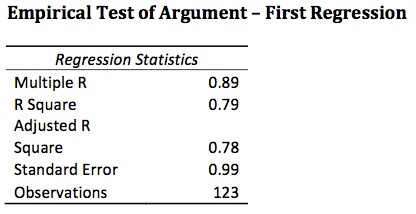
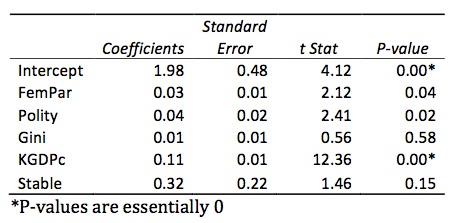
I found a very strong correlation (see chart above) between CPI and FemPar, polity, Gini, KGDPc and stable, with an adjusted R‐square of 0.78. In other words, these variables accounted for 78 percent of corruption perceptions. Breaking down the regression by individual variables, we can see some important results. Two things to consider are the coefficients and the P‐values.

regression2

First, FemPar is statistically significant because its P‐value is below 0.05 at 0.04. Its coefficient is 0.03. That is, for every percentage point increase in female participation in government, CPI rises by 0.03. It should also be noted that a government made up of only women has a CPI score increased by 2.47. Polity is also statistically significant. For every point increase in polity, we see a 0.04 increase in CPI. KGDPc is the most telling. With a P‐ value that is essentially zero, we see a rise of 0.11 in CPI for every increase in GDP per capita of one thousand dollars. Gini and stable are weakly correlated with P‐values above 0.05, but the correlation suggests that for every increase in Gini of one point, we see an increase in CPI score of 0.01, which is counter intuitive because a Gini score of 100 is perfect inequality (that is, one person owns all the wealth). Stable suggests that regimes that have survived for over a decade have 0.32 higher CPI scores than less‐stable regimes. Because of the low correlation, there is little need to determine if length of regime as a continuous variable is explanatory.

[[EDIT: It’s been brought to my attention that I forgot to include the STDEVs. Please forgive my oversight. I was more concerned with the argument of my post than I was the argument of my original research. In any case, here are the STDEVs and a short discussion:

regression3

Because FemPar increases CPI score by 0.03 for each percentage point of FemBar, and because the STDEV is 9.17, a rise in one STDEV in FemBar will result in a rise of 0.28 in CPI. A rise in one STDEV of polity results in an increased CPI score of 0.22. A rise of one STDEV of Gini sees CPI rise by 0.1. And a rise of KGDPc by one STDEV has a CPI score rise of 4.68. It must be noted again that Gini is weakly correlated.

I’m under the impression most of you aren’t interested in the rest of my research, which then went into a 3,000 word analysis of the potential reasons for my findings. I will not post it here for the sake of saving space.]]

Part 2: Why “I don’t know” works

The Adjusted R-square above is pretty damned good. It’s by no means perfect, but I would feel comfortable submitting my findings to a Senate inquiry and standing by my argument of how to deal with corruption perceptions. I would stop way short, however, of telling the Senate body that I know, for example, female participation in government would help solve their problems. Why? Because I don’t know that. My regression shows a correlation, but it fails to explain why there is a correlation. Furthermore, correlation is not causation.

Perhaps even more significant are the variables with higher than desired P-values. Notice again in the first chart. I only collected data on 123 countries. Depending on your definition of a country (state, actually), I’m missing data for about 75 states. If the Senate body asked me how certain I was that Gini affects corruption perceptions, I would say “I’m neither certain nor uncertain. Future research must be conducted before I can give a better answer.”

If I were to claim that I possess knowledge that Gini plays no role in our perceptions of state corruption, I would not only be being dishonest, the Senate might use my professional opinion as an excuse to disregard Gini when dealing with corruption perceptions. It could be (but it’s unlikely) that Gini plays a massive role in our perceptions of state corruption. Therefore, it’s not only dishonest; it’s counterproductive.

On a personal note, when I defended my thesis my board asked me if there could be other variables I don’t know about yet (I was presenting on what causes self-immolation). I answered, “Unfortunately, more people have to commit suicide in order to determine that.” It might sound like a heartless answer (and it is), but it’s the only answer we can get because we can’t get into the heads of suicide victims.

Part 3: What does this mean in the religious context?

When people profess to have direct knowledge that a) god exists or b) their religious teachings are the answer to social or other phenomena, it’s possible they are a psychopath. Exhibit 1, ladies and gentlemen of the jury:

David_Koresh

If they aren’t a psychopath, then the other option is that they don’t quite grasp the importance of the phrase “I don’t know.” They don’t understand (or they reject) that “I know” is both intellectually dishonest, even if the correlation is strong, and counterproductive and possibly dangerous. Unfortunately I see this all the time.

It’s not just psychopaths proclaiming to be Jesus, holding a sign about the end times on the corner of Granby St; it’s also well-intentioned old ladies who claim things like “I know Jesus will get you through this.” … I know your problems can be answered by putting faith in Jesus … instead of determining what the actual cause of the problem is and working to resolve it yourself. It’s actually better to say “I don’t know what the cause of my problem is, but I will work to figure it out” than it is to say “I’m not putting enough faith in Jesus. If I put a little more faith in him, then he will take the burden from me.” To do the latter is to completely ignore the problem. Or even worse, it’s risking never finding out the actual source of your problem by putting all your efforts into increasing your faith in your god because you “know” that’s the answer.

Conclusion

Saying “I don’t know” is useful in any context. It’s honest about your knowledge about the causes of certain phenomena. It allows for and encourages future research and discoveries. And it acknowledges that you’re not 100% knowledgable about the existence of god. Let’s face it: Besides the aforementioned psychopaths, everyone is an agnostic because they don’t pretend to know whether or not god 100% does or does not exist.

This post utilizes statistical analysis to illustrate its point, but when dealing with knowledge, no matter what method you’re using to collect it, “I don’t know” is infinitely more valuable than saying “I know” when in fact you don’t.

Posted in Atheism | Tagged , , , | 8 Comments

Bible Contradictions #54: How many false prophets are there?

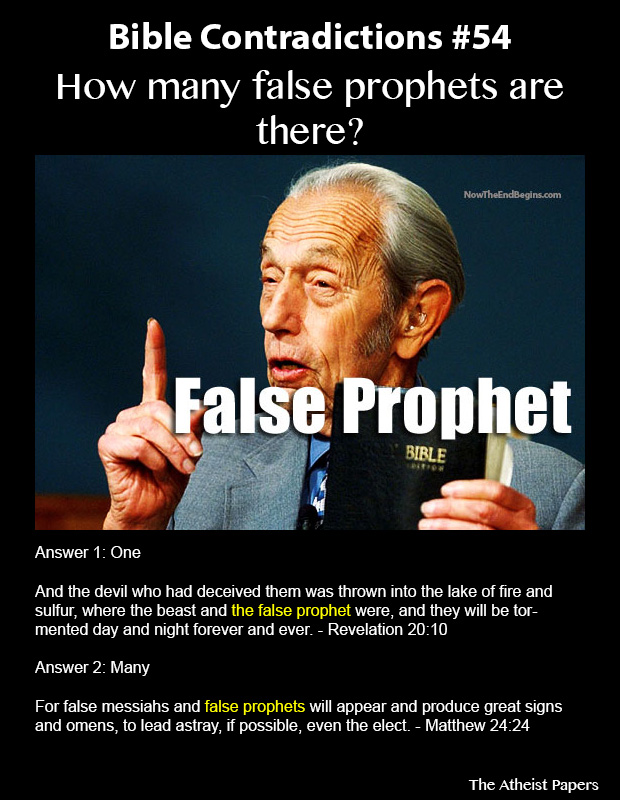
Bible Contradiction 54

I haven’t posted a bible contradiction in a long time. Long story short, I never backed up my .psd files for the images, and after I suffered a loss of data I grew lazy about creating a new template. But here it is in a very simple form.

Today’s bible contradiction stems from an earlier blog post I made back in March. I alluded to the contradiction at the end of the post but quickly forgot about it until someone brought it to my attention. This one asks the question, “How many false prophets are there?”

First I will ask everyone to open their bibles to the far back, all the way to Revelation 20:10. In this verse, taken from a short story called “Satan’s Doom,” we discover the devil’s immortal body heaped upon the burning immortal corpses of “the beast,” whatever that is, and the false prophet.* Not prophets with an “s,” but prophet, singular.

But if we turn back to the first book of the Gospels, we are given a different answer. Matthew 24:24 tells us that many false prophets (with an “s,” plural) will do a bunch of evil things… like prank politicians. In other words there are (or will be, really) more than one false prophet.

(EDIT: I should note here, as it’s been brought to my attention that I didn’t mention it, both of these stories talk about the same future event: the end of days just prior to the second coming.)

Of course it’s all made up. There’s no such thing as a false prophet as used in the religious context. In reality false prophets only exist in Hyrule when the player gives up and Link fails to defeat Ganon.

*Of interest here is also that “the devil who had deceived them” is differentiated from the false prophet. Usually religious apologists lump them together as one, which could make for yet another bible contradiction, depending on the verse they use.

Posted in Atheism, Bible Contradictions | Tagged , , , , , , | 5 Comments

New ISIS Flag Design Unveiled

Corrected ISIS Flag

Posted in Atheism | Tagged , , , , , , , , | 14 Comments

10 best songs ever written by god (in my opinion)

Jumping off my last post, as well as one I wrote earlier this year, I’m a giant music fan. Eclectic tastes doesn’t do it justice; I listen to everything from calypso to country, from Motown to metal, from rock to rap, and from Gypsy to gospel. It’s that last one that might surprise readers who aren’t familiar with me. One might think atheists usually ignore god’s music. But I love it. It’s not the lyrics; they could be singing about literally anything, and I would love it just the same. It’s the soul, the energy, and the beat. I’ve said this many times before, but you don’t need god to enjoy god’s music.

This post is a list of my favorite songs directly (or even loosely) related to religious beliefs. These songs span many genres, not merely gospel. So with that in mind, here’s my top 10 favorite songs written by god (if you didn’t read my last post, a Christian man told me god was the author religious songs). In reverse order:

10. “Tears in Heaven” by Eric Clapton
Genre: Soft rock
Year: 1992

This one’s rather difficult to listen to, considering the song was written about the tragic death of Clapton’s son, but the music itself is genius (we expect nothing less from Clapton). In the song Clapton laments that he cannot join his son in heaven just yet, even though he thinks his son misses him in heaven. He looks forward to an afterlife where “they’ll be no more tears in heaven.”

9. “God’s Gonna Cut You Down” as performed by Johnny Cash
Genre: Country
Year: 2006

Johnny Cash was almost known as much for being a deeply devout Christian as he was for being one of the most badass human beings to ever live. It’s difficult to pick a Cash song for this list because so many of his songs were about his faith, especially songs written during the last years of his life. “God’s Gonna Cut You Down” is a traditional folk song, performed by countless musicians, often by gospel bands.

8. “Spirit in the Sky” by Norman Greenbaum
Genre: Psychedelic rock with gospel influences
Year: 1969

Greenbaum, a Jewish man, wrote this song not as a song of worship, but as a song in the style of gospel that tells an American Western story. Although the song has long been regarded as a religious song, Greenbaum rejects this: “I had to use Christianity because I had to use something. But more important it wasn’t the Jesus part, it was the spirit in the sky. Funny enough… I wanted to die with my boots on.”

7. “American Pie” by Don McLean
Genre: Folk rock
Year: 1971

Seriously, who doesn’t love “American Pie”? Although it’s not overtly religious, McLean uses the trope of Christianity to tell the story about “The day the music died.” When singing along in my car, I have no problem singing the lines “Did you write the book of love/And do you have faith in God above/If the Bible tells you so?” and “And the three men I admire most/The Father, Son and the Holy Ghost.”

6. “All Along the Watchtower” as performed by Jimi Hendrix
Genre: Psychedelic rock
Year: 1968

Originally written by the deeply religious Bob Dylan, Hendrix really gave the song its soul. “All Along the Watchtower” quotes Isaiah 21:5-9 with “Prepare the table, watch in the watchtower…”

5. “Cross Road Blues” by Robert Johnson
Genre: Delta blues
Year: 1937

“Cross Road Blues” has, for years, reinforced the myth that Robert Johnson sold his soul to the devil by the cross roads in exchange for his musical talents. In reality, however, “Cross Road” is a song about a man asking god for help. While the cross roads may allude to the loss of a “sweet woman” or something more sinister (the threat of lynchings in the 1930s deep south, says Litwack, pp. 410–411), all we know for certain is Johnson’s trust in the “Lord above.”

4. “God’s Away on Business” by Tom Waits
Genre: Jazz cabaret
Year: 2002

To be honest, I’ve no idea what this song is about. The lyrics are schizophrenic. I don’t know what to make of them. A friend suggested Waits might be an atheist, but if he is this song is hardly evidence. Then again, Waits doesn’t believe in the devil. Per Waits: “Don’t you know there ain’t no devil, it’s just god when he’s drunk.”

3. “Far Away Eyes” by The Rolling Stones
Genre: Country
Year: 1978

While not explicitly religious, “Far Away Eyes” is a song about the radio stations in Bakersfield, playing mostly LA gospel shows. That’s the background. Jesus isn’t a central figure in the lyrics, but Mick Jagger makes it a point to thank him for the girl he shagged and left in Bakersfield.

2. “Devil Got My Woman” by Skip James
Genre: Blues
Year: 1968

At first listen the lyrics appear to be a classic blues formula: sing about heartbreak. But at closer inspection we find that James realizes how strong a hold Satan has over his heart, and in the end, after putting his faith in god, god forces the devil to let go his hold over James. Skip James’ entire song library is made up of mostly highly spiritual works, in stark contrast from the majority of blues music.

1. “Something Got A Hold Of Me” by People’s Temple Choir
Genre: Gospel
Year: 1973

From the “He’s Able” album, hands down “Something Got A Hold of Me” is my favorite song ever written by about god. Despite the complete lunacy of the band’s leader, the song is tragically fun. Just try to not tap along to the cadence! The song’s chorus lines stick in your head for days on end. It’s an incredible song! I even tracked down an original vinyl LP, still sealed, because I love this record so much.

10641199_10203025753070341_2825989241588919927_n


In fact, I like this record so much some friends tease me that if I had a religion, it would be Jonesian Suicidal Christianity.

Posted in Atheism | Tagged , , , , , , , , | 1 Comment