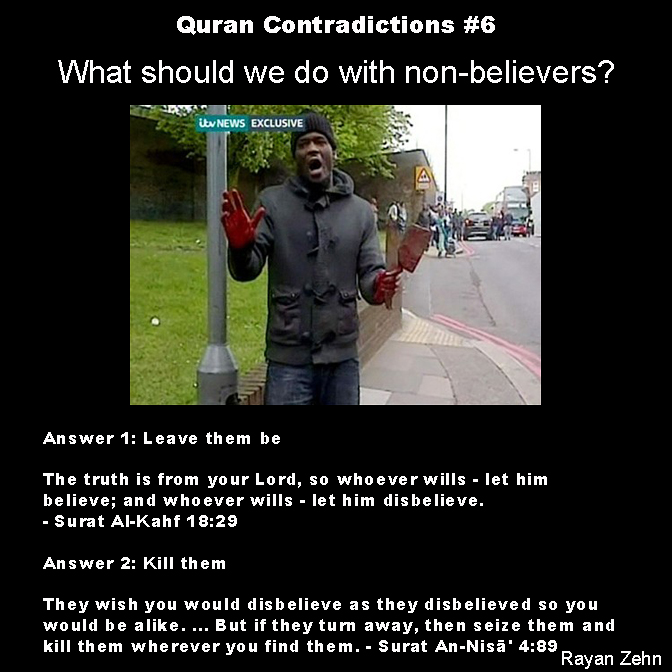
Quran Contradictions #6: What should we do with non-believers?

quran contradictions 6

When Muhammad invented his new religion he had to contend with a lot of different religions — like Judaism, Christianity, Zoroastrianism, and even many people with no religion at all. So what do we do with all of these people who refuse to follow Muhammad? The Quran is not the best place to find the answer.

In Surat Al-Kahf 18:29 Allah says to be patient with them. Leave them alone. The expanded verse in the link tells us why: Allah has prepared a pit of fire for them. In other words, it is for Allah alone to punish the non-believers. Humans are merely told to ignore them.

But then in Surat An-Nisā’ 4:89 Allah says kill non-believers. What is striking about this verse is Allah wants non-believers attacked from behind. Sucker punch. And when you’re done killing that guy, kill every non-believer you find!

Many would argue — and have, ad nauseum — that this only applies to atheists (well, that’s a relief). But no. It actually applies to all non-Muslims. Christians and Jews are constantly lumped together with atheists in the Quran. I’ve written about this before (literally, about 60% of the Quran is nothing but threats against non-Muslims).

To be fair, I’ve never, ever met a Muslim who condoned violence against atheists or other non-Muslims. I’ve even discussed my atheism over tea with a young member of Hezbollah, and I received nothing but kind words and warm wishes. That’s just the point though. The vast majority of Muslims already eschew the many verses calling for death to non-Muslims. It might be about time that they threw the rest of the Quran into the garbage as well.

Posted in Atheism, Quran Contradictions | Tagged , , , , , , , , , , , | 10 Comments

What the bible actually says about birth control and abortion: You can’t argue religious freedom without knowing your religion

The religious right’s case against birth control worldwide comes directly from the Book of Genesis. In chapter 38 we meet Onan, whose brother Er pissed off god and was thus smote. Therefore, their father, Judah, tells Onan that it is his duty according to rabbinical law to have sex with Er’s wife, Tamar, so that Er can have an heir. But when Onan is about to finish, he pulled out, “spilling his seed” on the ground. God was angry at this and smote Onan too. This is the story that Christians cite when they argue against birth control (or even covering birth control in insurance plans [which is another discussion — why do the courts allow bosses to have say over private health decisions??? But I digress]).

This is all that the bible says about birth control. Some may argue that the three verses in Genesis that say “Be fruitful, and multiply” imply an unfavorable view on birth control, but that’s stretching it. As I’m writing this I am not having sex. And I have no plans to go out and knock a girl up tonight. If the Genesis verses saying “Be fruitful, and multiply” are to be taken seriously, I would be condemned. And I’m sure the vast majority of my readers would be too. Anyway, there is nothing else in the bible about birth control.

On the other hand, the bible says a lot about abortion. And surprisingly, it’s all pro-abortion. There is not a single verse in the bible that condemns abortion. But god actually tells some people to force women to have abortions (and god also admits that he loves giving women abortions too). Let’s examine these verses.

Exodus 21:22-23 states:

When people who are fighting injure a pregnant woman so that there is a miscarriage, and yet no further harm follows, the one responsible shall be fined what the woman’s husband demands, paying as much as the judges determine. If any harm follows, then you shall give life for life,

In other words, if I get into a fight with some guy and accidentally hit his wife in the stomach, causing her to miscarry but not causing her to die, I’m guilty of no crime but must pay a civil fine to the husband (the woman doesn’t get any money). If the woman dies, I too die. Note here that the woman’s life is more valuable than her dead baby’s life.

Numbers 3:15-16:

Enroll the Levites by ancestral houses and by clans. You shall enroll every male from a month old and upward. So Moses enrolled them according to the word of the Lord, as he was commanded.

In other words, people less than one month old are not even considered people. Logically, this should apply to fetuses.

Hosea 9:14:

Give them, O Lord—
what will you give?
Give them a miscarrying womb
and dry breasts.

Here we can see that god gives women forced abortions. There are many other verses like this in Hosea.

And finally Numbers 5:21-21, 27-28:

—let the priest make the woman take the oath of the curse and say to the woman—“the Lord make you an execration and an oath among your people, when the Lord makes your uterus drop, your womb discharge;

When he has made her drink the water, then, if she has defiled herself and has been unfaithful to her husband, the water that brings the curse shall enter into her and cause bitter pain, and her womb shall discharge, her uterus drop, and the woman shall become an execration among her people. But if the woman has not defiled herself and is clean, then she shall be immune and be able to conceive children.

In the above verses, we see that god causes miscarriages (I.e. god is the abortion doctor). God probably only does things he enjoys, so I’m certain he enjoys giving women forced abortions.

So what does this all mean, Rayan? Well, I’ll tell you.

In the first example I showed, the man is punished for pulling out. (It should cause concern for religious people that no one has ever been struck down by god for pulling out. If he did that, porn films would end horribly.) But women in the bible are never punished for having a period. In fact, many fertilized eggs fail to implant in the uterus and are flushed from the body once a month without the woman being the wiser. Surely, apologists would argue here that the man willfully pulled out while the woman miscarried beyond her will. This is true, and it gets precisely to my point.

The rest of the bible shows men killing fetuses and infants countless times. God (as the father) even gets in on the action. It’s all about the actions of men. Women never have any say in any biblical verse whether or not they will be impregnated (except for Lot’s daughters, who rape their father) or have abortions.

If religious people are going to start flinging claims about their religious freedoms, they should learn what the bible actually says about those things. The only argument that religious people can make, according to their bible, is that women have no choice over birth control and abortion — that it’s the men who make those decisions. I would imagine this wouldn’t go over very well in our relatively enlightened time.

In closing, the bible is rather pro-abortion (but not pro-choice), and birth control is only mentioned once, when a man decides to ejaculate on the ground instead of inside his dead brother’s wife. If we are going to have an intelligent debate about the religious ethics of abortion and birth control, then we should probably understand exactly what the bible says about these things. But that doesn’t really matter; anyone who forces their religious beliefs on people is an asshole.

Posted in Atheism | Tagged , , , , , , , , , | 2 Comments

Widely cited story about Jesus and the adulterous woman was not originally in the bible

The other day I wrote a post about how the ending of the Mark’s gospel was added to the bible when scholars realized the original ending contradicted the other gospels. I also promised a followup with another example of people adding things to the bible. Here it is.

In the Gospel of John there is an often cited story about Jesus and an adulterous woman. We all know the story. Jesus is doing Jesusy things, like visiting temples and stuff. A group of men bring a woman in front of him, calling her an adulterous woman and reminding Jesus that Moses’ law demands that she be stoned to death. Jesus says, “Let he without sin cast the first stone,” and everyone leaves in shame. But this never happened. Even the bible agrees that this story was added to the bible after the fact.

The verses can be found in John 8:1-11. But like with the false ending in Mark, we find two footnotes that give us some insight into how the church views these verses.

The first footnote explains how some authorities place this story either at the end of John or somewhere in Luke. The footnote goes on to tell us that some versions of the bible disregard this tale completely and remove it from the bible. The second footnote explains that — while the Catholic church believes this apocryphal tale — the verse was absent in early transcripts of the bible and that the style suggests an author other than John.

New Testament scholar Bart D. Ehrman (a former Christian who, after studying the bible for his M.Div and Ph.D degrees, realized the problems with Christianity and became an agnostic) tells us what might have happened here. He says that many bible scholars suspect that an early bible scribe was copying John and thought that the gospel reminded him of a story he once heard about the adulterous woman, so he wrote it in the page margins. The next scholar who came around to make a copy of the gospel saw those notes and erroneously thought the story was part of the gospel. You can watch his video on the topic and more here in Misquoting Jesus in the Bible. He also has a book called Misquoting Jesus: The Story Behind Who Changed the Bible that I recommend.

The story of Jesus and the adulterous woman never happened. Even the bible admits that it probably shouldn’t even be in the bible. The next time you hear someone quoting this story, remind them that it’s not real, and show them the evidence in the bible itself.

Note: You’ll need either the catholic bible (or the anglicized version of the catholic bible), the CEB, the CEV, the ERV, the GNT, the LEB, or the Voice. Almost every other version of the bible, including the King James Version, omits these footnotes and pretends that the story was a part of the gospel all along. That’s not very honest of those bibles.

Posted in Atheism | Tagged , , , , , , , , , , | 1 Comment

Allah: “The earth is flat!”

In 1996 it was (possibly erroneously) reported that Saudi Arabian Salafist Islamic scholar Abd al-Aziz ibn Baz claimed that the earth was flat. He allegedly later changed his mind about the flat earth after hanging out with an astronaut who had seen the earth from space. While this modern flat earth claim is apocryphal at best, there is another modern Islamic leader who vehemently claimed the earth is flat.

Mohammed Yusuf, the deceased founder of the infamous Boko Haram, once gave an interview where he condemned Westernized education systems because they teach things that go against the Quran’s teachings:

“Like saying the world is a sphere. If it runs contrary to the teachings of Allah, we reject it. We also reject the theory of Darwinism.”

Why would Yusuf say this? It’s absurdly absurd (I couldn’t think of a better word, sorry). How could anyone in modern times reject the fact that the earth is round? Human beings have known (or at least assumed) the earth is round* for 2,500 years. Pythagoras and Aristotle knew this 1,000 years before the Quran was written. But that’s just the thing. The Quran. Mohammad wasn’t very educated, so he probably never read Pythagoras’ round earth findings. And thus, the Quran says the earth is flat. Numerous times.

I’m not going to even mention every time the Quran makes this false claim. That would make for a very, very long post. But here are a few of the highlights. (Really, I only need to list one).

Taha (20:53): “[It is He] who has made for you the earth as a bed [spread out] and inserted therein for you roadways and sent down from the sky, rain and produced thereby categories of various plants.”

So the earth is a bed that is “spread out”? There are countless other references about the earth being “spread out.”

Surat Al-Kahf (18:47): “One Day We shall remove the mountains, and thou wilt see the earth as a level stretch, and We shall gather them, all together, nor shall We leave out any one of them.”

In other words, the earth would be completely flat if not for those pesky mountains. (Note that newer translations of the Quran replace the words “level stretch” with the word “prominent.”)

Surat Al-Baqarah (2:144): “We have certainly seen the turning of your face, [O Muhammad], toward the heaven, and We will surely turn you to a qiblah with which you will be pleased. So turn your face toward al-Masjid al-Haram. And wherever you [believers] are, turn your faces toward it [in prayer]. Indeed, those who have been given the Scripture well know that it is the truth from their Lord. And Allah is not unaware of what they do.”

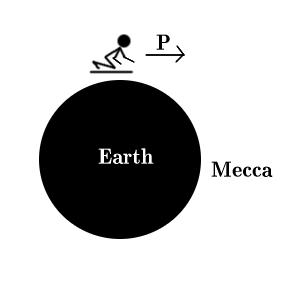
This is the verse in the Quran Muslims reference when teaching young Muslims to pray in the direction of Mecca. The Quran seems to think that facing east or west (or whatever direction) is the same as facing the Qibla, which might be on the opposite side of the world. If I face east, my gaze is pointed to outer space. This humorous diagram illustrates the point:

pray to mecca

In order to actually be facing Mecca (unless you’re already fairly close to the city), the earth would have to be flat! Otherwise, when my roommates pray they’re more likely praying towards the International Space Station, which literally couldn’t be in space if the earth was flat.

The vast, vast, vast majority of Muslims reject teachings that the earth is flat. No one’s saying that Muslims believe in a flat earth, but their prophet certainly did. And their holy book certainly does. This should be a sufficient reason to critique the rest of the book. If it gets something this easy wrong, it probably gets a lot of other stuff wrong as well.

*Of course, I mean spherical. I’m too lazy to type that over and over again, so “round” will stand in its place.

Posted in Atheism | Tagged , , , , , , , , , | 2 Comments

Major problem with Gospel of Mark: Everyone knows about it, but none care

The gospels are perhaps the best-known books of the bible (after Genesis, of course). These are the books that tell of the arrest, trial, crucifixion, burial, and resurrection of Jesus. These books make up the fundamental beliefs of Christianity — Jesus came back from the dead, fulfilling his own prophesy. If you read these books one after the other, you see a lot of repetition. And apologetics really love that. But if you compare them verse by verse, you find a lot of contradictions. For example, what did the women do after they found Jesus’ tomb empty? One of these contradictions is so glaring that the bible included a footnote that essentially says, “We know there was a contradiction, so we added a bunch of verses to the bible in order to make it a non-contradiction.” Behold Mark 16!

Mark 16 has twenty verses, but it originally had eight. Originally, Mark 16 ends like this: The women go to Jesus’ tomb and find a young man who tells them to tell Jesus’ disciples to meet Jesus in Galilee. But the women are afraid, so they run from the tomb in terror and don’t tell anyone. End of story. And (original) end of the Gospel of Mark.

When early bible scholars noticed how Mark contradicts the other gospels, they added two different endings to the book in an attempt to get rid of the contradiction. There’s the short version and the long version, both of which can be found here.

In the short version, the women indeed tell Peter and the disciples. And that’s pretty much it.

In the long version, Jesus does a bunch of other stuff and appears to a bunch of other people before flying up to heaven.

But what’s most interesting is that both of these endings are in brackets. And if you bother to look closely, you’ll find a footnote. Most people don’t bother reading the footnotes, but they should. Here the footnote basically admits to adding these endings to Mark (hence the brackets around them):

Some of the most ancient authorities bring the book to a close at the end of verse 8. One authority concludes the book with the shorter ending; others include the shorter ending and then continue with verses 9–20. In most authorities verses 9–20 follow immediately after verse 8, though in some of these authorities the passage is marked as being doubtful.

In other words, look, we know there are three different versions of Mark, and that some “ancient authorities” think these additional passages are “doubtful,” but we’re going to leave them in anyway and hope no one notices! That’s what strikes me so much about Mark.

The footnotes in Mark admit that verses nine through twenty were added to the bible after the fact, but no one seems to care! This is a major problem with one of the most important books in the bible! Why would a believer not pause for a moment when they read that footnote? I cannot emphasize this enough — the new ending of Mark is merely a coverup of a contradiction. Christians know this, but no one cares!

By the way, this isn’t the only confession about adding stuff to the bible that appears in the footnotes. I’ll bring another one up in my next post.

Posted in Atheism | Tagged , , , , , , , , , , , , | 12 Comments

Can god lead to global peace?: Maybe, but not in the way religious people think

I studied international politics, both in my undergrad and my graduate studies. We were less concerned with international relations (diplomacy and the inner workings of the state in global affairs) as we were with international studies, which is differentiated from international relations because we examine how states behave in a system of anarchy. The billiard ball model of international politics might help you understand. Imagine a billiard table. Each ball is a state (a country). The states are opaque. We can’t see their inner workings. But we can see the states bouncing around against each other. I also like to use the analogy of aliens hovering over the earth, watching us squabble. They can see our wars, but they can’t zoom in on Washington DC or any other capital city. The realist theories (as they are called) of international relations give us some insight into how states naturally behave. I’m not going to get into the theories (you can look that stuff up yourself if you’re so inclined), but I will get into a natural consequence of realist theory: There is no higher authority than the state. (Actually, it’s less of a consequence as it is part of the definition of anarchy).

That is, when conflicts occur in the international system, states cannot call on a global police force to punish other states that wronged them. There is no UN army that has authority to use force against aggressive states or to mitigate anarchy. Any state can do whatever it wants without fear of going to jail. It’s the classic line, who you gonna call, but without Dan Aykroyd showing up in a Ghostbusters costume.

I was trying to explain this approach to someone once, and they retorted back, “There is a higher authority than the state. It’s called god!” While this is not an intellectually honest answer, it did get my mind working a bit. That is, what if all states were to assume that god exists and actively engages in global affairs? This is a tall order, but we can imagine states believing this, at least for the sake of a hypothetical discussion.

In this case, states would not assume that anarchy exists. They would assume that all disputes can be settled by appealing to a divine supernatural agency for guidance. Here, there is the assumption of a global police force. I’m not certain of the mechanics of it, but I’d imagine each state involved in a dispute would send their top religious leaders to the top of a tall mountain to pray to god on behalf of the interests of their respective states. And then they’d wait for god’s answer.

Unfortunately for them, god’s not going to respond. He never has, and, judging by the past, he never will. If god were to interact with our global affairs don’t you think — in the words of Eddie Izzard — “don’t you think he would have flicked Hitler’s head off?”

We can imagine that because states — in this hypothetical situation — assume that god exists and is concerned with global affairs, state leaders would be reluctant to act against their enemy states while they believed that god was contemplating the issue. In this situation, we might see protracted periods of global peace. They might not last forever because new conflicts would arise.

To be completely honest, all of this is rubbish and highly unlikely. I should address an issue that I’m certain would be brought up in retort to this hypothesis, and I must cede to this logic. State leaders have, throughout history, assumed that god not only exists, and he not only is concerned with international affairs, but that he is always on their side. George W. Bush infamously said that god told him to invade Iraq. This exemplifies the weakness of my argument.

In other words, religious people must acknowledge that religious beliefs still cause wars, even today. Belief that god is on your side is a strong motivator to go all Joshua in the Old Testament on people you don’t like, especially if they have a different religion. Unfortunately, everyone thinks god’s on their side. With this in mind, it’s difficult to use my hypothesis. We can only use it in hypothetical situations because no one is willing to cede to the idea that god is an impartial ruler. Their narcissistic belief that god “blesses” the USA or any other country is ultimately what makes my hypothesis totally irrelevant.

You know what actually leads to global peace? Nuclear fucking weapons.

Posted in Atheism | Tagged , , , , , , , , , , , , , , | 2 Comments

God (doesn’t) love Uganda

I remember hearing about David Kato being murdered in 2011 and feeling nothing but sadness about his death. There’s still confusion about the motive behind the slaying. Some officials say it was a robbery gone wrong. Other officials say it was because Kato refused to pay a prostitute for sex. Still, many believe Kato was murdered because he was a gay activist in a country that tends to murder gay activists (Uganda even tried to pass a bill in 2013 that would have made homosexuality a crime punishable by death. Luckily — or not luckily — the bill was amended, and the death provision was replaced by life in prison). Whatever the reason behind Kato’s murder, he has since become the face of the secular movement in Uganda.

I watched a documentary the other day titled God Loves Uganda. Methodologically, it is my favorite kind of documentary. That is, instead of being filled with Michael Moore-ian commentary, the filmmakers allowed everyone to speak for themselves. Evangelical Christians, pro-LGBT Christians, and everyone else are given the opportunity to speak without a narrator analyzing the material. Of course, I think the directors gave preferential treatment to ministerial Christians in Uganda, but then again, that makes the documentary more powerful. The more they speak, the more they give us to scrutinize.

The film follows a group of Christian missionaries from the International House of Prayer in the US as they embark on a mission to spread Christianity in Uganda. We hear tales of their experiences with Christianity, even seeing many writhing on church floors as they experience god firsthand. We hear candid interviews about why they come to Uganda, with direct biblical quotes that make it every Christian’s mission to spread the word of Christ. But we also hear from gay rights activists and others who paint Christianity in a grim light. That is, they explain how the spread of Christianity has created a hostile environment for the LGBT community, an environment that was ripe for murder and other human rights abuses.

The more you listen to the Christian missionaries, the more angry you become. They don’t have any clue about the damages they are inflicting upon the Ugandan people. There’s even a scene where a young Christian married couple is asked what they think about the proposed bill that would give the death penalty to people convicted of homosexuality. The man laughs and evades the question by stating that he doesn’t know anything about the bill, but Christianity is opposed to homosexuality. In a court of law, this man might be classified as a hostile witness.

The evangelical Christians in the film show us that many Christians are more concerned with spreading Christianity than they are with living up to the teachings of Christ. The Jesus in the bible would’ve never condoned the way that the LGBT community is treated in Uganda (or anywhere else in the world). Instead of trying to live by Jesus’ standards and creating an environment of peace and inclusivity, these Christians merely want to push their beliefs on others, even if those beliefs lead to hatred and murder.

God Loves Uganda is well worth watching, even if it leaves a bitter taste in your mouth.

Posted in Atheism | Tagged , , , , , , , , , , , , | Leave a comment

The Mothman and god: When evidence exists for one but not the other

The Mothman — popularized by John Keel in the book (and subsequent film) The Mothman Prophesies — is a cryptid (in other words, unproven and most likely fake) creature. But this creature is widely believed to exist, for reasons that baffle my mind. The story goes like this: A group of teenagers were driving around Point Pleasant, WV one night in 1966, near the McClintic Wildlife Management Area (also known as the TNT site). Suddenly, a giant creature with large, glowing red eyes began flying after them, chasing their car at speeds topping 100 MPH. They managed to escape and immediately reported their sighting to the police, who, for whatever reason, believed their story. Subsequently, hundreds of Mothman sightings were reported during the next 13 months, until a bridge collapsed. Suddenly, while everyone’s attention was shifted to retrieving the bodies of dead children and Christmas presents, no one saw the Mothman ever again.

While the Mothman is most likely either a hoax or a misidentification of a crane, we have evidence that it actually exists. Hundreds of eyewitnesses filed official reports with the police, and the police treated these reports the same way they would treat an alleged crime. That is, they followed up on these reports. But this evidence is merely anecdotal. It’s not actual evidence; it’s merely a claim, a claim supported by hundreds of eyewitnesses, but still a claim.

Most of these eyewitnesses are still alive. Their testimony can be impeached. This is not true for the alleged witnesses of biblical stories. This isn’t even true for the eyewitnesses of the eyewitnesses of the eyewitnesses of biblical stories. Yet, for reasons even more absurd than those about the Mothman, people put a lot of stock in the bible. There is actually more of a reason to believe the Mothman exists than there is to believe Jesus was resurrected. That’s not saying much because we have practically no reason to believe the Mothman exists.

Furthermore, biblical stories are fantastical, featuring supernatural beings of such power that, by definition, we cannot comprehend. The Mothman is merely a giant, birdlike creature, well within our ability to comprehend. One claim is impossibly absurd. The other is just merely unlikely.

My point is that people who attach supernatural claims to their religious beliefs should be reminded that we have a lot more evidence to believe in the Mothman, vampires, the Loch Ness Monster, and Bigfoot than we have reason to believe in their god(s). If we can disregard cryptids and other unproven creatures, then we can disregard all religious claims because there is no evidence to support those claims.

The Mothman should be a stark reminder to religious people: Don’t believe everything people tell you.

Posted in Atheism | Tagged , , , , , , , , , , , , | 6 Comments

Bible Contradictions #41: Do sinners go to hell?

Bible contradictions 41

The cornerstone of the Christian religions is conversion. Win souls for Jesus! Christianity is much, much more about growing the faith than it is about actually following the teachings of Christ. So how do you convince an otherwise normal person to join a religion that they otherwise wouldn’t join? Threaten them with eternal hellfire if they don’t join. It worked brilliantly for millennia. But where does Christianity get the idea for hell? Straight from the bible, of course! But then again, the bible contradicts itself more times than I can count. In many verses the punishment for sin is hell. In others punishment is death. The list is long, so bear with me.

Verses supporting hell for sinners

  1. Daniel 12:2
  2. Matthew 13:41-42
  3. Matthew 18:8-9
  4. Matthew 22:13
  5. Matthew 25:41
  6. Matthew 25:46
  7. Mark 9:43-48
  8. Luke 16:22-24
  9. John 5:28-29
  10. 2 Thessalonians 1:8-9
  11. Jude 1:7
  12. Revelation 14:10-11
  13. Revelation 20:10
  14. Revelation 20:14-15

Verses supporting only death for sinners

  1. Deuteronomy 29:20
  2. Psalm 1:4-6
  3. Psalm 34:16
  4. Psalm 37:1-2
  5. Psalm 37:20
  6. Psalm 69:28
  7. Proverbs 10:25
  8. Proverbs 24:20
  9. Obadiah 1:16
  10. Romans 6:21
  11. Romans 6:23
  12. 1 Corinthians 3:17
  13. 2 Corinthians 2:15
  14. Galatians 6:8
  15. Philippians 3:18-19
  16. James 1:15
  17. James 4:12
  18. James 5:20

But not to worry! First, it’s highly, highly unlikely that hell exists. It’s so unlikely that we can completely disregard it as a possibility. But furthermore, there are bible verses that claim that everyone, including sinners, goes to heaven! Verses like 1 Corinthians 15:22 and 1 John 2:2, which states “and he [Jesus] is the atoning sacrifice for our sins, and not for ours only but also for the sins of the whole world.” The whole world, which must also include the indigenous peoples of modern Americas who never heard of Jesus.

In short, the bible makes three contradictory claims: 1) sinners go to hell, 2) sinners die, and 3) everyone goes to heaven.

Posted in Atheism, Bible Contradictions | Tagged , , , , , , , , , , | 19 Comments

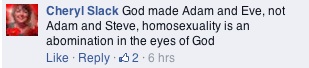
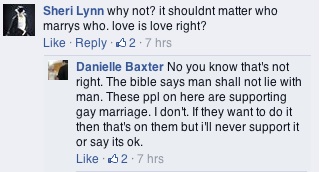
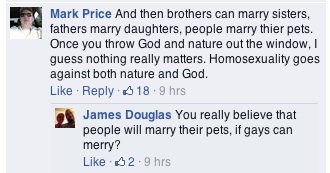
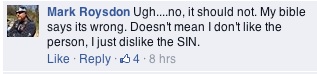
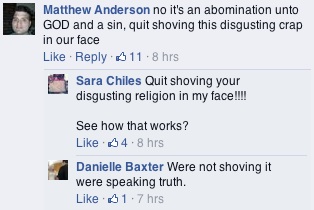
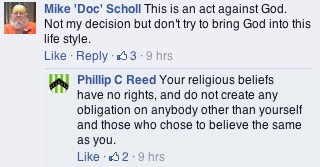
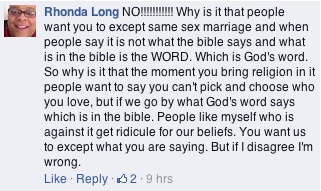
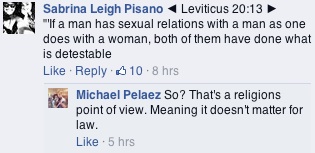
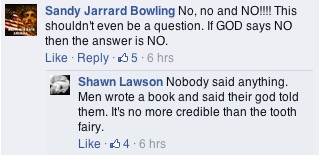
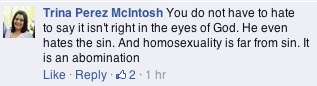
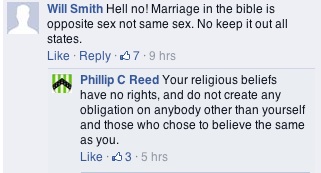
Exposing bigotry: Here are some Christians very angry about same-sex marriage

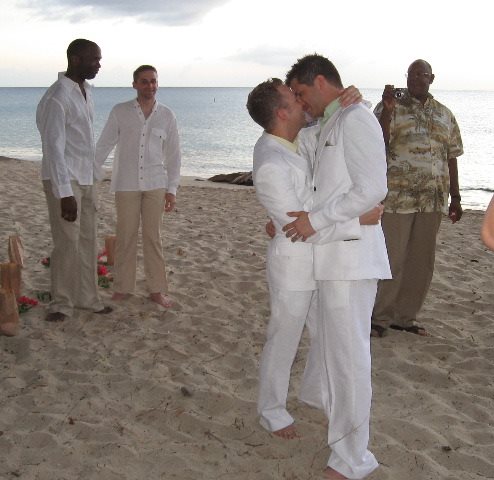
It’s my opinion that if you post something in a public forum, your comments are fair game for public criticism. With that stated, last night I clicked on a Facebook image from Fox 45 Dayton that asks, “Do you believe Same-Sex Marriage should be legal in Ohio?” The image in question is below:

10492317_687951117942204_4408775416862510466_n

The image is a simple image — two (I’m assuming) recently-married men on a beach, flanked by family and friends and another couple — but the question is perhaps purposefully provocative. That is, Fox 45 Dayton implicitly wanted the image to go viral with religious fanatics and same-sex marriage supporters squaring off. Fox got exactly what it wanted. Religious fanatics flooded the comments with religious bigotry. So I did what anyone in my position would do; I took numerous screen caps to call out religious bigotry where I see it.

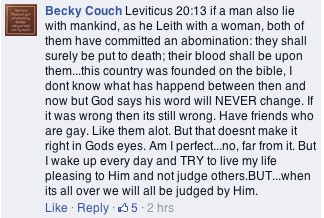
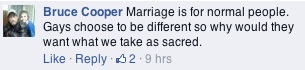
Below you will find these comments. I’m not censoring their names because, as I stated before, these comments were left publicly. Besides, they probably stand by these statements anyway. I’m lazy so these are in alphabetical order. Note that not all of the original comments are bigotry; some show bigotry in the replies.

I hope that all of you will follow suit, exposing bigotry everywhere you find it.

becky couch

Definitely far from perfect.

bruce cooper

Gays choose to be different? I would imagine you’d find it impossible to choose to be gay. Go ahead and try it.

cheryl slack

Which god?

danielle baxter

Actually, love is love. Sheri had it right.

mark price

I would totally marry my cat!

mark roysdon

Your bible has no power.

matthew anderson

LOL at Sara’s response! I couldn’t have said it better myself!

mike scholl

Listen to Mike. He’s a “doctor.”

norma nichols

Please tell me more of what the lord say.

patricia sproat

What the fuck does “he’ll no” mean? He’ll no what?

rhonda long

We don’t want you to “except” anything. That doesn’t even make sense!

roberta keating

The bible is very clear about a lot of stuff. How many of your children have you murdered for disobeying you?

sabrina leigh pisano

Thanks Michael!

sandy jarrard bowling

God also tells fat people to commit suicide.

ted adkins

How original.

trina perez mcintosh

So is your bastardization of Jesus’ teachings.

will smith

Is that THE Will Smith? I hope not.

As a recap, if you’re gonna be a bigot, people like me will call you out.

Posted in Atheism | Tagged , , , , , , , , , , , | 7 Comments