Bible Contradictions #22: After resurrection, how many disciples did Jesus reveal himself to?

Bible contradictions 22

The appearance of Jesus to his disciples following his crucifixion and subsequent resurrection appears several places in the bible. Not surprisingly, the stories given by the various accounts are way different, all the way down to how many people were there.

1 Corinthians 15 is the first version. All twelve disciples (including the dead one) are in attendance when Jesus swings by. Matthew 28:16-17 is more on point, taking the obviously dead Judas out of the audience, leaving eleven disciples to greet the risen Jesus. John 20:24 gets rid of Thomas, leaving only ten.

So which is it? Ten, eleven, or the impossible twelve? You might hear some Christian apologists say that these were three different appearances. They might stand by this because in each story Jesus does different things (like teaching them how to evangelize and baptize people). But that’s rubbish. If there were three different appearances, all three books would probably go out of their way to mention that. Instead, they all act as if they are talking about the only appearance of Jesus.

This contradiction also appears in my video:

Posted in Atheism, Bible Contradictions | Tagged , , , , , , , , | Leave a comment

Abraham’s Pyramid: How religions built on other religions die

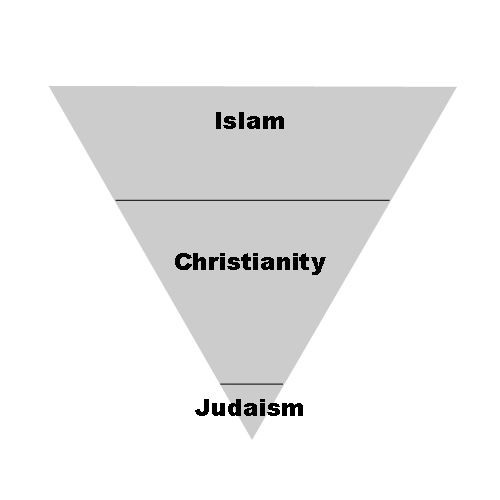
Jumping off of yesterday’s post about evolution negating the religions that rely on Adam and Eve, I have developed what I will call “Abraham’s Pyramid.” The basic premise of Abraham’s Pyramid is as follows: Christian doctrine relies on the validity of Jewish doctrine. If we take original sin out of the equation (by removing Judaism) then Christianity will collapse. Islamic doctrine relies on the validity of both Jewish and Christian doctrine. If we remove either original sin or Jesus (or both) then Islam will collapse. This is, of course, an inverted pyramid. See below:

abraham's pyramid 1


Each tier higher than the last relies on the tiers below it being true. The higher up the pyramid you climb, the less stability you have. For example, if Jesus a) did not exist or b) was not resurrected, then that spells big trouble for Islam, but it doesn’t mean much to Judaism.

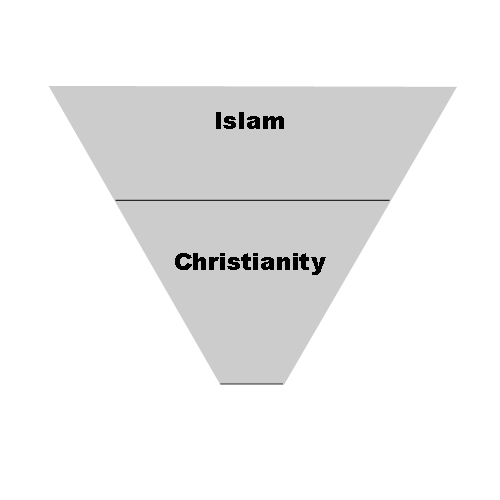
If we remove (as was mentioned in the beginning of this post) Adam and Eve, this is what the pyramid looks like:

abraham's pyramid 2


Adam and Eve are central to the Jewish faith. Their actions lead to original sin. Original sin creates a need for a savior to save us from death that will reveal himself at no specific time. The Torah goes out of its way to build lineages from Adam and Eve to various other figures, such as Noah, Abraham, Moses and David. If we bring evolution into the mix, Adam and Eve did not exist, and therefore no such lineages are true, which casts doubt (at best) on the rest of the Jewish faith. At worst, it utterly destroys Judaism.

Another metaphor we might use is a tree. I’ll admit that I was first tempted to use a tree, but my photoshop skills are not the best in the world (hence my rudimentary pyramid). Judaism is represented by the roots. Judaism feeds Christianity (the trunk), which in turn feeds Islam (the branches). If we cut out the roots, the rest of the tree dies.

And as I wrote yesterday, evolutionary theory essentially does just that: cuts out the roots of Christianity and Islam. This is why building a religion on the back of another religion is dangerous. This is also why we can feel comfortable saying that the religions of Abraham are false.

Post Script: I anticipate a rebut that claims Adam and Eve were allegorical (original sin came not from the first man and woman but rather from our inherently evil ways). This argument is interesting because it strays far, far away from the bible in an attempt to save the bible. If this is their argument, they might ask why the bible isn’t more clear. They might also ask why the bible needs saving. The bible isn’t very strong if it relies on mere humans to protect it.

Posted in Atheism | Tagged , , , , , , , , , , , | 3 Comments

You cannot be a believer in the God of Abraham if you accept evolution

I’ve heard the following argument a million times. It’s so ingrained in human thought that I can’t even remember from where it originated. The argument is as follows:

  • If evolution is true, then Adam and Eve did not exist
  • If Adam and Eve did not exist, then Jesus did not die to save us from original sin
  • Therefore, if evolution is true, then Jesus did not die to save us from original sin

The hypothesis takes the position that evolution essentially negates the Abrahamic religions. That is, if humans evolved, then there was no first man and woman. There was no temptation by a serpent. There was no original sin. There was no need for Jesus to save us.

I think it’s a fairly simple hypothesis gleaned from the questions that evolutionary theory has given society. It’s a straightforward statement that is rather unquestionable. I wracked my brains trying to come up with a theistic retort to the hypothesis and concluded that any retort is meaningless.

In order to reconcile evolution with their religion, they must add to and subtract from their religion. The holy texts of Abraham offer absolutely no insight into evolutionary theory. Instead, the books are highly explicit in how the world was created (six days), where the heavens are located (they exist in a physical firmament), and from where humans came (Adam and Eve). One must subtract these from the bible and add in some new stuff that appears nowhere in the bible. They will have to add evolutionary theory: Humans evolved from other creatures. At some point god was pleased with the progress and placed two in the Garden of Eden. At that point the biblical story can continue.

This saves their religion but creates it with a completely different foundation. (It also does nothing to answer the whole heaven-existing-in-a-physical-place problem that I mentioned yesterday).

But why a believer would want to change this foundation is beyond me. Believers probably don’t want to change it (changing it admits that these parts are wrong). But that leaves open the question, if you accept evolutionary theory, why do you still believe? Jews no longer have a need for a savior. Adam and Eve did not exist and therefore did not cause original sin. Christians can not say that Jesus died to save them from original sin because it didn’t exist. And if Christianity falls, there too goes Islam.

If you accept evolution then you cannot also accept the teachings of the Abrahamic religions. They are mutually exclusive. If you want to still be a believer, you’ll have to dismiss the scientific method, live your life in delusion, and convert to creationism.

Posted in Atheism | Tagged , , , , , , , , , , , , , | 1 Comment

According to the bible, we live in a snow globe. Science proves this wrong, but why do many still believe in the bible?

Centuries ago science disproved Genesis 1:6-8 (which, needless to say, blew a huge hole in the story of Noah’s ark). In the creation story the heavens and the earth coexist in a physical universe. The earth sits below, covered in a little water. The rest of the water rests on a physical boundary above the earth. The stars are holes in this physical boundary through which heavenly water can fall to earth as rain. Above that is god and his angels.

This is called the Firmament, a physical, dome-shaped boundary between heaven and earth. The Firmament is central to the Noah story. Prior to the flood, it had never rained on earth. Then god opened the Firmament and flooded the earth with heavenly water.

But we now know that there is no Firmament. We’ve known this for 500 years, possibly as much as 1,400 years. There is no dome-shaped, snow globe-like structure surrounding our planet. Rain comes from evaporated water that collects as clouds. And stars are massive, gravity-rich plasma spheres that generate massive amounts of energy by breaking down hydrogen into helium (for the majority of their lives). They are not holes in anything!

This is an enormous problem with the creation story that cannot be reconciled with fact. The vast, vast, vast majority of Jews, Christians, and Muslims do not even claim this part of the creation story to be true. But if this can be so easily dismissed, why do so many have a hard time dismissing everything else in the bible that science contradicts?

Posted in Atheism | Tagged , , , , , , , , , , | 13 Comments

Religions cannot claim a monopoly on objective morality: The debate is based on flawed definitions

(If you don’t feel like reading this whole post, scroll to the purple text, which is the main point of this post).

I generally stay out of the objective morality debate between theists and atheists because the conclusion that atheism has no objective morality is a fallacy: it assumes that atheism takes positions on things outside the scope of supernatural belief. But I wanted to add my two cents to the argument. The idea that atheists have no objective morality is wrong. It’s religion that has no objective morality.

Christianity, for example, draws 100% of its (what they call) “morality” from the Christian scriptures. But there are hundreds, if not thousands, of other religious texts in the world. By definition, this makes Christian morality subjective to the book from which this morality originated. Christian morality is subjectively different from Islamic morality, or Buddhist morality, or Konkokyo morality. Christians draw their morality from a book based on the flavors of their own likings.

To further illustrate this point, let’s look at the human consumption of animals. Christianity tells us that after Noah’s flood, god gave (some) animal flesh to humans to eat. Most Jews, Christians, and Muslims see no moral problems with eating animals. Many Jains and Buddhists, on the other hand, believe that it is immoral to eat animals. When left up to religion to decide, the answer is subjectively based on which religion to which one subscribes.

The secular version of morality, on the other hand, is rather simple and not subjected to variations among different religions. Secular morality goes like this: Is the action that I’m about to take a form of violence? If yes, then I will not take that action. If no, then I’m free to take that action.

Violence, be it physical or structural, is not subjective. Harm is harm. If our actions harm another person or animal then it is not moral. If our actions harm no other person or animal, then it objectively is moral. (Of course, this in no way implies that atheists, Christians, or any other group of people follow these morals. Case in point, most people eat animals, despite the fact that doing so harms animals).

But all of this is irrelevant. No religious person makes the argument that you need the bible to know that murder is wrong. Instead, people are confused about definitions. Here is the main point of this post:

Outside the scope of harm, what religious people call their monopoly on “objective morality” should instead be called something like “Christian ethics,” “Islamic ethics,” etc, because they have no basis in morals. Ethics differ from morals in that morals are within each individual. Everyone knows murder is wrong. Ethics, on the other hand, are socially constructed. An example of an ethical question is this: Is gay marriage ok? Because gay marriage causes no harm, the answer cannot come from morals; rather, the answer is subjected to our ethics.

Here everyone answers the question based on their ethical understanding. Christians can say all they want that it is unethical to have same sex marriage, to not tithe, and to not honor the sabbath, but they cannot say that these things are immoral. And if they take the position that these things are unethical, they must admit that their positions are subjected to the religious belief to which they belong.

To sum up, here’s a table to help you better understand.

  Morals Ethics
Where do they come from? An inner sense of what is right and wrong. Social constructions, religious texts.
Example Murder is wrong because it harms people. Homosexuality is wrong because the bible says so.*
What happens if you act against them? You feel guilt. Society looks down on you.

*Of course, this is BS. It can easily be argued here that Christians who try to deny the LGBT community certain rights cause harm and are, thus, being immoral.

Posted in Atheism | Tagged , , , , , , , , , , , | 1 Comment

Bible Contradictions #21: Should Christians preach to atheists?

Bible contradictions 21

Atheists get preached to all the time! Which is sort of block headed if you ask me. Between friends, family, neighbors, and even complete strangers, evangelical Christians really like trying to evangelize the non-believers. They believe it is their Christian duty to convert as many to Christ as they can. But the bible isn’t exactly that clear on the topic. It can’t seem to make up its mind.

In 1 Peter 3:15, the bible tells Christians to preach the gospel to any non-believer who asks why they have faith in supernatural beings. Colossians 4:5-6 supports this behavior. It reads, “Walk in wisdom toward them that are without, redeeming the time. Let your speech be always with grace, seasoned with salt, that ye may know how ye ought to answer each one.”

But 2 John 1:10 tells Christians to ignore non-believers. Don’t preach to them. Don’t invite them into your house. And don’t even tell them good morning. 1 Timothy 6:20-21 tells Christians turn away from those who don’t believe. And 2 Timothy 2:16 warns Christians that trying to convert atheists is a lost cause.

To some Christians preaching to atheists is a favorite pastime. But it is incredibly annoying to atheists. Listening to evangelical preaching is no different from listening to a mad man who’s trying to convince you he was abducted by aliens. The good news is that, despite the bible’s contradicting verses, the score is three to two against preaching to atheists. If Christians want to play it safe, they should take the winning side and stop preaching to us.

Posted in Atheism, Bible Contradictions | Tagged , , , , , , , , , , | 4 Comments

Casting off god in the name of faith: Should more believers leave their religions to search for truth?

Late last year we heard about the pastor who was taking a break from god, trying out atheism for 365 days to see what it has to offer. Ryan J. Bell’s decision sparked a few controversies: From his church (who fired him), his university (who fired him), and some in the atheist community (who thought that you can’t “try” atheism if you still believe in god). All of these minor dissensions aside, the act itself has provoked questions in my head.

Is it more admirable for a believer to put their immortal soul at risk by questioning faith and seeking truth, regardless of what they find? Or to never risk anything and simply accept what they’ve been told?

It seems to me that the answer is rather simple; everyone of faith should leave their religion to explore other ideas, especially a life without god. If their faith is strong, the understanding of varying world views should not shake their faith, allowing them to return to their religion with a better understanding of how their faith shapes their lives.

But furthermore, leaving behind their religion and exploring other world views is a cosmopolitan approach to life, one that bridges the “us/them” divide and, as we’ve seen, generally leads to tolerance and acceptance of different cultures and religions.

On the other hand, this carries social and professional risks. Bell lost two jobs just for conducting this experiment. To be shunned by your leaders and peers might be devastating, especially for teenagers and young adults.

But with secularism growing more and more accepted everyday, we should find that experiments, such as Bell’s, become more and more the mainstream.

So believers, cast off god for a while. Explore. See what the world has to offer. Maybe you’ll leave your religion forever. The worst that can happen is that you find that your religion is the best model for you, and you’ll return to your religion with more conviction.

Posted in Atheism | Tagged , , , , , , , , , , , | 1 Comment

The battle over gay rights: Terrorism is no longer just for terrorists

With all of the progress made in recent months for equal rights for the LGBT community, we’ve also seen a reactionary movement. The recent Arizona bill that was–thank godvetoed yesterday by Gov. Jan Brewer was the most extreme reactionary force against the LGBT community. But we’ve also seen the Internet whiners–those who wield no real power–staking claims against LGBT rights, many of whom invoke the Almighty God of Abraham. Behold the following:

dr marsh

Doesn’t matter what an earthly judge says. He or she will have to give account for his or her actions one day. It matters what the Heavenly Judge says and He has already handed down His ruling that regardless of the thumbs down I receive, homosexuality is an abomination.

“DrMarsh” (I doubt he or she is a real doctor) gets one thing right; It doesn’t matter to him or her that a judge ruled an anti-gay marriage bill unconstitutional. But the point is that here we see another example of how the anti-LGBT group is comprised mostly of religious ideas.

But during the last year or so I’ve been seeing increasing references to gay activists as terrorists. For example:

gay sinners

the only thing about religion is seems to be to attack those that believe in religion..what defense is there against the sinners attack? Refuse a gay and lose everything in court..that is not freedom of religion that is gay terrorism.

“Big Time” (who looks suspiciously like Howard Stern) has now sought to close the light-years-wide gap between the 9/11 hijackers and gay rights activists. Terrorism is a very powerful word. Let me define it for you:

Terrorism is the deliberate act of physical violence by non-state actors against a civilian population for the explicit purpose of forcing a government to affect change.

“Big Time” and others like him invoke the word “terrorism” to justify their claims of perceived “religious persecution.” But gay rights activists are not throwing bombs at civilians or flying planes into buildings to force the government to legalize gay marriage or to defend against the failed Arizona bill. They are filing lawsuits in court. They are doing the exact opposite of terrorism. They are using legal avenues set up by the American Constitution to voice their grievances and seek redress.

Terrorism is an awful thing that has caused the loss of countless lives around the world (many times in the name of religion). When the word “terrorism” is belittled for any reason, be it religious or non-religious, that also belittles what terrorism means. Calling a LGBT activist a terrorist not only raises them to the level of terrorist, but it also lowers terrorism to the level of LGBT activism. There is a massive difference between the two and should be respected, else we lose our ability to tell the difference.

A LGBT activist who uses actual violence against a civilian population to force the government to act is a terrorist. Let’s stop calling LGBT activists who file lawsuits or hold parades terrorists. That’s just absurd.

Posted in Atheism | Tagged , , , , , , , , , , , , , , | 2 Comments

Quran Absurdities: Apes come from sabbath-breaking Jews

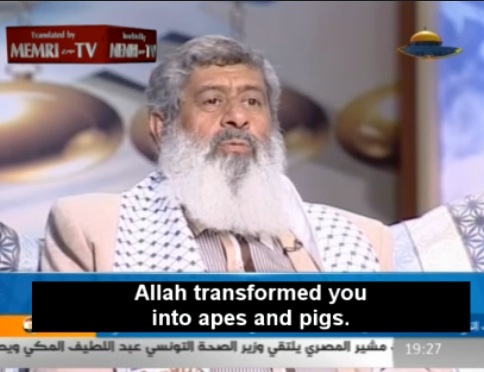
According to the Quran, both evolutionists and young-earth creationists have it wrong. In reality, Allah got pissed at some Jews who were breaking the sabbath and cursed them by turning them into apes. He went even further by cursing all succeeding generations, which is why when apes have babies, they have ape babies instead of human babies.

If Allah’s really pissed, he might turn you into a pig instead.

apespigs

Posted in Atheism | Tagged , , , , , , , , , | Leave a comment

Choosing to believe in god: Choice is not an option

I’m strange because I don’t like chocolate. I never have. Give me vanilla or strawberry any day of the week over chocolate. I didn’t choose to not like chocolate. Early on my parents noticed me swapping my chocolate Halloween candy with my siblings for Juju fruits. I admit that this makes me miss out on some enjoyment in life. I think life would be more joyous if I enjoyed more things. But I don’t. I can’t. Even if I try, chocolate will never sit right on my palate.

This is very much the same with belief in god. I’ve posted about this before, but I continue to hear the questions made over and over again: “Why do you choose to be an atheist?” Or the comments: “You can believe in whatever you want to believe in.” Or atheists might say, “When I chose to stop believing in god…” These are errors in logic. One presupposes that belief in god is determined by choice. It is not.

Belief in god is merely a conclusion that the god theory best supports the data gained through observation. Unbelief in god is the conclusion that the data gathered through observation is insufficient to support the god theory. One has no choice in whether or not one will adopt the god theory. Try as we might, we cannot change our beliefs by our own free will. To change our beliefs, new and contradicting data must be observed.

In my case, I would have to find a version of chocolate that I actually enjoy. Enjoying chocolate, even if only for a moment, would require me to at least say, “I sometimes enjoy chocolate” instead of “I don’t enjoy chocolate.”

But choice is not completely irrelevant in regards to belief in the divine. Choice plays a major role in the quest for new and contradicting data. Many atheists (especially scientifically-minded atheists) are constantly choosing to seek evidence that will change their minds. We read scriptures, probably more than many believers. We don’t believe what we are reading, but we try to ignore the cognitive dissonance that plagues all human thought. We choose to keep an opened mind because conclusions can only be made after observing all available facts.

Many believers do the same thing. They choose to seek out new and contradicting data. Most believers don’t subscribe to impossible claims of a young earth or creationism. Even some Christians have abandoned the idea of immaculate conception. They stopped believing such things because they chose to view all of the data through (mostly) non-biased lenses.

But cognitive dissonance is a very powerful force, and even many people who choose to consider all available evidence will still make illogical conclusions, because they want to make those conclusions: the fallacy of assumption.

So believing in god is not a choice. It’s a feeling, an idea, based on observations. The only choice we have is whether or not we seek out new and contradicting data and whether or not we honestly examine and consider new and contradicting data when we find it. Considering this data will not lead us to finding fact (because the god theory cannot be proven), but it will alter our beliefs. You might choose to call yourself a Christian, but you cannot choose to believe that Jesus is your personal savior. If you don’t believe me, try it. Try to stop believing in god for an entire day. You’ll find it’s impossible if you truly believe. It’s also impossible for me to choose to believe in god for an entire day. I can say that I believe in god all I want, but without new data my actual lack of belief will not be altered.

Posted in Atheism | Tagged , , , , , , , , , | 15 Comments