Tolerant Christians are failed Christians

The conversations I have with my Christian friends and family members usually center on the dangers of Christianity. They will invariably speak about how Christianity is relatively peaceful compared to the horrors inflicted upon the world in the name of Allah. The following atheist meme sums it up:

militant atheist


All joking aside, and to give Christians credit, the militant Christian murdering a family physician due to religious beliefs about abortion is rarely observed. Just in the last week alone, however, we’ve seen a deadly suicide attack by the Sunni Islamic State of Iraq and the Levant in a Shia Hezbollah-dominated suburb of Beirut, and the same Islamist organization take control of an entire city in Iraq. The dangers of Christianity pale in comparison to the threat of Islam. Take another look at the picture above. If you were forced to invite two of those guys over to dinner to discuss politics, which one would be snubbed? I’m pretty sure the guy with the bomb won’t get an invitation.

But why are Christians so “tolerant”? I use the word “tolerant” loosely, of course. Why aren’t they out in droves murdering atheists and other non-Christians? The answer is because most Christians are failed Christians.

I’m not making a “no true Scotsman” argument here.

The Spanish inquisitors were following the literal teachings of Christ, complemented, of course, by Deuteronomy. The Spanish inquisitors argued that Jesus supported the widespread torture and slaughter of non-Christians. Indeed, they were right. John 15:6 says “If anyone does not abide in me he is thrown away like a branch and withers; and the branches are gathered, thrown into the fire, and burned.”

Modern Christians almost categorically reject the idea that non-believers should be killed. It seems natural that this should be true. As breakthroughs in science, and indeed knowledge, are made, religions must liberalize to survive. For example, we no longer believe that non-believers are given magic abilities to harm Christians through sex with Satan. Because of that, we no longer believe that atheists pose existential threats to Christians. Therefore, most Christians have no reason to kill a non-believer.

But this liberalization of the Christian religion is nothing more than an example of failing to live by the teachings of Christ. Christianity, through this liberalization, seems to be able to just throw away teachings that counter modern social norms. By admitting that certain Biblical teachings no longer apply, one is also admitting one of two things: 1) Christianity is flawed and thus subject to scrutiny, or 2) Christianity is perfect and the Christian is a failed Christian.

I posit that it would counter Christian beliefs for a Christian to admit that Christianity is flawed. If this is true, then Christians should confess their uncertainty and failings.

Indeed, Will Durant, in The Age of Faith: The Story of Civilization (1950), writes, “Intolerance is the natural concomitant of strong faith; tolerance grows only when faith loses certainty; certainty is murderous” (p. 784).
Posted in Atheism | Tagged , , , , , , , , | 10 Comments

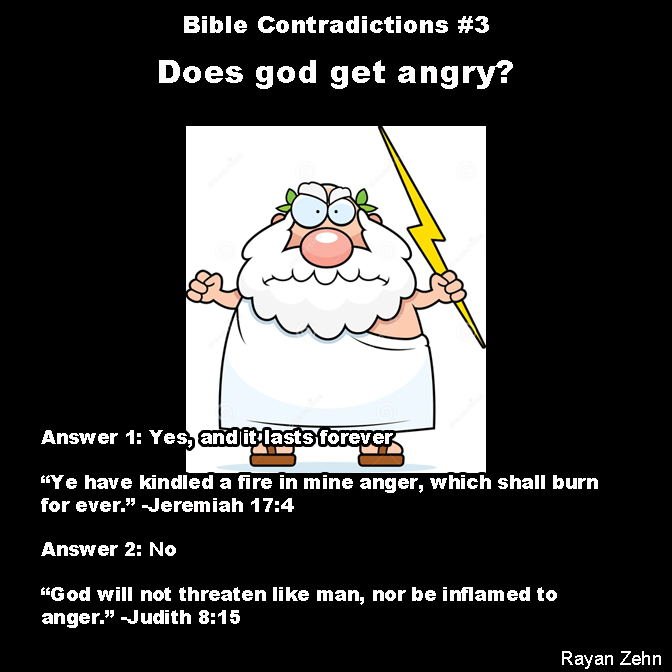
Bible Contradictions #3: Does god get angry?

Does god get angry? The bible wouldn’t have us know. It’s all over the place on this one.

Bible contradictions 3

First, I should note that the book of Judith was stripped from the bible by the Jews and Protestants, but it remains canonical by the Catholic and Eastern Orthodox churches. But even if I control for the book of Judith, the bible is still very contradictory regarding god’s wrath. Let’s take a look at all of the other verses that disaffirm the others.

God’s wrath only lasts a moment:

  • “For his anger endureth but a moment.” –Psalm 30:5

God’s wrath lasts 40 years:

  • “And the Lord’s anger was kindled against Israel, and He made them wander in the wilderness forty years, until all the generation that had done evil in the sight of the Lord was consumed.” –Numbers 32:13

God’s wrath is not eternal:

  • “…I am merciful, saith the Lord, and I will not keep anger for ever.” –Jeremiah 3:12
  • “…He retaineth not His anger for ever, because He delighteth in mercy.” –Micah 7:18

God’s wrath is eternal:

  • “…they shall call them the Border of Wickedness and the people against whom the Lord hath indignation forever.” –Malachi 1:4
  • “Then shall He say also unto them on the left hand, ‘Depart from Me, ye cursed, into everlasting fire prepared for the devil and his angels.” –Matthew 25:41
  • “And these shall go away into everlasting punishment, but the righteous into life eternal.” –Matthew 25:46

So there you have it. According to the bible god doesn’t get angry. But when he does, it’s cool because it’s only a moment, 40 years MAX!! It’s not like he’s mad forever. Ok, he’s mad forever.

Posted in Atheism, Bible Contradictions | Tagged , , , , , , , | 9 Comments

Did Jesus imply that one need not worship god any longer?

The New Testament is an interesting book. It cannot escape its own contradictions, but moreover, if you read some of Jesus’ teachings, they create more questions than answers. In my search through bible contradictions, I came across one that implies that Jesus was more concerned with social issues than the worship of god.

That is, when asked which of the 10 commandments should be retained under his new religion, Jesus left out all of those commandments referring to god. Three times. Here are the verses:

  • “And he said unto him, why callest thou me good? There is none good but one, that is, God: but if thou wilt enter into life, keep the commandments. He saith unto him, which? Jesus said, Thou shalt do no murder, thou shalt not commit adultery, thou shalt not steal, thou shalt not bear false witness, honour thy father and thy mother: and thou shalt love thy neighbor as thyself.” -Matthew 19:17-19.
  • “And Jesus said unto him, why callest thou me good? None is good, save one, that is, God. Thou knowest the commandments, do not commit adultery, do not kill, do not steal, do not bear false witness, honour thy father and thy mother.” -Luke 18:19-20.
  • “And Jesus said unto him, why callest thou me good? There is none good but one, that is, God. Thou knowest the commandments, do not commit adultery, do not kill, do not steal, do not bear false witness, defraud not, honor thy father and mother.” -Mark 10:18-19.

Absent are the first four commandments: No other gods, no graven images, no taking the lord’s name in vain, and keeping the sabbath. These commandments serve as the cornerstone for Christian worship. If Jesus was so quick to dismiss them, then perhaps Christians will do good to dismiss them as well.

Also notice that in Mark Jesus added a new commandment: “defraud not.”

Posted in Atheism, Bible Contradictions | Tagged , , , , , , , , , | Leave a comment

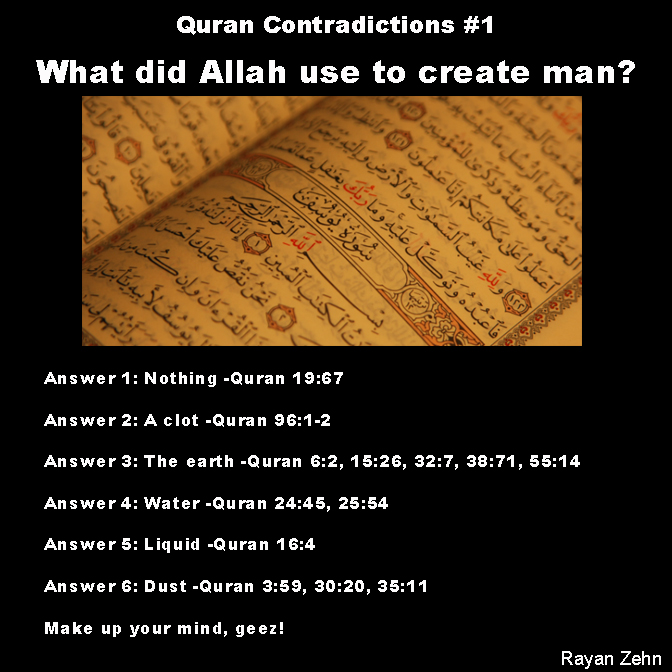
Quran contradictions #1: What did Allah use to create man?

In the same vain as my bible contradictions, I submit the first quran contradictions.

quran contradictions 1

Posted in Atheism, Quran Contradictions | Tagged , , , , , , , , | 15 Comments

Secularism and existential security: Peace between Israel and Palestine unlikely until religion is shaken off

The atrocities carried out by Islamic Palestinians with bombs strapped to their chests are horrible events, which, planted deeply in the heart of Koranic code (see Koran 4:74-78), are invented strictly out of the promises of religious necessity. Indeed, Sam Harris, in his book The End of Faith: Religion, Terror, and the Future of Reason, points out:

“Subtract the Muslim belief in martyrdom and jihad, and the actions of suicide bombers become completely unintelligible, as does the spectrum of public jubilation that invariably follows their deaths; insert these peculiar beliefs, and one can only marvel that suicide bombing is not more widespread” (p. 33).

Zionism, too, entrenched in the philosophy of Jewish nationalism, offers us no salvation from the horrors of religious doctrine. Zionism, working in tandem with Holocaust guilt, invents justification for human rights abuses: the segregation of people, the destruction of homes, the stealing of land, etc. These abuses create a hopeless situation that has been exploited by suicide terrorists to commit unspeakable acts. In this sense, Zionism is as much to blame for Palestinian suicide missions as is Islam.

While the debate over the Palestinian state rages on, and while John Kerry naively believes he can be the harbinger of peace in the Middle East, very little attention has been paid to the giant obstacle that makes peace impossible: religion.

Removing religion from the equation makes peace inevitable. This is problematic for the people of Palestine, however, whom suffer a dearth of existential security. That is, if the findings of Ronald Inglehart and Pippa Norris in their book Sacred and Secular: Religion and Politics Worldwide are to be believed, Islam will continue to dominate the social and political landscape of the Palestinian people because 1) they rely on Islamic code for survival, and 2) they are promised a paradise after death, a paradise especially granted to martyrs.

For the people of Israel, especially the Jews, secularism is more within reach. As Inglehart and Norris explain, as existential security rises, secularism becomes more mainstream, and the state becomes malleable to social pressures for liberalization of all aspects of domestic and foreign policy. Israel is by far the most advanced state in the Middle East, and, as recent studies show, secularism and irreligion are on the rise in the Jewish state.

If the findings by Inglehart and Norris hold true in Israel (which they almost definitely will), we should expect to see a decline of Zionism as more and more Israelis divorce themselves from Judaism. Therefore, I posit that the ball is in Israel’s corner to secure peace. To do so, Israel has the responsibility to help build existential security in Palestine–to help shake off the Islamic hold over the society that promotes acts of terror.

Religious teachings in Islam and Judaism are natural barriers to peace. Only when such superstitions are pushed to the back of social consciousness can any headway be made. The lack of existential security in the Arab World, especially Israeli-occupied Palestine, make secularism unlikely, making it Israel’s responsibility, as being the more secure and more secular state, to help Palestine grow. Until then, even if Palestine achieves full statehood under Kerry’s guiding hand, we should not expect peace between the Jews and the Muslims. As a consequence, more Palestinians will suffer abuses by Israel, and more Israelis will die in terroristic acts.

Posted in Atheism | Tagged , , , , , , , , , , , , , , , , | Leave a comment

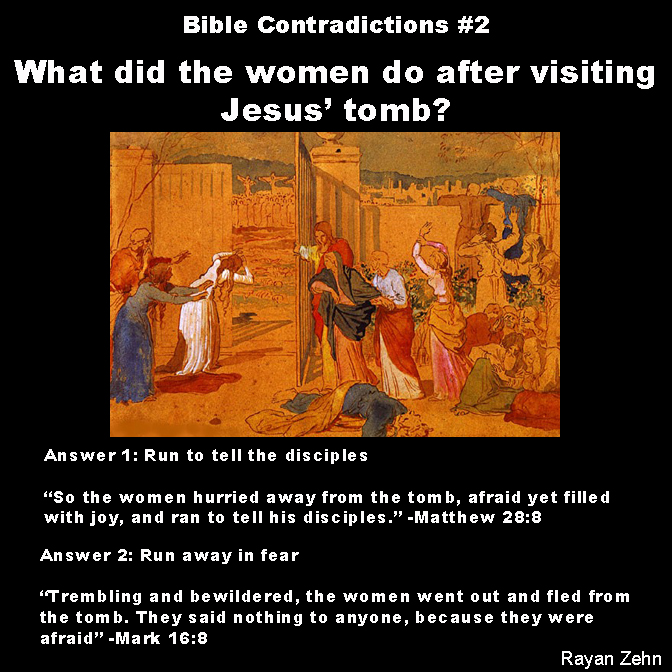
Bible contradictions #2: What did the women do after visiting Jesus’ tomb?

The women who witnessed Jesus’ crucifixion, his burial, and the discovery of the empty tomb play a major role in the resurrection myth. Why then is there such a major discrepancy between the gospels when it comes to what the women did after discovering that the tomb was empty? Unfortunately, the bible gives us no answers.

Bible contradictions 2


This contradiction also appears in my video:

Posted in Atheism, Bible Contradictions | Tagged , , , , , , , , , , | 5 Comments

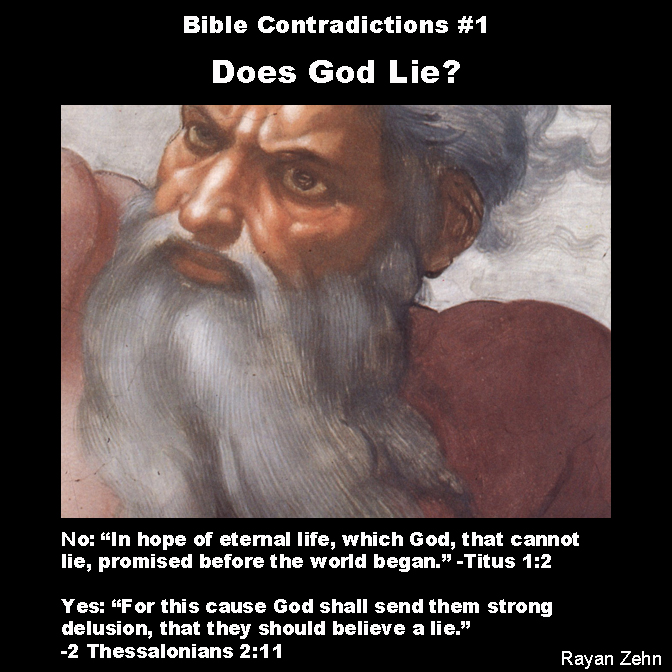
Bible contradictions #1: Does god lie?

I’m fascinated by contradictions in the bible. Because of that I’ve decided to create a sub-section on this blog titled Bible Contradictions. The first is below, which addresses the question “Does god lie?” The answer is unclear.

1

There are many more contradictions regarding whether or not god lies. Those verses saying he can’t lie are found at Numbers 23:191 Samuel 15:292 Samuel 7:28Psalm 119:160, and Hebrews 6:18.

Verses claiming that god can or does lie are found at 1 Kings 22:232 Chronicles 18:22Jeremiah 4:10Jeremiah 20:7, and Ezekiel 14:9.

Posted in Atheism, Bible Contradictions | Tagged , , , , , , , | 35 Comments

Godless heads of state and government: Atheist leaders around the world

Here’s an image I made showing many of the current and previous atheist heads of state and heads of government. This list is by no means complete. Notable is the fact that the United States is missing from this list. Although many of our founding fathers were Deists, and Abraham Lincoln is suspected to be an atheist, there have been no open non-believers to hold a major position of authority in our government’s administration.

Please, if you know of politicians that I’ve missed, feel free to comment below. Also, if you can attribute some atheism-related quotes to anyone below, send them my way as well.

For obvious reasons I left off controversial figures.
heads of state and government

Posted in Atheism | Tagged , , , , , , , , , , | 10 Comments

A bunch of Christians and an atheist on Christmas morning: I was not expecting how I was treated

Each year for Christmas my family uses Elfster to coordinate a secret Santa-type gift exchange. The website randomly pairs family members together, with a $50 maximum gift cost. Usually I ask for that $50 to be donated to a secular charity. I log in to the site, type in what I want, and it instantly sends what I want to my secret Santa. This year I decided to conduct an experiment. I asked for books about atheism. It just so happens that this year I was paired up with the most religious person in my family.

I did not expect what happened next.

This is what I asked for.

This is what I asked for.

First, let me rewind a little bit. Immediately after submitting the three books shown above to my Elfster wish list, my sister sent me the following message over Facebook:

xmas01To be honest, I always thought my sister was Christian. I had no idea she considered herself “an agnostic at most.” So, awesome! But regardless, my sister has always been the most open minded person in the family. So I was a bit surprised that she found offense in my wish list. Remember, all I did was merely wish for three books. I left no commentary about religion or Christmas.

Also, I’ve never really discussed my atheism with my family. So this wish list was an informal way of outing myself to a group that probably already assumed that I don’t believe in god. After receiving that message from my sister, I assumed that Christmas would be awkward at best, and everyone-pick-on-our-heathen-atheist-Ryan at worst.

No matter what, I didn’t expect to actually get the books on my wish list.

So Christmas morning comes, and I’m given a gift from my secret Santa, who happens to be my ultra religious aunt. It’s a card. I’m expecting a gift certificate to Amazon and a letter explaining why she can’t buy the books herself. I was halfway right. Here’s the contents of the card (she gave me a donation in my name of $50 to savethechildren.org):

Hi Ryan,

I chose this gift for you before you told us about pay-it-forward. I love that concept. What are their stats? This one [Save the Children] has 5% mgt, 6% fundraising, 89% programs. Being a Christian, I didn’t feel I could buy the books you wanted. I think if you explored Christianity as you do other things, your perspective would change. Your inquisitive mind will show you things others may not see. Try not to put shutters on any subject. You are my crazy-off the wall-nephew and I love your differences, but that doesn’t mean I agree with them.

Lovingly,

Your aunt

She also gave me some seeds for my garden, which was awesome!

Anyway, despite her little jab at me (assuming that I’m not Christian because I haven’t looked into it), she basically said (in my words, paraphrased) “good on you for being different!”

I expected anger, not acceptance. I mean, I expected tolerance because I’m family. But I didn’t expect her to be so open about it.

She and I briefly spoke about atheism. It appears that my 15-year-old (or thereabouts) cousin believes he’s an atheist. My aunt mentioned her desire to allow him to figure it out for himself.

The moral of this story is that sometimes it pays to be open about atheism and to discuss your views with your family. I feel like I’m lucky because when I put everything out there, everyone was happy for me. I know many people with opposite experiences. But you never know until you try it.

PS. This is in no way promotes Save the Children. To be honest, I don’t know much about them as an organization. I’m not even sure if they’re secular or not.

PPS. In a strange twist, Elfster teamed me up with my uncle, who asked for $50 in canned goods to be donated to his church. I’m vegan, so I hope the homeless in his city enjoy vegetables!

Posted in Atheism | Tagged , , , , , , , | 1 Comment

Self-immolation: Is religion to blame?

Often the finger is pointed at religion as being an underlying cause of suicide terrorism. Generally, the finger is pointed at Islam. Suicide terrorism is a radical form of suicide, often employing bombs or vehicles carrying incendiary materials. And indeed, there is a correlation between religious belief and suicide terrorism. But self-destructive people who wish to die for a cause–to construct themselves into martyrs–are not limited to terrorism.

You see, suicide terrorism is generally met with scorn from the public audience. Because the goal of terrorism is to maximize civilian casualties, the message the terrorist is attempting to convey to the audience is lost amid the carnage and mayhem that follows the terroristic act. Because of this, other methods are sometimes chosen. One of these methods is self-immolation. Self-immolation is the act of individuals who commit or attempt to commit suicide by setting themselves on fire to make a political statement, usually attempting to compel the state or civilians to take action.

I spent the last year studying self-immolation for my thesis, the results of which are outside the scope of this blog post. In my research I came across hundreds of suicide notes, written by people who have since self-immolated. There appeared to be a recurring theme: religion.

Self-immolation as a tool to voice contention was invented in 1963 when South Vietnamese Buddhist monk Thich Quang Duc set himself on fire in a busy Saigon intersection. He did this to protest against the way the Buddhists were treated by the Catholic minority. Since then it has spread to every continent and has been utilized as much as 3,000 times (See Michael Biggs). The majority of which occurred in Asia. Refer to the following diagram.

Self-immolation by region 1963-2012

Most of those who committed suicide by self-immolation have done so in the name of Buddhism or Hinduism. In 1990 a huge spike of self-immolations occurred in India following the reservations for lower castes. In 2011-2012 another huge spike occurred in the Tibetan region of China.

Another interesting cluster occurred in the United States from 1965-1970. As many as 25 people self-immolated to protest against the Vietnam War, most of whom referred to god in their suicide letters. Alice Herz was the first, a widow and Holocaust survivor who referred to her struggle against the arms race as being the battle between David and Goliath. This was followed by Norman Morrison, a Quaker, and Roger Allen LaPorte, a Catholic Worker, both of whom explicitly stated their religion as playing a role in their decision to kill themselves.

What makes the US case so interesting is the incarnation of their god. The US protestors worshipped the god of Abraham, who promises eternal suffering for suicide. The gods of the Indic religions (Buddhism and Hinduism) promise no such threats. Despite the guarantee of eternal hellfire, religious Americans felt that their religious teachings made it their duty to kill themselves in the name of peace.

A final interesting cluster is the Arab Spring. As many as a few hundred people, mostly Muslims, self-immolated in the Arab World to protest against their governments. This is not only interesting because they worship the same god of Abraham; it is also interesting because self-immolation was unheard of in the Arab World until December 2010, when Mohamed Bouazizi brought it into the public knowledge. Those who killed themselves in the Arab World were not doing so for religious reasons; rather, they did so for ethnic and national reasons. Therefore, we cannot always blame it on religion. Furthermore, religious meaning for self-immolation is largely absent in Europe.

Finally, while not always the case, we can say that there is a correlation between religion and self-destructive behavior. Some people choose to blow themselves up and take as many civilians with them as possible. Others choose a more peaceful method. Despite the method, it can be argued that without certain religious beliefs, fewer people would be burning themselves to death. Indeed, self-immolation is built into many Buddhist belief systems as a means to reach enlightenment.

The question is: How much self-immolation would we expect to see in an atheistic world?

Posted in Atheism, Self-Immolation | Tagged , , , , , , , , , | 5 Comments