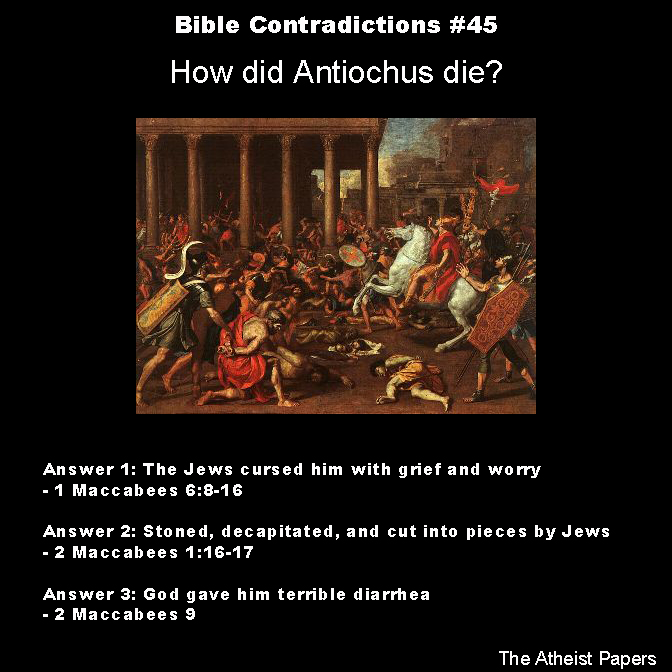
Bible Contradictions #45: How did Antiochus die?

Bible contradictions 45

Antiochus IV Epiphanes is a moderately important bible character, even though he doesn’t even appear in many versions of the bible. Antiochus is the main antagonist in the war against the Jews that culminated in the events that are now celebrated as Hanukkah.

The story about the Maccabean revolt is chronicled in the books of Maccabees, deuterocanonical books held as cannon by the Catholic and Greek Orthodox churches. The books are not considered cannon by the Protestants and — interestingly enough — the Jews. As legend tells us, Antiochus lost the war, dying suddenly four years before it was finished. But how did he die? In order to answer this we should look at the books of Maccabees, but unfortunately doing so will only confuse us.

First in 1 Maccabees 6:8-16 we find the Jews cursed Antiochus with grief and worry, which led to his death.

Then in 2 Maccabees 1:16-17 we find Antiochus entering a temple to get married. Unbeknownst to him, some Jewish assassins were waiting for him, having entered the temple through a secret door. The Jews stoned Antiochus and his men, decapitated them, and chopped them into pieces.

But apparently not even decapitation could kill Antiochus because he appears in the book again. In 2 Maccabees 9 god gets pretty pissed at Antiochus after he gets in his chariot to flee from battle. God’s had enough of the leader’s shenanigans, striking him down in a classic god of Abraham way; god gave Antiochus uncontrollable diarrhea. So terrible was this diarrhea that Antiochus fell from his chariot, breaking several bones. The feces attracted a swarm of worms, which feasted on Antiochus’ flesh. The stink was so awful that his men couldn’t get near to save him. He became so desperate that he asked god to save the Jews in exchange for relief. God said not a word, so Antiochus, covered in shit, wrote a letter to the Jews, freeing them from persecution. And then he died.

That’s a pretty crazy story. What makes it even crazier is it was Antiochus’ third death.

As I mentioned above, this is considered cannon by the Catholics and the Greek Orthodox church. The Jews and the Protestants do not consider this story cannon. Perhaps it’s because this contradiction was so glaring they decided to cut the entire story from the bible. Who knows? It’s still pretty funny that it’s in some bibles!

Posted in Atheism, Bible Contradictions | Tagged , , , , , , , , , , , , | 7 Comments

Do atheists exist?

We all read the article in Science 2.0 that said “Atheists might not exist.” I went to the sources and found that the author cited op eds instead of actual scientific research. So I did some digging on my own and found what the latest scientific literature says about atheism.

Enjoy!

Posted in Atheism | Tagged , , , , , , , | 6 Comments

The Genesis of Self-Immolation

In this video I present the findings of my research into self-immolation as a tool for contention. Although this project doesn’t necessarily have much to do with religion or atheism, it does briefly discuss how religion may have inspired many people to set themselves on fire in the US between 1965 and 1970. And I offer this little jab at religion:

If there is a correlation [between self-immolation in the US and religion], then it is an interesting one because these were followers of the God of Abraham, who promises no eternal reward for suicide, but rather eternal suffering.

If you’ve ever wondered why people are willing to set themselves on fire to make a political statement, you might find the answer in this video.

Posted in Atheism | Tagged , , , , , , , , | 15 Comments

Science suggests we have no free will: Implications on belief

In 1985 Benjamin Libet published a peer-reviewed paper where he instructed his test subjects to lift their arm while recording their brain activity. What he found was interesting. Brain activity increased before the subject had even decided to lift their arm. In other words, the brain made the decision before they were aware of this decision. This lends some evidence towards the position that we do not have free will. Instead decisions might be made subconsciously based on both internal and external conditions and stimuli. That is, the neurological and the environmental.

(For the sake of intellectual honesty, I must also point out that the author went to great lengths to avoid jumping to conclusions: “it is important to emphasize that the present experimental findings and analysis do not exclude the potential for ‘philosophically real’ individual responsibility and free will.” But he also said this: “Processes associated with individual responsibility and free will would ‘operate’ not to initiate a voluntary act but to select and control volitional outcomes.”)

There is a very minor debate about free will in the scientific community, but most of the community agrees: The idea of free will is a construct. We are not free to decide. I’ll leave a bibliography at the bottom of this post if you wish to read the scientific literature on free will.

If we take the scientific position that free will does not exist, then we are not free to decide whether or not supernatural agencies exist. Whether or not we believe in the supernatural—be it god or other—is the result of natural response through internal conditions to external stimuli. We might also invoke the rational actor model (which makes few assumptions about free will, but many about natural response). Our position regarding the divine is a natural conclusion based on how much utility that position grants us. Since we are all utility driven creatures, belief in supernatural agencies might grant us some comfort in a dog eat dog world. However, as existential security rises, the utility of belief declines, and our natural position then shifts back to the default position and disbelief might offer more utility.

Both atheism and theism, therefore, are probably natural responses. That doesn’t mean we shouldn’t make fun of religious belief, because doing so increases the amount of external stimuli that might lead religious people toward reason.

To sum up, the religious idea of free will is largely contradicted by what we’ve discovered in the scientific community. It’s unlikely that we are free to decide whether or not we believe in supernatural agencies. I would suspect, however, that secularism will continue to rise in the West as existential security increases.

Further readings on free will in the scientific literature:
(Contact me for copies of these articles)

Baumeister, R. F. (2008). Free will in scientific psychology. Perspectives on Psychological Science, 3, 14-19.

Baumeister, R. F., Masicampo, E. J., & DeWall, C. N. (2009). Prosocial benefits of feeling free: Disbelief in free will increases aggression and reduces helpfulness. Personality and Social Psychology Bulletin, 35, 260-268.

Libet, B. (1985). Unconscious cerebral initiative and the role of conscious will in voluntary action. Behavioral and Brain Sciences, 8, 529-566.

McAdams, D. P. (2013). Life authorship: A psychological challenge for emerging adulthood, as illustrated in two notable case studies. Emerging Adulthood, 1, 151-158.

Pronin, E., Wegner, D. M., McCarthy, K., & Rodriguez, S. (2006). Everyday magical powers: The role of apparent mental causation in the overestimation of personal influence. Journal of Personality and Social Psychology, 91, 218-231.

van Roekel, E., Verhagen, M., Scholte, R. H. J., Kleinjan, M., Goossens, L., & Engels, R. C. M. E. (2013). The oxytocin receptor gene (OXTR) in relation to state levels of loneliness in adolescence: Evidence for micro-level gene-environment interactions. PLoS One, 8(11).

Further readings on secularism and existential security

Inglehart, Ronald. 1997. Modernization and Postmodernization: Cultural, Economic, and Political Change in 43 Societies. Princeton: Princeton University Press.

Inglehart, Ronald, and Pippa Norris. 2004. Sacred and Secular: Religion and Politics Worldwide. Cambridge: Cambridge University Press.

Posted in Atheism | Tagged , , , , , , , , , , , | 10 Comments

Bible Contradictions Collection and Commentary: New Video!

Sorry for posting so many videos lately. Because it’s summer I have some extra time on my hands, but I start a new position on Monday, so videos and blog posts will slow down after that. In the meantime, I’ve created a video with some of my favorite bible contradictions from my ongoing list of bible contradictions. Feel free to comment on Youtube. Those conversations usually spiral into nasty ad hominem attacks and reductio ad Hitlerum accusations. I love reading through them!

Posted in Atheism, Bible Contradictions | Tagged , , , , , , , , , | 22 Comments

Sigh… I have reluctantly delved into the atheism and feminism debate.

This is more of a disjointed rant than anything else.

Posted in Atheism | Tagged , , , , , | 2 Comments

Introducing the Silence of Mind Award

In keeping with the tradition of Potholer54‘s Golden Crocoduck Award, I’m suggesting a brand new award for the blogosphere. The Silence of Mind Award (The SOMA) will be awarded to blog commenters who make outlandish, unintelligible, and unscientific claims to support a theistic position. Silenceofmind is not eligible to receive this award due to the fact that it wouldn’t be fair to give it to the person it’s named after. Everyone else is fair game.

Rules for candidate submission:

  • The candidate must make a ridiculous comment on the Internet bastardizing science in the name of a religion.
  • Take a screenshot of the ridiculous comment (make sure a name is provided).
  • E-mail the image in jpg form to theatheistpapers [AT] gmail [DOT] com.
  • I will post them on this blog and ask my readers to vote on them in a poll.
  • Votes will be publicly shared, and the winner will receive a certificate bearing Silenceofmind’s name that they can post on their website.
  • They will also be directed to Wikipedia’s article explaining the scientific method and links to any other article explaining what science actually says about that topic.

Here are some examples of crazy statements:

SOM3

And:

SOM2

And don’t forget my personal favorite:

multiverse

Posted in Atheism | Tagged , , , , , , , , , , , | 17 Comments

When the objective morality argument backfires: A story of an atheist child

I’ve always been an atheist. Since my earliest memories I rejected the theistic stance. Fortunately for me I never had to go through the emotional trauma of de-conversion. For years, however, I didn’t know what an atheist was. It wasn’t until a Sunday school teacher told me I was atheist that I realized it. … which brings up a funny story.

My childhood was relatively church-free. On Sundays when all of my friends were decking themselves out in cheap suits and penny loafers, I was free to explore the massive wooded area behind my house. I used to bring home buckets of wild blackberries, but I never told anyone about them. I sprinkled sugar on them and ate myself sick every night. But there were times when we had to go to church. My parents’ Christian guilt kicked in every Easter, and we — the children — were forced into this yearly ritual at a soulless baptist church (they didn’t even have a band). It was here when I first learned the story of Easter. I was about six or seven.

The kids — myself included — were in the Sunday school classroom. The teacher had just told us about Jesus’ crucifixion, death, burial, and resurrection. ButI thought to myself, I’ve seen dead things before. They don’t come back to life. They just rot and smell really bad! I remember the boy next to me gasped “Holy cow!” when the tomb was revealed as empty. “What does holy cow mean?” I asked. The teacher heard me.

“It doesn’t mean anything. It’s like ‘wow’ or ‘amazing.'”

(This conversation occurred to the best of my memory.)

“Oh I thought he meant there was a magical cow, kind of like Jesus. I don’t believe in magic. My dad once showed me how David Copperfield did his tricks.”

“Jesus doesn’t use magic. He uses the power of god.”

“I don’t think Jesus was dead. I think he was faking it.” (Remember, I was six or seven. My thoughts on this have shifted considerably.)

“Jesus couldn’t fake it. Lying is a sin. And because Jesus was the son of god, he couldn’t sin.”

“How do you know?”

“Because it’s what the bible teaches us.”

“I don’t believe in the bible.”

“Do you believe in god?”

“No. I think it’s all make believe, like David Copperfield.”

“If you don’t believe in god then you’re an atheist. And if you’re an atheist then that means you’re free to lie, cheat, and steal.”

I took her last statement as a statement of fact. Later on she asked the class if anyone had brought a friend with them to church. If you brought a friend, you got candy. Well, my sister was next to me, so I said yes and pointed to my sister. The teacher chided me. “That’s your sister, not your friend. Why did you just lie to me, right in front of everyone?”

“You said if I don’t believe in god I was allowed to lie.”

You gotta admit, although my logic was flawed, it was still quite remarkable for a six or seven year old. I knew lying was wrong. I’d learned it from my parents, and I’d learned it in kindergarten. But this woman opened a door, and I decided to walk through it.

What’s really interesting about this story is that we can see how the objective morality issue is constructed. Before that day I knew certain forms of lying were socially damaging. She deconstructed objective morality long enough for me to pounce on the loophole in order to get some candy. Of course, even though I am still quite aware that lying can be socially destructive, I’m sure certain apologetic Christians will use my story to say, “See! Without god this boy thought it was ok to lie!” Well, no. I was a little boy. Lying is pretty much all that little boys do.

Posted in Atheism | Tagged , , , , , , , , , , | 1 Comment

The Prophesy of Tyre: New video!

As some of you might remember, a while back I made a post about god’s promise to so utterly destroy Tyre, Lebanon that it would never be rebuilt. The problem is, of course, that this never happened, and Tyre still stands today. So baffling is this biblical blunder that I thought it would be appropriate to turn that post into a video. Enjoy!

Posted in Atheism | Tagged , , , , , , , , , | Leave a comment

There are no authorities: Stop block quoting to make a point (a short rant)

I’ll be honest, when I’m reading someone’s blog and they have a block quote by a philosopher to lend credit to their position on something, I usually skip the entire thing. Theists often block quote C.S. Lewis or, for whatever god awful reason, William Lane Craig. Atheists do the same with Hitchens or Dawkins. I’ll be even honester: I’ve done it too. When I see this I sigh. I’m reading your page. If I wanted to read what Lewis or Craig or Hitchens or Dawkins say about something, I’ll go to the library and check out their book. Or I’ll read their blog.

When people use block quotes to make a point, two things go through my head. 1) They haven’t gone through the effort to form their own opinion on the topic, and 2) I wonder if this is the product of quote mining. First, I’m curious about your views. That’s why I clicked on your blog. Tell me in your words how you feel about something. And second, quote mining is a form of intellectual dishonesty. If at all possible, stay away from it. A few accidental quotes out of context might be forgiven, but don’t make a habit of it.

This doesn’t mean you should put everything in your own words. I don’t mind people directly block quoting bible or Quran verses. And if you quote an academic journal, I’d recommend the block quote (because I do check those to make sure they’re accurate representations of what’s in the actual journal… you don’t want to be the subject of a Rayan Zehn rant… I have zero tolerance for that. See my video on that here). Block quotes are also acceptable when you’re criticizing someone else’s work. But that’s about it.

In the field of philosophy there are no authorities. Reference the giants if you will. Use links if you must refer readers back to the authors from whom you got your ideas. But don’t — for the love of all that is holy and sacred — make a blog post with an opening paragraph, followed by a 1,500 word block quote from some author, and concluded with a one paragraph closing line. Put things into your own words. I’ve probably missed out on some good ideas because I’ve been put off by your persistent block quoting.

Posted in Atheism | Tagged , , , , , , , , , , , , , | 2 Comments