Is Silenceofmind an atheist troll?

Atheist bloggers everywhere might be familiar with silenceofmind (SOM), a Christian apologist serial commenter who appears to believe to know more about what atheists believe (and don’t) than the atheists themselves. SOM uses non sequiturs, kettle logic, arguments from ignorance, red herrings, naturalistic fallacies, etc. etc. ad nauseum. To say that SOM’s comments are endearing, kind, or harmless is to miss the point SOM is trying to convey. Indeed, a fellow blogger, What comes to my mind…, had some pretty scathing words for SOM last month.

There is a professor I know who studies how Internet comments devolve (usually into comparisons to Hitler or some other fallacies of irrelevance). His methodology was interesting and compelled me to take a closer look at Internet comments. If I read an article or a blog, sometimes I’ll spend more time going through the comments section than the article or blog itself. Sometimes I screen shot interesting or idiotic comments for future use. SOM’s comments are no exception.

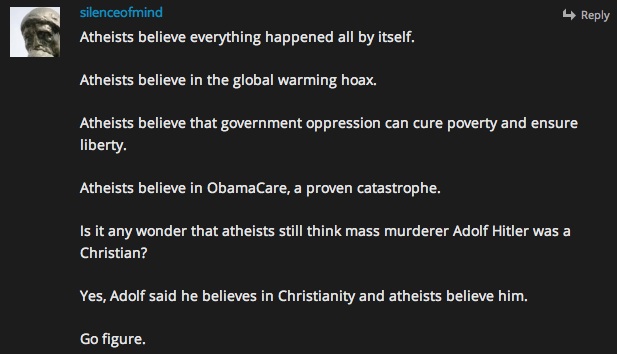
But what is most interesting about SOM’s comments is SOM’s refusal to learn from his or her mistakes. The following two screen shots were taken some time apart, perhaps months apart (I don’t time stamp these things. I probably should).
atheists believe

atheists believe 2

In the first image SOM makes many claims about what atheists believe. Apparently all atheists (or even a majority of us) believe in ObamaCare because it’s what the Atheist Good Book says. In the second image, SOM again makes the claim that atheists believe that “everything happened all by itself,” which would be like saying, “Christians believe that Jesus was born on December 25th.” Both arguments are wrong.

But SOM continues to make these claims about atheists even though I and other bloggers have corrected him/her more times than we can count. To keep making the same errors in logic is a symptom of mental disorder. But there is no reason to believe (other than this weak evidence) that SOM suffers from a mental disorder. Perhaps there is a reason SOM keeps making these mistakes. Perhaps SOM wants to make these mistakes.

Proving this claim is a pretty tall order, and I will not attempt to do so. But we’re all familiar with Internet trolls. And I’d be safe to assume that most atheist bloggers are familiar with Poe (a person who pretends to be a religious fundamentalist with the purpose of arousing strong responses). Unfortunately for me, the Urban Dictionary definition (see the link) claims that SOM cannot be Poe unless SOM admits it. Nevertheless, let’s examine some of SOM’s other strange comments.

immorality of atheism

Here, SOM appears to believe that because many skeptics have a problem with OT god’s violence, atheists believe that stopping Hitler and Imperial Japan was wrong. Ie. If we condemn divine wrath then we must condemn human warfare. First, the two are completely different. One was the destruction of innocent people (including babies) because god got pissed off. The other is the destruction of guilty and innocent people because nationalism was threatening the human population on a global scale. War to stop homicidal maniacs, even when innocent lives are taken, is not akin to wanton genocide because your feelings got hurt.

multiverse

I don’t even know where to begin with this one. I’ll allow Santi Tafarella to have the final say here.

science happened all by itself

“Atheist humanists believe that science happened all by itself.” That is probably the most absurd claim I’ve ever heard. It’s one thing (albeit wrong) to say we believe the big bang happened all by itself, but that the actual scientific method just poofed into existence one day is one of the strangest beliefs I can imagine. I have little reason to believe that anyone, even a five-year-old, would make this claim about atheists.

uninformed atheists

Again with the conspiracy theories. And again lumping non sequiturs into an argument. The post from which I got this screen shot had nothing to do with global warming, ObamaCare, or corrupt governments. Trolls generally use non sequiturs to further engage the audience.

rather be in love

Again SOM can’t learn that atheism makes no claims about how the universe and world were formed. Additionally, SOM appears to believe that you can either be in love (by not saying sorry) or be an atheist. That’s it. Atheists can’t love and lovers can’t be atheists. I find it hard to believe SOM, or anyone, would think this way.
prove god 3 sentences

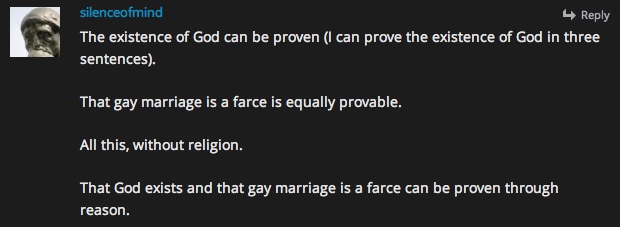
This one came from today. This comment shows an even stranger departure from SOM’s usual style. SOM claims to have proven without a doubt that god exists (using three sentences). But the first sentence (you have to be pretty liberal in your definitions to call it a sentence) is merely a claim that god is provable and gay marriage is bad. It doesn’t tell us anything. The second sentence isn’t even a sentence. I assume SOM means you don’t need religion to prove god exists and gay marriage is bad, but I could be wrong (since it’s not even a sentence!). Finally, SOM says reason alone will prove god and the evils of gay marriage. Again, this doesn’t tell us anything, let alone prove anything. I find it difficult to imagine that SOM really believes that claims count as proof. This is an extreme example of what we’ve seen from the usual apologetics.

And finally…

urine test

Troll. Classic troll.

I have little reason to think much about who SOM is. I don’t know their gender, their country, their ethnic background, or even their religion. But I was wondering, does anyone else ever get the impression that SOM is Poe?


Posted in Atheism | Tagged , , , , , | 17 Comments

Jesus and Mahasstava: Two similar tales of self-immolation

The story of Jesus dying to save humanity is generally accepted as bearing similar qualities to many, many stories of human saviors throughout history. In fact, many go so far as to suspect that the Jesus-on-the-cross story is a rip off of a rip off of a rip off… I count myself among the skeptics.

In my graduate studies I researched for my thesis self-immolation as a form of altruistic suicide. Jesus’ death can accurately be called altruistic suicide (self-immolation too, since the term refers merely to self-destruction, not just fiery deaths). When I began with the existing literature, I had to consider an interdisciplinary approach. I investigated auto-cremation (and other forms of sacrificial suicide) throughout the ages. The scope of my project, however, only considered suicide protest, or self-immolation from 1963 onward. But I became at least somewhat aware of the phenomenon throughout recorded history. Here I discovered stories similar to the Jesus Myth in unsuspected places. Namely, similar stories turned up in the Orient in times that greatly predated the life of Buddha.

In one we have a man named Mahasstava (claimed to be a pre-incarnation of the Buddha), who noticed a hungry mother tigress (tigers in ancient China were considered incarnations of evil) who was too weak to lactate for her cubs. Fearing that the cubs would starve to death (or be eaten by the mother tigress), Mahasstava cut his throat to give his body to the tigress so that she could grow strong enough to feed her cubs. When he did this there was a great earthquake and an eclipse that announced his death to his family.

Mahasstava sacrificed his body to evil. If we look to the Jātaka we can make more sense of Mahasstava’s sacrifice (and perhaps more connections to Jesus). For my part, I will pull some insight from James A Benn’s book Burning for Buddha: Self-Immolation in Chinese Buddhism and add insight of my own.

Mahasstava’s suicide was not merely to discard his body; rather, his sacrifice was to transform his being from an impermanent human to a permanent Bodhisattva. Here we see a direct link between Mahasstava and Jesus. Both are claimed to have shed their earthly forms in exchange for heavenly bodies.

Just as importantly, Mahasstava, prior to his sacrifice, also claimed that his sacrifice was not just for the tigress; he was sacrificing himself for the welfare of all beings. Although Jesus sacrificed himself only for humans (Mahasstava’s kindness to animals propels his morality above Jesus), we can still see a link. Both Jesus and Mahasstava publicly declared the purpose of their sacrifices: to benefit others.

If you read the link to the story above, you’ll find that Mahasstava’s death was not easy. It was gory, extremely painful, and extended. This is much in the same way of Jesus. In order to make his sacrifice profound, Jesus had to suffer immensely. Benn sums up the idea nicely: “The jātaka makes clear in the most graphic and horrific way the heroic determination that was necessary to make an offering of the body.” Jesus’ sacrifice would not have been “heroic” enough if he had merely been pushed (or jumped) from a cliff.

In the Jesus story, his death is announced by earthquakes, an eclipse, and “miracles.” These are also found in the Mahasstava story. These supernatural events act as “proof” that these stories are true (strangely enough).

Finally, relics belonging to Mahasstava, which possessed supernatural powers, became spiritually significant. His clothing and bones were enshrined and acted as a beacon for the hopeless and hopeful. The Jesus story, both inside and outside the bible, is mystified by the claims of the “existence” of Jesus’ relics. These artifacts are necessary to bolster the claim and to embellish the significance of the sacrifice. Indeed, the claim that these relics exist offers the believer with a hope that these claims can be validated (unfortunately for them, no such relics exist, or if they do, they have not been discovered).

I don’t mean to imply that Mahasstava’s sacrifice to the tigress was ripped off by early Christian scribes. This post is merely to highlight how heroic tales of altruistic suicide are similarly designed to meet certain expectations and hopes. The two men sacrificed themselves for different (albeit similar) reasons, but the literary elements surrounding their actions and demises are identical in the points listed above. Dissimilarities between the stories exist, sure, but one should take a moment to consider if supernatural heroes are constructed rather than born.

Posted in Atheism | Tagged , , , , , , , , , , , , , | Leave a comment

How does the bible end? Jesus is revealed to be Satan

The book of Revelation. It is almost as well known as Genesis. It’s the strangest book in the bible. It’s actually the funnest to read. It’s more like an action flick than any of the other books of Christian-Islam text. Sure, there are some exhilarating tales about Joshua’s genocidal rampage in the Old Testament, but Revelation is pretty much a zombie flick, complete with insane monsters and rip offs of pagan deities. But few people who pick up a bible make it all the way through, so they might have missed out on a very important Shyamalanian-like plot twist in the sixth to last verse. Jesus Christ is the accuser, the thief, the deceiver, the little horn, the roaring lion… Jesus Christ is Satan.

Before you flip open your book of rolling papers (ahem, I mean the bible) to Revelation, first let’s get some context. Way back in the Old Testament we meet Satan (called Lucifer) for the first and final time. In Isaiah 14:12 Lucifer is described as follows: “How art thou fallen from heaven, O Lucifer, son of the morning! how art thou cut down to the ground, which didst weaken the nations!”

He’s referred to as the “son of the morning.” Why? I have no idea. Maybe it has to do with humankind’s awakening in the Garden of Eden. Taken literally, the “son of the morning” is the sun… or the “morning star.” Regardless of why Satan (Lucifer) is called this, it must be reiterated: This is the only time the “son of the morning” is mentioned in the bible…. until we get to Revelation.

In Revelation 22:16 we are hearing from Jesus. He says, “I Jesus have sent mine angel to testify unto you these things in the churches. I am the root and the offspring of David, and the bright and morning star.”

In other words, Jesus referred to himself in the same vernacular as Isaiah used in the Old Testament. Jesus, obviously being familiar with the very book he preached, called himself Satan’s nickname. It might not be a perfect reference, but there is very little wiggle room here. Jesus would never, ever reference himself in any way similar to king of the bottomless pit unless he meant it. It would be like if David Berkowitz, when asked if he was the Son of Sam, said “I’m Sam’s son.” It’s the same thing.

So there you have it. Jesus is Satan, Lucifer, the serpent of old. It’s either that, or the bible made a pretty huge mistake.

Posted in Atheism | Tagged , , , , , , , , , , , , | Leave a comment

Fat people should commit suicide (according to the bible)

I stumbled across this blog post today by Violetwisp. (Thanks for bringing this to my attention!) In it, the author points out a problematic proverb. For reasons unknown I usually avoid proverbs. They are incredibly boring (well, so is the rest of the bible, but these are boring even for the bible). So I hope you forgive me for not being familiar with this verse until this morning. I didn’t have time to properly put this verse into context, but I don’t think context matters with a verse like this.

The verse in question from the NRSVCE:

and put a knife to your throat
if you have a big appetite.

That’s Proverbs 23:2. In context Proverbs 23 appears to mean (summed up in its entirety) it’s not good to covet the wealthy. But still, the context could’ve been anything at all, and it wouldn’t change the meaning of this verse. If you’re fat, kill yourself.

I can already hear apologists (SOM is that you???) saying that this verse is allegorical or metaphorical. If we are overweight we should cut the sin of gluttony from our beings. Or even better: Don’t be a fat jerk when the rapture comes. God’s carrying you all the way to heaven. He would appreciate it if you lost some weight. So what? Who cares if this is allegorical?

Some people will read this verse and interpret it literally. They may feel that god would rather they be dead than fat. Indeed, all it takes is one literal interpretation for this verse to become a tragic consequence of religious belief. Even if they don’t take it 100% literally, they may still feel the shame of being overweight.

At best this verse is about fat shaming. At worst it condones suicide for people who eat more than they should (there goes most of the US).

Posted in Atheism | Tagged , , , , , , , , , , | 5 Comments

9 books for the thinking atheists’ summer reading list

Because there seems to be at least a small correlation between non-belief in supernatural agencies and interest in physical sciences, I want to present you all with a list of science-based books from my own specialty–political science. Although my field is chock full of statistical analysis, it is also a system of theoretical frameworks that lie outside the scope of physical prediction. My field is a social science, which means that as soon as society changes (even a little) the variables change and, thus, the theories we develop become more or less suspect. Still, I am quite taken by this field and believe that, even people with Ph.Ds in cosmological sciences or atmospheric physics will enjoy these books. Read them while on vacation on a beach in Mexico, beer in hand! Summer is just around the corner!

This may be my longest post yet. I hope you can make it through the list.

  • Sacred and Secular: Religion and Politics Worldwide (2004) – Pippa Norris and Ronald Inglehart. I’ve mentioned this book plenty of times. Norris and Inglehart explain, using many decades of data, how, although religious societies continue to become more religious (having large families), secular societies are becoming more secular. This leads to the liberalization of social practices, putting emphasis on the individual instead of the state. This happens when existential security rises and people no longer have to depend upon the state for security. As history moves forward, more and more societies will experience rises in existential security and will thus become more and more secular.
  • Modernization and Postmodernization (1997) – Ronald Inglehart. If you  want a more detailed explanation of Inglehart’s theory in Sacred and Secular, this book explains the full phenomenon. Once a society has industrialized, he argues, economic development and cultural and political changes are correlated, and he even sees some levels of predictability. He predicts a transition from an insecure materialist state, focused on strong political order; economic growth; traditional sexual and gender norms; and strong religious beliefs, to a secure postmaterialist state, where political strength falls upon the individual and non-traditional political structures are stimulating; quality of life trumps economic growth; liberalized sexual and gender norms; and a de-emphasis on religion.
  • Capitalism, Socialism and Democracy (1942) – Joseph Schumpeter. Joseph Schumpeter makes the case for socialism, not as a socialist, but rather as a scientist. That’s not entirely true; he makes the case that capitalism will naturally collapse because it rests on entrepreneurial innovation, which results in “creative destruction,” business models, which belittle individuals, and rationality, which, Schumpeter believes, pulls intellectuals towards socialism. Schumpeter doesn’t believe that capitalism can survive given these processes that undermine “the social institutions which protect it, and ‘inevitably’ creates conditions in which it will not be able to live and which strongly point to socialism as the heir apparent” (p. 61). On the other hand, Schumpeter is at least somewhat optimistic that a socialist form of democracy can thrive given that certain criteria are met. My inclusion of this book in no way is to suggest that I agree with Schumpeter, but it is a fascinating theory nonetheless.
  • Imagined Communities: Reflections of the Origins and Spread of Nationalism (1991) – Benedict Anderson. In discussing the cultural roots of nationalism, Anderson argues that nationalism was a secular alternative to religious identities that were growing more diverse. The nation, nationality, and nationalism are abstract ideas without coherent definitions. Therefore, creating a theory to understand nationalism is difficult. Anderson attempts to provide an explanation for this difficulty. Essentially, Anderson argues that we just made up these abstract ideas—or imagined them. Not only is the nation imagined (in the sense that “the members of even the smallest nation will never know most of their fellow-members, meet them, or even hear of them, yet in the minds of each lives the image of their communion” [p. 6]), but also the nation is imagined as limited, sovereign, and as a community. In other words, the nation has borders, and other nations exist outside those borders; the concept of the nation dates back to the creation of sovereignty; and despite differences, belonging to the nation denotes deep comradeship.
  • Making Democracy Work: Civic Traditions in Modern Italy (1993) – Robert Putnam. Italy has a long-standing tradition of using its civic capital to shape politics. But its success as a democracy has been questioned. Indeed some have called it a failure. Robert D. Putnam conducts an extensive survey of the differences between Italy’s regional governments, finding that, while some (mostly in the South) struggled to function efficiently, some (mostly in the North) thrived. He makes a compelling generalization: Social capital—or civic participation—and history matter a lot to present day political institutional performance. Putnam, despite inherent problems with decentralization, believes that in order for a democracy to succeed, institutions must be placed closer to the people. In Italy, grassroots politics under a decentralized government has helped this become a reality in various regions. He uses twelve indicators (found in Chapter 3) through four strict tests to measure institutional performance. He finds that regions that score high in many of these indicators are many times more likely to be efficient.
  • Dialogues in Arab Politics: Negotiations in Regional Order (1998) – Michael N. Barnett. Barnett uses a highly constructivist approach and a somewhat postmodern approach to explaining international relations (IR) in the Arab world. Barnett seems interested in explaining why Arab states have not behaved in ways that can be explained by traditional IR theories. For example, he notes that, while realist theories predict that states will engage in arms races to balance against their neighbors, Arab states have not done this. To explain this lack of materiality, he points to “presentational politics.” That is, Arab leaders view politics as the utilization of words, not might. He also uses the 1967 war to make his case in point: contrary to the realist view, Nasser was willing to sacrifice himself in order to promote Arab nationalism. This suggests that, for the most part, Arab politics is about Arab nationalism, not balance of power or power distribution. But this is not to suggest that Arab states are unified; they have “rival opinions of what [the] norms should be, and a defining feature of [the] dialogues is that Arab states compete through symbolic means to determine the norms of Arabism.” In other words, states compete to build a narrative. The norms, however, remain constant: reactions to the West, Zionism, and the need for a strong Arab community.
  • Gendering World Politics: Issues and Approaches in the Post-Cold War Era (2001) – J. Ann Tickner. The end of the Cold War has brought a lot of changes to the study of IR, such as a decline in military-security issues and the emergence of economic issues (more liberal theoretical approaches to IR). Therefore, where conflict does occur, it might be best to explain them with alternative theories, theories that can focus more on identities and cultures. This shift in IR studies also brings more women into the discussion. It also shifts the state somewhat out of this discussion. She quotes Ken Booth when she writes, “the state, the traditional frame for IR, ‘might be seen as the problem of world politics, not the solution’” (p. 2). But feminism still sits on the sidelines in IR to traditional theories. Tickner explains that the third debate in IR focuses on critical theory and is highly postmodern in its approaches. This was the setting for the emergence of feminist theory. Ultimately Tickner does not believe that the post-Cold War world has adequately addressed the problems in international politics because it has disenfranchised non-androcentric issues. Feminists can fix this problem by looking at the individual; that is, to “draw on local knowledge to construct their theories. Emphasizing the need to listen to marginal voices, they often use the term conversation to describe the way in which they generate knowledge” (p. 126). The point is to understand how knowledge is built and evolves, disregarding any notion that objective reality can be obtained. The failure to do so is problematic, not just to women, but also to men.
  • Nuclear Weapons After the Cold War: Guidelines for U.S. Policy (1992) – Michèle A. Flournoy. Flournoy attempts to determine to what extent nuclear policy after the cold war should be reevaluated. She opens in the introduction with the following questions: Now that the Cold War has ended, do nuclear weapons still matter? If so, what are their functions in US foreign policy? How should policy be written? How many weapons should still be in deployment? And how does arms control play into this new era? In answering these questions, she finds “three distinct but related challenges” (p. 1): Mitigating risk of inadvertent detonation, controlling the spread of nuclear weapons, and dealing with a defunct nuclear doctrine.
  • The Communist Manifesto (1848) – Karl Marx and Friedrich Engels. This is an incredibly short book, considering its powerful reach as a source of global activism and action. Love or hate communism (or any feeling in between), I believe every human being should take a few hours out of their lives to read this and judge for yourself. Too many people embrace or condemn Marxist ideas without ever reading Marx’s and Engels’ words for themselves, which is like critiquing the bible without ever reading it yourself. This is the perfect book to read on that beach down in Mexico. Doing so should guarantee plenty of conversations with strangers.

This list is by no means complete. Even though I study politics (especially from an international perspective), I reach out into other fields quite often. You should do the same. Even if you’re an engineer with a passion for the physical universe, you should familiarize yourself with the social. These books are good starting points.

Posted in Atheism | Tagged , , , , , , , | Leave a comment

What happens when Christian children and atheist adults have a conversation about god?

The other day I was visiting a friend. We play in a band together. She has an 11-year-old daughter who, after spending some time with the grandparents, is currently going through some sort of religious awakening to Christianity. The mother, on the other hand, is what I will call a non-practicing Christian by practice. Meaning, she identifies herself as Christian, but she doesn’t believe in Christianity, and she doesn’t go to church.

Anyway, without any provocation on my part (it might seem far-fetched, but it’s true), the girl began the ritual of evangelical “truth” spreading. I bit my tongue for as long as possible until she wandered into the domain monopolized by the scientific method and, thus, permanently divorced from millennia-old religious doctrine.

I’ve never in my life been so blunt to an 11-year-old girl.

I explained to her how the universally accepted theory of evolution means that there was no first man and woman who passed their “original sin” onto the rest of the human population. Without this there was no reason for Jesus to die to save us. She brushed that aside and said “That’s not true. The bible says god created the world, the humans, the animals, and the plants. Adam and Eve are real.” I said “Your bible is not science. It never went through a peer review and couldn’t survive one if it did.” She then made up some stuff that’s not in the bible. Her new story goes like this:

God created Adam and Eve and millions of other people. Dinosaurs too, even though she “doesn’t believe in dinosaurs” (for real, I’m not making that up). But they became evil so god sent the flood to wipe them out, save Noah. Since Noah can trace his lineage back to Adam and Eve, Adam and Eve are merely the first humans in the surviving human gene pool, the de facto first humans, not the first humans by design.

Nothing like this is in the bible. So she just made it up (or, more likely, heard it from her grandparents). This was a good segue into the malevolent god problem. I asked her how she could justify god killing thousands of innocent babies and children in the flood when he has the power to zap evil out of the world? I asked her about Joshua’s genocidal rampage. How was that morally justified? God of the bible and Joshua are literally worse than Hitler (if we count the corpses in their trail of innocent victims). What about Numbers 31? She’s (presumably) a virgin. If this were biblical times she’d be ripe for sexual slavery.

“If your god exists he’s the definition of evil, and I don’t know why anyone would worship him. Believing in god is one thing, but the God of Abraham deserves no respect.”

The conversation went on for about another 30 minutes. Before long we drank some beers (the adults only, of course) and the conversation moved onto other areas. When I got home I received an email from the mother. This was when I learned that she’s a non-believing Christian. She thanked me for talking some sense into her daughter. She explained that she was raised ultra-conservative Christian and felt trapped in Christianity her entire life. Even as an adult, she can’t seem to shake off the Christian identification, even though she doesn’t believe in Jesus (she does believe in god, however*). She doesn’t want her daughter to go through the same torment that plagued her growing up and into adulthood.

I was relieved to receive such a note. I’ll admit that I was a little apprehensive about speaking about such matters with a child. The average Christian parent would’ve probably kicked me out of their house, perhaps even called the police. But what about what the mother said? How evil does Christianity have to be if it has the power to instill torment into the minds of young children and adults alike? I was never a Christian, so I don’t know what being raised Christian is like. There must be something from which she’s trying to protect her daughter. I hope that in time she’ll explain to me how Christianity damages the minds of young children.

Then again, I’m pretty sure Dawkins wrote an entire chapter about this. So I could just go read what he has to say.

Anyway, the moral of this story is… I don’t really know. I just felt like sharing it with you.

*It’s unclear what her current religious views are. I think she’s a spiritual deist. But she has not articulated her beliefs to me.

Posted in Atheism | Tagged , , , , , , , , , , , | Leave a comment

Atheists have no meaning in life? Does that mean your dog’s life is meaningless too?

Human companionship with animals is an almost-universal feature throughout all of the planet. And the animals speak a universal language with us. Compassion. Love. Kindness. Empathy. They are there when we need them the most–to help us through tragic events, to enthusiastically greet us upon our return home, to invariably break something that we also hold dear. But we forgive them because without those creatures in our lives, life would have a little less meaning. Many of us treasure animal companionship. Be they dogs, cats, ferrets, cockatiels, rats, or bunnies, companion animals are a very important part of the lives of animal lovers. As a consequence of the joy animals bestow upon us, we naturally care for their well-being, safety, and happiness.

Animals are by definition godless. The Judeo-Christian version of the supernatural offers no eternal reward for non-human animals. Jesus did not die on the cross to save your pet iguana from eternal emptiness. Your pet turtle will not be resurrected upon the second coming. Indeed, in the bible animals are merely tools to be utilized on the field, slaughtered as offerings to the lord, traded for virginity. Yet, followers of Christ are not immune from the power of love for our fellow non-human earthlings.

When Christians (and other believers) ask me “if there is no god then isn’t life meaningless?” I say no. No one, even devout Evangelicals, have any reason to believe that their kitty’s life is meaningless even though there is no reason to believe that there is actually a dog and cat heaven. At least, I haven’t met anyone above the age of reason who still believes in dog and cat heaven. Animal lovers, despite their religion or lack thereof, fully understand the meaning in our animals’ lives. Our animals find meaning in the comfort of companionship, in food, in barking at would-be intruders wearing brown shorts, in chasing “mysterious” red laser points. Even though they can’t articulate their thoughts in a way that we can understand (yet??), we have no reason to believe that our companion animals suffer through a life without god.

Even in the wild, where human love has not penetrated, we have no reason to believe that an elephant’s life is meaningless merely because it hasn’t read the bible. The great apes are cherished for their human-like traits and intelligence. And, no one believes that apes don’t find meaning in their relationships and playful activities. Many of us feel at least a small sting of guilt when we see wild bears or orcas in captivity. Why? Because we’ve deprived them of the natural meaning of their lives.

All non-human animals are godless (as far as we can tell). At least, none of them believe the Genesis-through-Revelation story. None of them have formed religious institutions with memetic-like communication structures to reinforce their beliefs in the minds of other non-human animals. No. The closest thing to god in our companion animals’ lives is we, their companion humans. And we are a constant let down in our animals lives. Forgetting to feed them. Not taking them on enough walks. Rubbing their faces in their messes. And just not showing them 100% of our attention. Yet, despite all of our failings, they forgive us because they know that we exist and will continue to love them.

If our fellow animals can find comfort, happiness, and meaning in life without having to believe in a supernatural agency that will save their immortal soul, then it should be pretty clear to the believer why atheists can find comfort, happiness, and meaning in life too.

Posted in Atheism | Tagged , , , , , , , , | 1 Comment

Divine Intervention: When “god” interferes with our relationships

I recently wrote about how religion is often used to exclude people of other faiths and non-faiths from their romantic relationships, and how this is an example of modern-day religious extremism. But I have much, much more to say about the love issue–something I’ve observed and experienced several times. I’m sure many other atheists (etc.) have gone through similar experiences. Before you read this entry, please take a moment to watch the following television show clip:

Unfortunately, this is a rather typical reaction when two lovers realize that one is religious and the other is not. It is an almost universal reaction when a religious family realizes their daughter or son is dating an atheist.

I don’t allow religious differences to determine who I will or will not date or fall in love with. About 10 years ago I dated a Christian girl (Pentecostal) for two years. We had a relatively perfect relationship, but it ended suddenly when the idea of marriage developed in her head. How could she marry an atheist? How could she allow the father of her children to teach them to question god’s existence? 

I think I learned more about her in our breakup than I did for the entire two years we were together. But this isn’t the only time I’ve felt the sting of rejection for merely not believing in god.

The video above is especially interesting because it depicts a black American family. For reasons unknown to me, I hit it off better with black girls than I do white girls. I have livelier debates with people who are not my skin color (I’m a “white” man, whatever the hell that means). This naturally leads me to develop romantic interest in non-white women, usually black women. When my lack of god belief is revealed, any reciprocated romance is quickly rescinded.

The African American community in the US has incredibly strong bonds, held together largely by religious belief and practice; religious beliefs which are, in turn, held together by song, dance, and food. White guys like me are not excluded from such festivities. Indeed, I’ve spent many nights checking out local gospel bands because the music is fantastic! (You don’t need god to enjoy god’s music). I am treated with great respect by the black community, even when they learn that I don’t believe in god. But to date one of their daughters would condemn me exile. Such is the strength of religious beliefs. It trumps everything else, even to the detriment of romance.

Interestingly, this was not the case when I lived in Beirut. Perhaps it’s because Lebanon has a strong secular movement, I dated a Shia Muslim woman and, even though I was an open atheist, never felt shunned by her family.

From my personal experience, in the United States it appears that Christians are more likely to exclude atheists from potential romantic partners, but atheists do not exclude believers. This is merely an observation, and I am not presenting this as fact. But could it be true that religious people, particularly Christians (and to a larger extent black Christians) are more likely than atheists or non-believers to exclude someone based on their religious beliefs?

Call me old fashioned, but I always thought that love was the effect of a biological process, not a socially religious construction.

Posted in Atheism | Tagged , , , , , , , , , , , , , , | 4 Comments

Former Christians are literally the antichrist(s) (according to the bible)

We’ve all heard the word “antichrist” before. The word conjures up images of armageddon, scenes from Rosemary’s Baby, and, in some circles, President Obama. But what actually is the antichrist? Well, to answer this we need only look at 1 and 2 John. The answer may surprise you.

Unfortunately no, keep reading.

Unfortunately no, keep reading.

1 John 2:18 sets the stage. John knew we were living in the “end times” because prophesy said that the antichrist was coming. (Sigh, we’re still waiting, John). Lo and behold, in John’s day there were many antichrists (go ahead, click the link to see for yourself). But that doesn’t tell us much about the antichrist, however. So skip to 1 John 2:22 for more elaboration.

According to verse 22 the antichrist is someone who lies and denies Jesus and the holy spirit. Ok, makes sense. We would expect the antichrist to lie and deny Jesus and the holy spirit. What else you got, John?

1 John 4:2-3 tells us that any person who denies that Jesus will return is the antichrist. Anyone. Period. Furthermore, these (5 billion or so) antichrists are already on earth (even back then).

Skip to 2 John 1:7. We see that the antichrist is anyone who lies about Jesus.

The word “antichrist” does not appear anywhere else in the bible. It is often confused with other supernatural beings. The  false messiahs and false prophets that Jesus warned us about appear in Matthew 24:24. Once again there are many, not just one. In the book of Revelation the false prophet is said to be only one (another bible contradiction).

So there you have it. If you are a former Christian (or, well, any non-Christian) then you have denied Christ and therefore Congratulations! You are the antichrist! Put that on your CV!

Posted in Atheism | Tagged , , , , , , , , , , , | 1 Comment

Why we should all mourn the passing of Fred Phelps, Sr.

Fred Phelps, Sr. might have been one of the most vile Americans (or indeed humans) in the last few decades, and he deserves no respect. But we need to remember that at one point in his life he harbored none of the hatred that came to define him in later years. At one point there was a toddler Freddy who knew nothing of the bible, of hatred, of bigotry, of god. This little boy was instructed with the horrors many of us came to know through our Sunday School classes. For whatever reason, these biblical teachings stayed with Freddy and consumed him. A little boy was lost, forever tainted by Yahweh’s hatred of the nature he instilled in his humans.

The elder Fred Phelps should be remembered for his terrible deeds. He deserves not the respect to erase history. But we should mourn the person he could have been if not for the Good Book. Unfortunately, even in the fledgling years of the third millennium, there are too-numerous-to-count people being indoctrinated into the same level of hatred. And this indoctrination always begins in childhood.

So we should mourn for the minds of young Freddy and all children lost to the evangelical hate grinder.

Posted in Atheism | Tagged , , , , , , , , | Leave a comment
